Vol.11 Issue 2 / Latest topics 4Discover Shimadzu’s Innovations at the 2024 AOAC INTERNATIONAL Annual Meeting
-
The 2024 AOAC INTERNATIONAL Annual Meeting & Exposition was held in Baltimore, MD, UDA. Shimadzu participated in the science sessions, presented posters, and held corporate exhibitions to provide insights on food analysis, while engaging with many attendees.
Overview of AOAC INTERNATIONAL
-
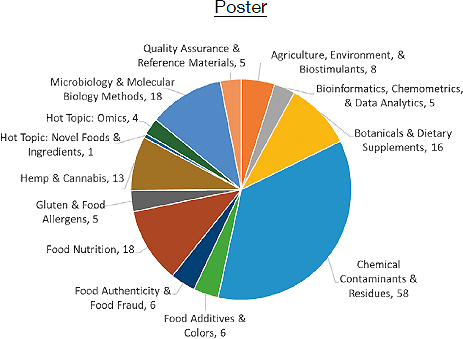
AOAC INTERNATIONAL was founded in 1884 under the USDA and US FDA as an independent, non-profit membership association of analytical science professionals from government, industry, and academia worldwide. This organization consists of scientists, government officials, and other organizations involved in the validation of analytical methods and procedures, practical analysis, and quality control in the field of analytical science. With approximately 3,000 members from around 90 countries, there is a significant presence in the United States. The association’s activities include the review and supervision of AOAC Official Methods, training, and hosting the Annual Meeting.
The 2024 AOAC INTERNATIONAL Annual Meeting & Exposition was held in Baltimore from August 23 to 28. The annual meeting included a space for interacting with other participants and providing technical information, such as conducting scientific sessions, presenting posters, or displaying corporate exhibitions.
The meeting covered a wide range of topics, surrounding food quality and safety. Key topics included nutrients and functionally beneficial ingredients in foods and supplements, but chemical substances, natural toxins, pollutants, and other residual substances contained in food and packaging took the largest share of conference time. Given the growing demand for faster, more streamlined analytical methods, there is an increasing amount of research on utilizing automation and AI technologies. Especially notable were sessions and poster presentations about analytical case studies on the current status of harmful pollutants and residual substances, particularly per- and polyfluoroalkyl substances (PFAS) or mycotoxins.
Shimadzu Group Activities
-
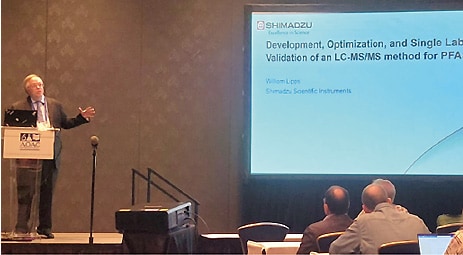
At this meeting, Shimadzu participated in a variety of activities, including serving as symposium chairs, and hosting vendor seminars and exhibitions.
During the conference proceedings. Shimadzu provided information about PFAS, ethylene oxide (EtO), and other topics in oral seminars,roundtable panels, and hosting vendor seminars. For PFAS, Shimadzu developed a single LC-MS/MS method that can be used for the 11 food categories addressed in AOAC SPMR 2023.003 and discussed factors that should be considered for PFAS analysis. The topic generated the most interest as Shimadzu was one of only 4 submitters of methods to the SMPR. Shimadzu routinely participates in AOAC by submitting analysis methods, participating in working groups and advisory panels and presenting at the annual conference.
-
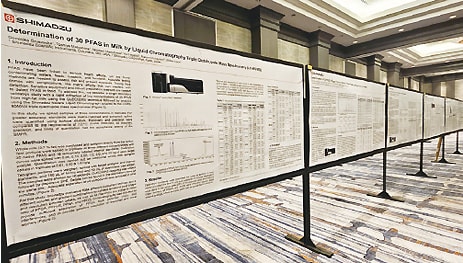
At poster sessions, Shimadzu presented research results on 25 topics. The poster sessions featured many examples of using LCMS and GCMS systems for PFAS analysis and provided knowledge about not only food but also food packaging. A wide variety of instruments, such as LC-MS, GC-MS, ICP-MS, HPLC, and FTIR systems, were used in presentations on a wide range of topics, such as nutrient components,aroma components, pesticides, PAHs, MOSH/MOAH components, and inorganic elements. Participants asked questions about factors to consider and detection sensitivity for analyzing food samples that contain a large number of contaminants. Shimadzu presentations can be viewed via the Shimadzu website.
-
This year, Shimadzu gave presentations on new LC-MS and GC-MS products.Of those, a presentation on the new GCMS-QP2050 system was given in the corporate exhibit area. In addition to superior robustness and reliable performance, the system also includes software with automation technology.For GC-MS systems, a presentation was given on analyzing pesticides, PAHs, and aroma components. Using a hydrogen carrier gas for pesticide analysis attracted the most interest.
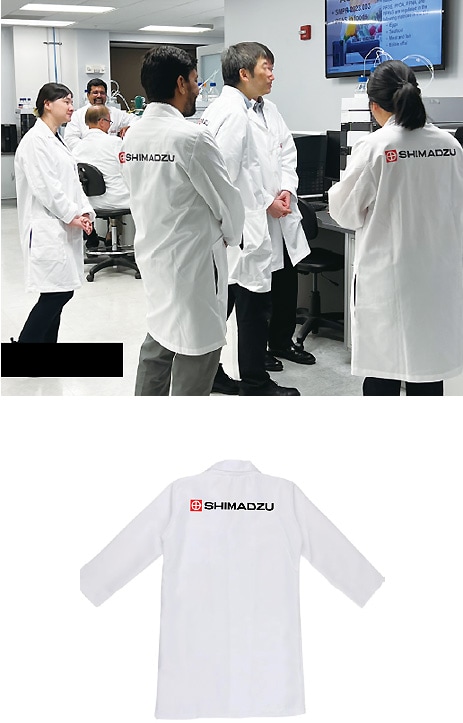
During the AOAC meeting schedule, many attendees participated in tours of the nearby SSI laboratory. The tours provided an opportunity for participants to freely discuss PFAS analysis with LC-MS and GC-MS engineers. Participants shared comments about struggling with contamination originating from working environments and with detecting trace concentrations. Given Shimadzu’s involvement in a variety of research on food samples, Shimadzu engineers provided information about how different matrices can affect analytical results. The fact that Shimadzu engineers in respective regions have been working together to study and share information about PFAS was also highly appreciated by participants. The PFAS logo themed laboratory coats worn during the tours were also very popular and offered as souvenirs.
The AOAC is an organization that provides important analytical methods referenced throughout the world and its annual meeting offers exposure to a large amount of technical information. Shimadzu will continue to offer solutions useful to customers based on the feedback received from participants about the information provided by Shimadzu. In 2025, Shimadzu are planning many poster presentations on PFAS, allergens, heavy metals and microorganisms, and vendor seminars on Screening for EtO and 2-CE by HS-GC-MS/MS.

