



“Providing Answers at Shimadzu” Training in Problem Solving for New Employees, as Conceived by an Employee with Engineering Background
“Providing Answers at Shimadzu” is a training program for new employees at Shimadzu Corporation, 98 % of whom consider the program “meaningful.” The program started in 2021, following revisions to the long-standing training content. It was the brainchild of Naoki Matsuda, who has been active in the R&D departments of Shimadzu Corporation for more than 20 years. While not a so-called HR specialist, he had exactly what he wanted new employees to learn through the training.
Turning the Awareness of New Employees from Inward to Outward
At Shimadzu, the same training was held for a long time. Workplace field trips and group work were performed to inform the new employees about Shimadzu business activities and products, as well as the mindset and thoughts of the engineers involved. The new employees then presented their results, learning a lot in the process.
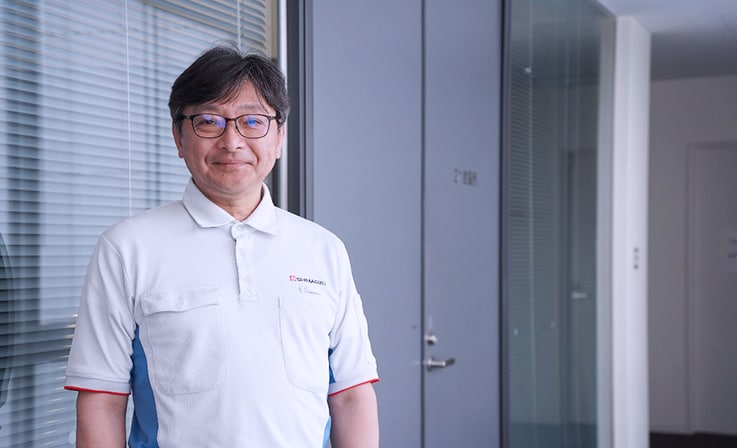
Naoki Matsuda of the Human Resources Development Department, Human Resources Department, who conceived of the new training program
“New employees can learn all about Shimadzu later, but right now, they likely have novel ideas to share precisely because they know so little about Shimadzu. This, I believe, is what new employees have to offer,” says Naoki Matsuda, who is an engineer at heart. Before he was assigned to the Human Resources Department in 2017, he spent more than 20 years at the Technology Research Laboratory, a Shimadzu research department, where he studied and developed analytical and measuring instrument technology.
“The main difference between students and corporate employees is the quantity and quality of output. After joining the company, new employees must evaluate things themselves, think for themselves, and come up with new things. The conventional training that leads to becoming a corporate employee involves being lectured by a teacher while the new employees feverishly take notes. This style of training is no different from the lectures they attended in school. I wanted to keep the input from staff to a minimum, while increasing the amount of output from the participants as much as possible.”
Wishing to See Them Address the Societal Issues from a Fresh Perspective
About two years of planning led to “Providing Answers at Shimadzu,” a workshop-type training program for new employees. In this program, new employees are provided with an opportunity to do everything from identifying needs to thinking up solution strategies and presenting their results. Firstly, the new employees split up into groups of around five people. Each group holds intense discussions regarding the kind of future they would like to realize and the society to aim for. In order to achieve these results, new employees consider what can be accomplished utilizing the advantages provided by Shimadzu. By running these ideas past seasoned employees, they hone the details.
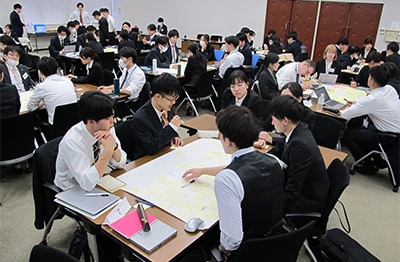
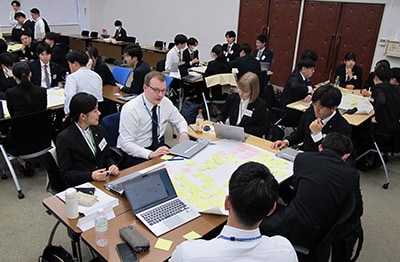
The new employees contribute their perspectives on these societal issues, and summarize them in note form
“My hope is that novel ideas will emerge by leveraging the fresh perspectives of these new employees. The basis for business activities at Shimadzu is the corporate philosophy of “Contributing to Society through Science and Technology.” To put this into practice, it is important to uncover the issues facing society. To this end, it is important to enhance our awareness to discern what is really important among the daily news and information we gather. I wanted the training first and foremost to cultivate this awareness among the participants. Rather than not expecting much just because they are new employees, I ask for high-quality output from them as members of society.” (Matsuda)
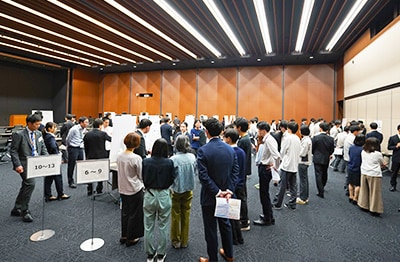
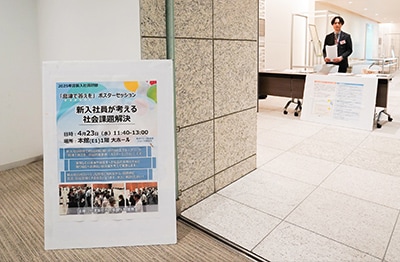
They considered their perspectives over six days in their small groups. Then the presentation of results was held in the hall at Head Office in Kyoto. All employees were free to participate. More than 200 employees attended the presentation and held broad-minded discussions with the new employees.
More than half of the total of 18 groups participating in the presentation selected the healthcare field, which is a focus of interest at Shimadzu, as their theme. Business models were proposed from a variety of perspectives. In terms of preventative solutions to extend the healthy human lifespan, ideas included diagnostic exhalation kits and toilets that automatically test human waste. In addition, microplastics have been raised as an issue facing society, and it was suggested that the amount within the body be analyzed to clarify the correlation with diseases.
A stimulating discussion was held between the new employees and the employees who attended the presentations. One attendee noted that they were impressed by the detail that was incorporated, including market analyses, issues, product ideas, feasibility studies, and subsequent deployment. Another was stimulated by the high quality of the poster presentation, and said that they now realized how fixated they had become on reality, rather than considering possibilities.
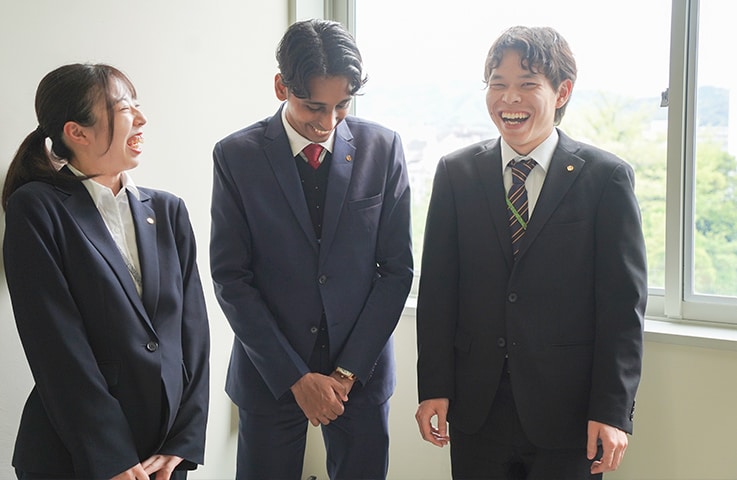
New employees after training. From the left, Nanaka Kanehara, Manas Anjalekar, and Yusuke Kita
Here, we will look at some of the impressions of the new employees who have finished training.
My group chose storage batteries as the theme. Our presentation was on the development of new examination techniques, in an effort to resolve issues of safety and the establishment of recycling technology. This was not my field of expertise, so it was a lot of work to understand the market and the issues, and to think about what Shimadzu could do in this context. At the same time however, I found it quite interesting. Ideas were generated precisely because the group members all had different backgrounds. It taught me about the importance of diversity of perspectives. (Nanaka Kanehara)
We selected human health as the theme. Our presentation was on solution strategies using a smart refrigerator, which suggests recipes personalized to suit the nutritional status of the individual. It made me realize that with my engineering background, I gave no consideration to selling items. In thinking up solution strategies for this project, the other members and I found it stimulating to discuss the issues from a variety of perspectives, including development, manufacturing, sales, marketing, and customers. (Manas Anjalekar)
Before taking this training, I knew very little about Shimadzu’s products and business activities. I am now quite aware that this is a company that considers challenges very important. I will not forget to take a strategic approach when I am given my own work assignments. (Yusuke Kita)
Venue to Discover Dreams of New Employees
This training has one other aim. After their job-hunting efforts, the new employees sometimes feel burned out. The training helps them to identify their next dream and find their next target by asking themselves what they wish to accomplish at Shimadzu, and how they plan to make a social contribution. This is also the hope of the Human Resources Department, which is responsible for hiring and training, and of the people already working at Shimadzu, who have addressed the issues facing society.
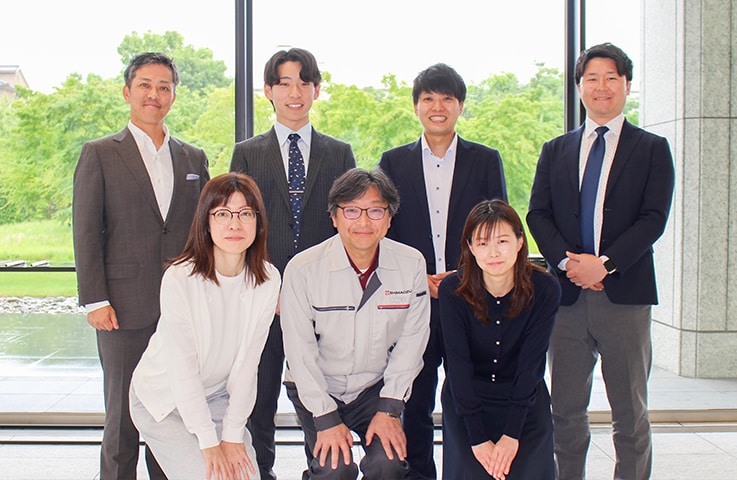
Staff at the Human Resources Department who manage the new employee training. In the center is Naoki Matsuda. In the back row on the far right is Yuki Nakamura, and to his right is Takayoshi Shiota. All three were in charge of the 2025 “Answers at Shimadzu.”
In conclusion, Matsuda said, “Our corporate culture is tolerant of people who take the initiative and supports challenging activities. My hope is that through this training, the new employees experience this culture first-hand and get to know how interesting it is to contribute to society through Shimadzu.”
 Page Title and URL Copied.