



Thoughts by the Developers of HuME, Aiming for an Era in which Sensitivity can Be Visualized
Just by putting on a smart device, you can obtain data on body temperature, heart rate, and sleep levels, and take control of your own health. Such a device was considered technology of the future just 10 years ago, but now it is commonplace. The miniaturization of sensors and the IoT technological revolution have accelerated the global development of physiological sensing, the assessment of many types of physiological signals from the human body and their conversion into data. With our focus on the business of measurement, Shimadzu Corporation is also promoting the development of physiological sensing technology.
Inducing Better States of Body and Mind in People
One of the Shimadzu research departments contains the Brain and Five Senses Technology Unit, which aims to provide solutions for inducing better states of body and mind in people based on information from physiological signals. At present, 25 employees are assigned to this organization. In April 2025, they released the HuME biometric system.
Introductory product video for the HuME multi-device biometric system (in Japanese)
The HuME system assists in understanding the psychological, sensory, and emotional states of human subjects. Using facial electromyography devices, electrocardiography devices, and electroencephalography devices, the system converts physiological signals into data, including heart rate, electrocardiograms, electroencephalograms, and myopotentials (electrical signals produced when muscles are active). This is paired with video data taken by video cameras, and then analyzed.
In the future, the aim is to utilize this as a new evaluative method in fields such as automotives, cosmetics, and food products.
Commercialization of Research Initiated by a New Employee
HuME development began in 2017. Koichi Murata, a new employee at the time, was selected as a member.
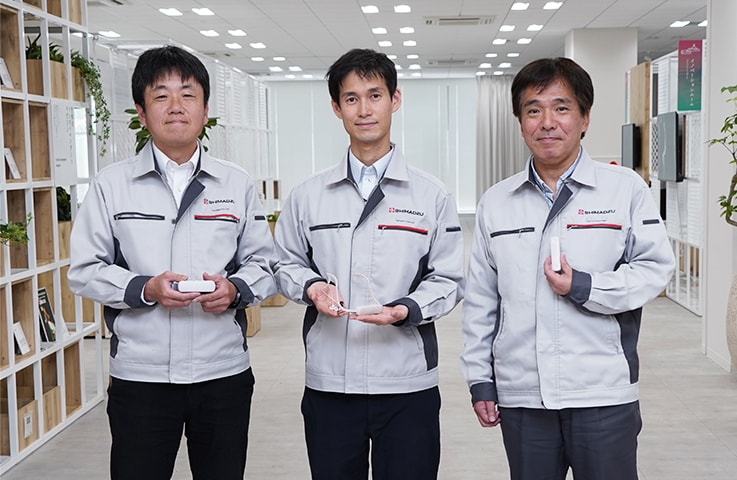
From the left, Manager Kenji Kimura, Koichi Murata, and Yoshitada Ito. Affiliated with the Startup Incubation Center, a department responsible for bridging the gap between development and business deployment
Murata says, “In university, I was involved in research and development of an MRI-compatible sensory stimulation system that measured brain activity. When I heard about the development of biometric devices, I was intrigued. However, while this was not too far outside my field of expertise, it was also not exactly in it. I began by taking courses in how to construct wearable devices.”
Murata settled on the development concept while searching for Japanese and international technology and devices related to biometric measurement. He wanted something that was so unobtrusive that it could be put on and then forgotten, enabling its use in a relaxed state.
Masafumi Furuta is the Manager of the Sensory Measurement Group in the Brain and Five Senses Technology Unit. He notes that “In measuring a person’s psychological state and emotions, research has been conducted in laboratories and other specialized environments because the results are easily swayed by the situation as well as the preceding and subsequent circumstances, which is an issue. In making sensory evaluations of products, various customers have asked for an experimental situation in which the subjects do not feel burdened, and in which measurements can be taken under conditions close to everyday life where the products are actually used.”
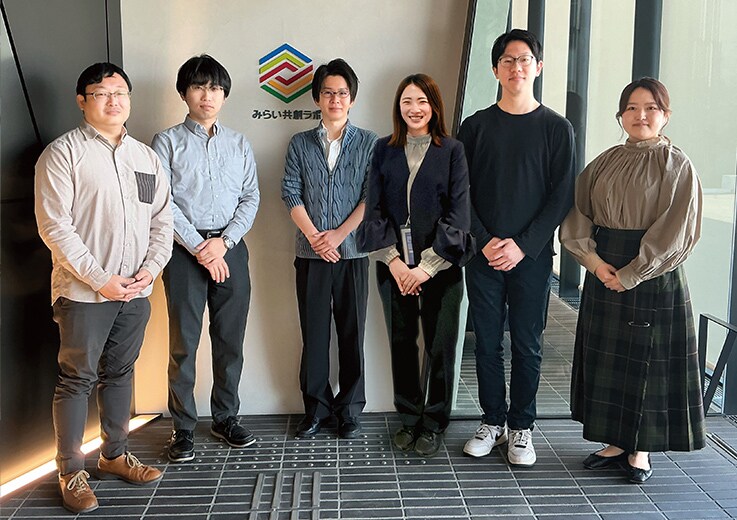
Members of the Technology Research Laboratory who participate in basic HuME research. Masafumi Furuta is at far left
They have also simplified the collection and integration of the data, which had become an issue in research in the sensory measurement field. “It has often been pointed out that cross-checking data from various devices for analysis is both laborious and problematic. If we could create an experiment support system to reduce the labor involved in such measurements and data analysis, we felt that it would enable our customers to focus on what they wanted to do in the first place.”
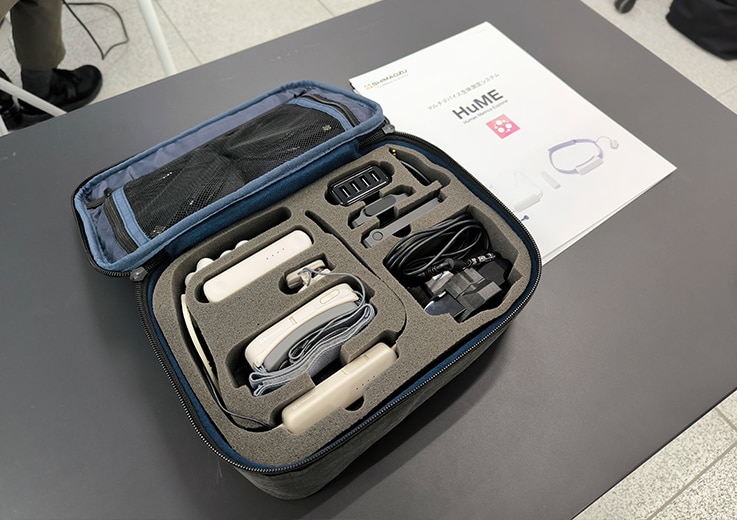
HuME product package. The HuME system includes a facial electromyography device, an electrocardiography device, an electroencephalography device, a video camera, and specially designed accompanying software, all of which can fit in a single bag
Murata says, “When development initially started, this was a new, unprecedented product for Shimadzu. Accordingly, we learned a lot from our customers, including their needs for such a device. Going through the entire process from research to the creation of a prototype and then commercialization was a precious experience for me, and the fulfillment of a dream that I had had since my years at university.”
The development members noted that the process of creating HuME affirmed the value of sensory measurement for them. Murata added enthusiastically that “Currently, the only effective means of measuring a person’s sensory experience is with a questionnaire. I am doing my best to make HuME another option for doing so.” In the future, they will start developing applications to assist in data analysis.
 Page Title and URL Copied.