



Shimadzu Wall Charts Return Home after 90 Years Thanks to University of Fukui Donation
Wall charts made by Shimadzu in 1934 for mathematics education were recently discovered at the library of the University of Fukui. After 90 years, they have now been returned to their original manufacturer, Shimadzu.
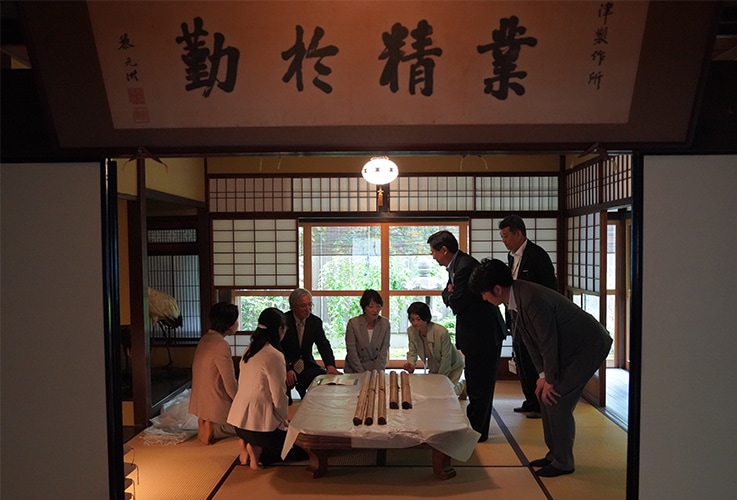
Those involved in donating the wall charts gathered in Shimadzu Genzo’s living room at the Shimadzu Foundation Memorial Museum
Wall Charts that Played a Role in Education
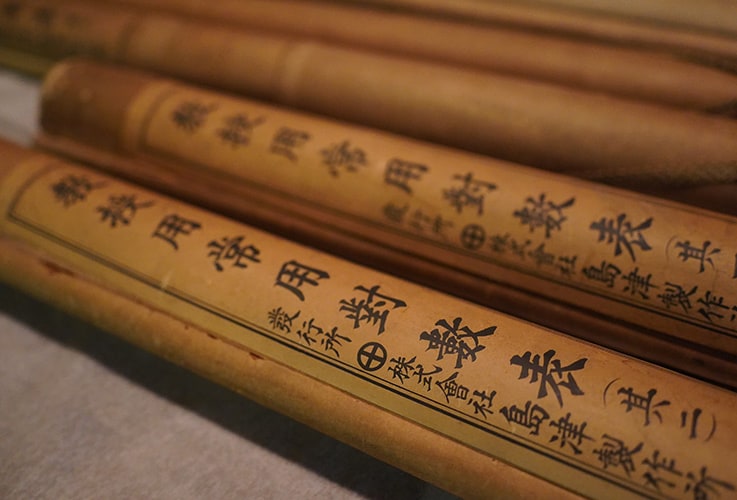
The “Common Logarithm Table for Teaching” wall charts that were donated
The items donated included a “Common Logarithm Table for Teaching” and a “Trigonometric Function Table,” both of which were found in the University of Fukui Library.
Back in 1934, Shimadzu produced educational equipment for science education, and wall charts were commonly displayed in classrooms as teaching aids. These charts are also listed in its old catalog, “General Education Mathematics Equipment Catalog” (No. 239), confirming their role in supporting math and science education.
Currently, the science education business is being handled by Shimadzu RIKA Corporation, a Shimadzu Group company.
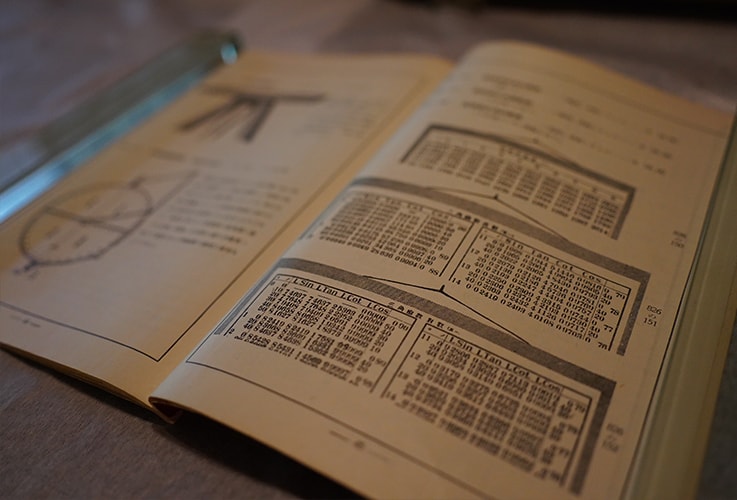
An old Shimadzu catalog, “General Education Mathematics Equipment Catalog”
The wall charts bear the stamp “Naval Engineering School, March 1934,” suggesting that they were sold to the Naval Engineering School located in Maizuru at the time, and then passed through Fukui Normal School and Fukui Technical College, predecessors of the University of Fukui, before becoming part of the university’s collection.
The Trigonometric Function Tables
The first trigonometric function table was created by Hipparchus, an ancient Greek philosopher known as the “father of trigonometry.”
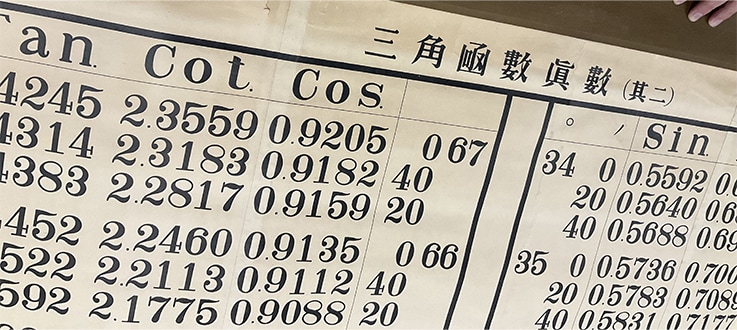
Donated trigonometric function table, with angles and trigonometric values
How were trigonometric function tables used?
Trigonometric tables were widely used in fields such as surveying and celestial navigation, as they enabled the calculation of distances and angles that were difficult to measure directly.
In celestial navigation, trigonometric tables are used to calculate the positions of celestial bodies and determine the current positions of ships and aircraft. Before the widespread use of GPS, they were extremely important for ensuring safe navigation.
In addition, trigonometric functions are useful when investigating the properties of waves, making them essential in areas of study such as engineering and physics that deal with electromagnetic and sound waves. They are also important in the design of our analytical instruments and other Shimadzu products.
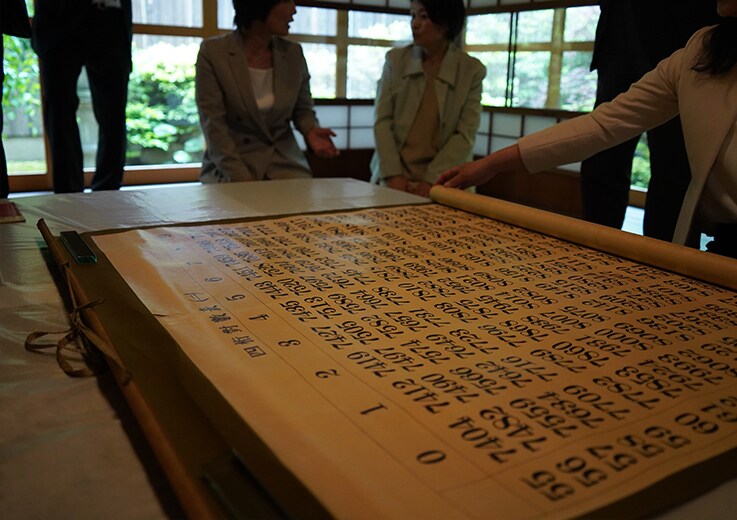
Common logarithms are used to make large numbers easier to work with. Converting very large numbers into smaller numbers simplifies calculations and is used to reduce the amount of calculations and convert data scales.
Nowadays, Excel's LOG function and online calculation websites make performing such calculations easy, but in the past, people used common logarithm tables and trigonometric tables to simplify the work.
Donated to Shimadzu by the University of Fukui
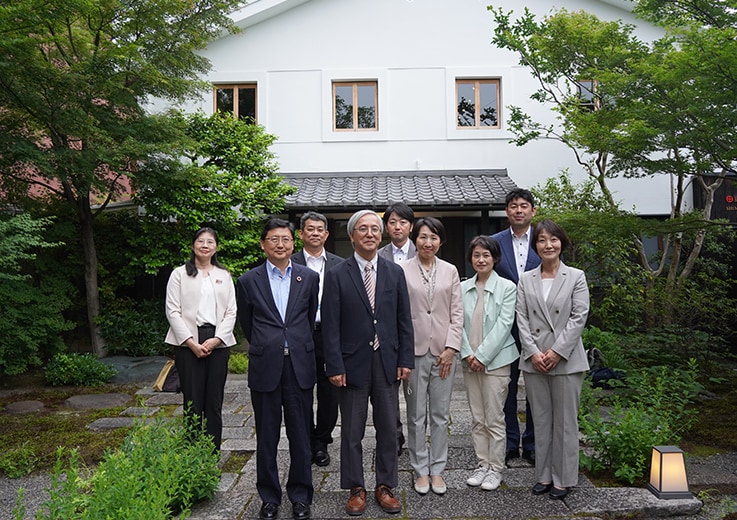
Front row, center left: Professor Emeritus Shin-ichiro Suye, University of Fukui; Front row, center right: Director Misako Kawakatsu, Shimadzu Foundation Memorial Museum
On May 29, Professor Emeritus Suye and others from the University of Fukui visited Shimadzu Corporation and the Shimadzu Foundation Memorial Museum, where documents related to the donation were exchanged. He said, “I am delighted that the value of these wall charts, which have been stored at the University of Fukui for so many years, has been rediscovered by their original maker.”
At the museum exhibition, Suye was particularly fascinated by the high-performance liquid chromatograph (LC-3A) and its data processor (C-R1A Chromatopac). He shared a nostalgic story from 50 years ago, when he was a student and asked his professor to install the LC-3A in the laboratory.
When the wall charts were discovered at the University of Fukui Library, Suye, who had been a long-time user of Shimadzu instruments and was serving as the library director at the time, naturally became involved in the donation process.
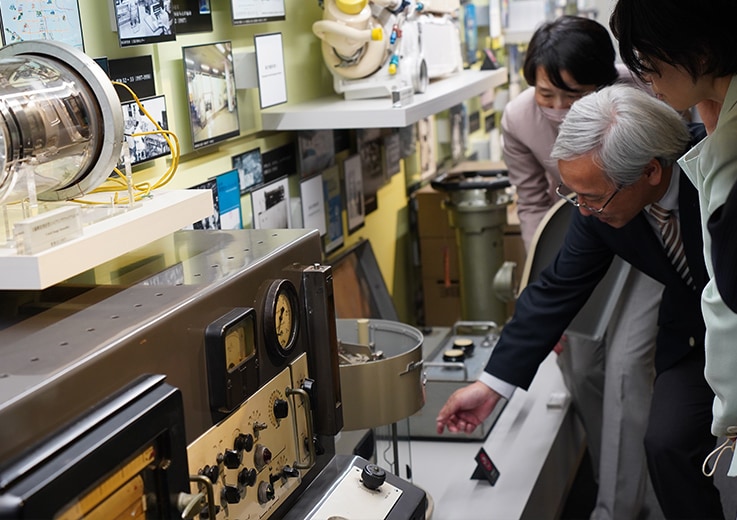
Professor Emeritus Suye explained the use of the direct-reading balance to his companions
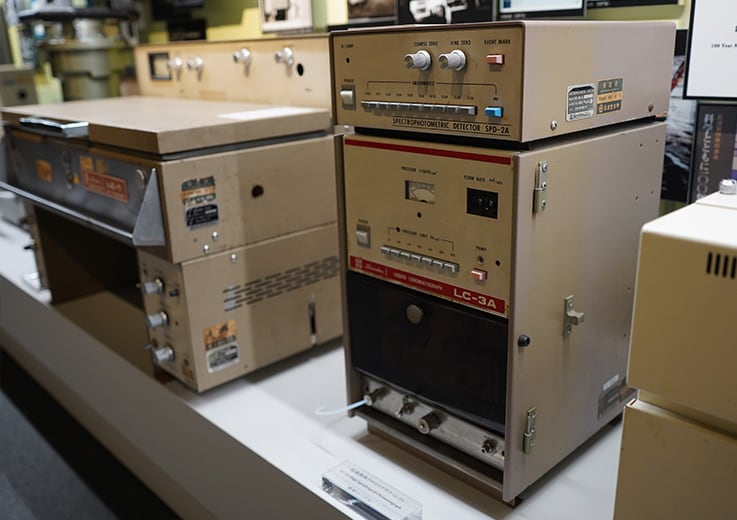
The LC-3A high-performance liquid chromatograph was a product that achieved constant flowrate liquid delivery by adopting a pump method that was unavailable in Japan at the time (Scientific Instrument Heritage No. 34)
Comments from the Museum Director
Wall charts were introduced as visual teaching aids for classroom instruction in modern education after the Meiji period. They are large pictures or tables that are hung on blackboards or walls. Shimadzu has been selling wall charts featuring subjects such as history and animals since its founding, and they have been widely used alongside the spread of physics and chemistry education.
However, because they are made of paper, they are easily damaged and difficult to store due to their large size, so only a small number remain. Of those that have survived, the wall charts donated by the university were produced in the early Showa period when the quality of paper was declining, and despite having been used in various schools, they are in surprisingly good condition and are extremely valuable as historical records.
Thanks to the generous cooperation of everyone who helped bring us together, these materials, which are now back home, will be preserved and utilized as historical documents.
 Page Title and URL Copied.