



Gakken’s “Otona no Kagaku” and Shimadzu Rika: Collaboration on the Theme of Electrostatic Generator
Shimadzu celebrated its 150th anniversary in March of this year. To commemorate this event, Shimadzu Rika, a company in the Shimadzu Group that manufactures and sells physics and chemistry education equipment, produced a Wimshurst electrostatic generator, as part of its plans for a collaboration with Gakken’s “Otona no Kagaku.”* We asked Izumi Nakai, President of Shimadzu Rika, and Toshiyuki Nishimura, the Editor-in-Chief at the “Otona no Kagaku,” for a behind-the-scenes look at this manufacturing project.
- *“Otona no Kagaku (Science for adults)” is a magazine intended for people who enjoy science and handicrafts. It is published by Gakken. A do-it-yourself kit is provided with each edition, featuring themes such as cameras or musical instruments.
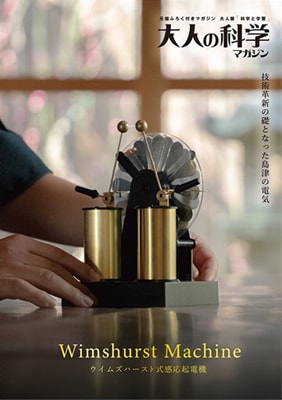
Electrostatic Generator Built by Genzo Shimadzu Jr. at the Age of 15
The Wimshurst electrostatic generator, the theme of this collaboration, was a symbolic product and the cornerstone of growth at Shimadzu when it was founded.
In 1883, the British inventor James Wimshurst invented an electrostatic generator. This manual generator produced static electricity when two glass discs affixed with metal foil were rotated in opposite directions in close proximity to each other. One year later, 15-year-old Umejiro Shimadzu (later Genzo Shimadzu Jr.), the son of Genzo Shimadzu Sr., the founder of Shimadzu, manufactured the first Wimshurst electrostatic generator in Japan, working just from illustrations and diagrams of it.
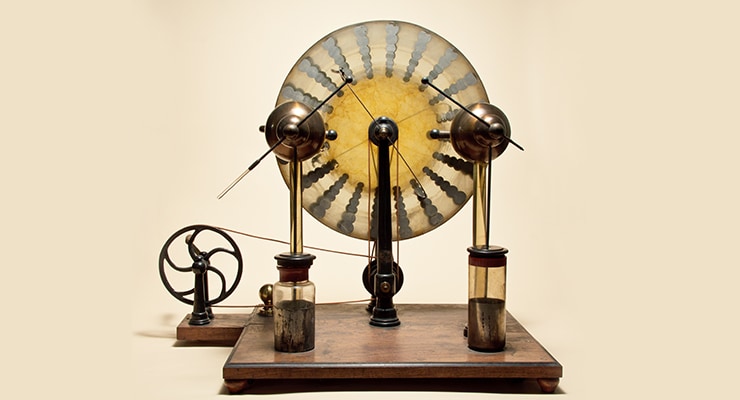
Wimshurst electrostatic generator (in the collection of the Shimadzu Foundation Memorial Hall)
This electrostatic generator was referred to as “Shimadzu Electricity,” and was used in educational and research settings. Furthermore, the instrument was used as a power source in follow-up experiments by Professor Hanichi Muraoka of the Third Higher School (today’s Kyoto University), who had learned about the discovery of X-rays by Dr. Roentgen. Genzo Shimadzu Jr. and his brother Genkichi assisted Professor Muraoka in his work, and in October 1896, collaborated in successfully taking an X-ray image. That was a mere 11 months after Dr. Roentgen’s discovery of X-rays.
Dialogue: The Collaboration between “Otona no Kagaku” and Shimadzu Rika
We asked Izumi Nakai, President of Shimadzu Rika, and Toshiyuki Nishimura, the Editor-in-Chief at the “Otona no Kagaku,” about their collaboration.
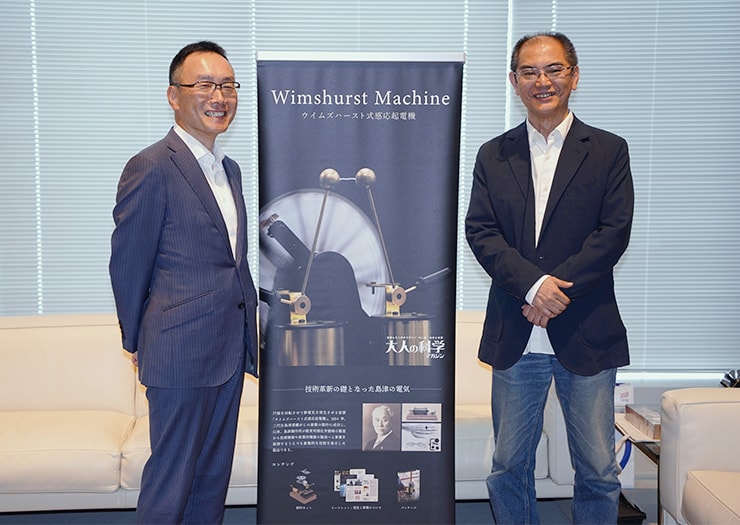
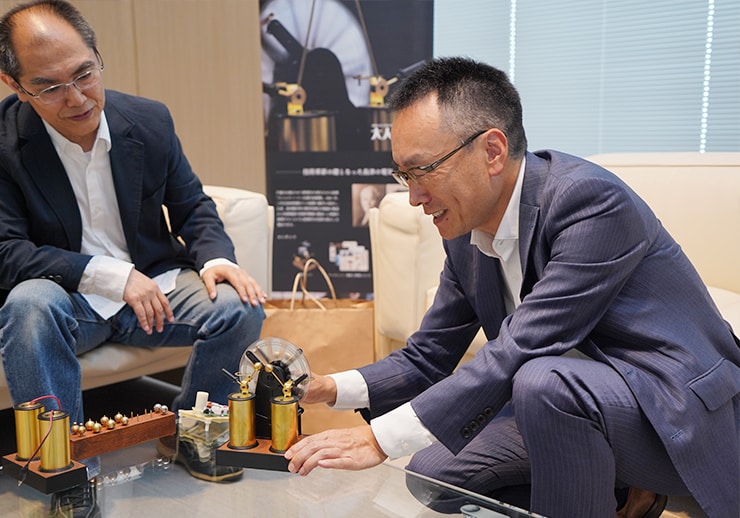
Nakai (left), President of Shimadzu Rika, and Nishimura (right), the Editor-in-Chief at the “Otona no Kagaku”
Opportunity for Collaboration
| Nakai | : | The Wimshurst electrostatic generator is treated as a symbol of the history of Shimadzu. Even today, Shimadzu Rika still sells electrostatic generators, and on the 150th anniversary of Shimadzu, we felt that we would like to do something to mark the occasion. We had an opportunity to meet with Gakken at the National Science Koshien, an event that both Shimadzu Rika and Gakken were sponsoring, so we set up a meeting. |
| Nishimura | : | I was surprised when I heard from our staff that it was President Nakai who had contacted us. |
| Nakai | : | Actually, I am a big fan of “Otona no Kagaku,” and have built several of your projects, including a planetarium and a musical instrument called a theremin. To my mind, the electrostatic generator has just enough parts to make a great project for Gakken to build. |
| Nishimura | : | We were privileged to take part, but it was the first time that we had started product development from scratch in response to a request from another company, so we were also a little uneasy. However, there had previously been calls from our readers for an electrostatic generator, so we decided to take on the challenge. |
Attention to Detail
| Nakai | : |
We collaborated with the staff at the Corporate Product Design Center of Shimadzu Corporation on everything from the product concept to the detailed design of the kit. Early on, they had the idea of taking a photo of the building that had been used by both Genzo Shimadzu Jr. and Sr. as their combined shop and residence (now Shimadzu Foundation Memorial Hall) as the main visual for the package. 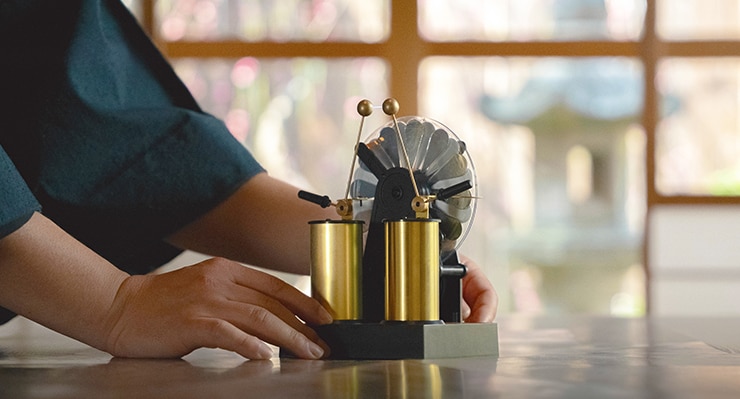
The packaging image, taken at Shimadzu Foundation Memorial Hall |
| Nishimura | : | During the initial prototype stage, they clarified the concept, and the entire staff proceeded with the same image in mind. However, it was difficult for both parties to decide on a compromise between attention to detail and cost. |
| Nakai | : | An example of this attention to detail was your team’s suggestion to make changes to the project despite being on the verge of mass production. |
| Nishimura | : | Just two days before the start of mass production, the development team informed us that adding spikes to the metal spheres would make the electric spark jagged. It is certainly true that the spark that appears between the metal spheres is ordinarily linear, but when spikes are added, jagged lines are created that differ each time. |
| Nakai | : | They contacted us, explained that this would increase the cost, but wanted to know if we would be interested. We immediately decided to make the change. I was impressed by their enthusiasm, as they continued testing the device even after the design stage, and it became a means of conveying just how interesting science is. In contrast, the initial parts were decided on because the Shimadzu staff sought the dimensions that made the spark appear beautiful. Since we had the opportunity, we adopted both styles and ensured that the readers could swap the parts. |
Test video using this product (Provided by Shimadzu Rika, Japanese only). Change in the appearance of the spark with and without the spikes on the metal spheres (20 to 50 seconds).
Reflections on the Project
| Nishimura | : | At the very beginning, I had an impression of Shimadzu Rika and the Shimadzu Group as a serious enterprise with cutting-edge technology. As a result of this project, I now think of Shimadzu as a venerable enterprise that has amassed a long history. At one point, Shimadzu Corporation was involved in education just like us, and it is interesting to think that we could have been rivals. |
| Nakai | : | Editor-in-Chief Nishimura was kind enough to visit the Shimadzu Foundation Memorial Hall and reviewed Shimadzu's historical corporate publications. I will be pleased if this product serves as an opportunity for many individuals to encounter science and the Shimadzu Group. For me, collaborating with “Otona no Kagaku,” a favorite magazine of mine, was a dream come true. |
| Nishimura | : | We created something good while sharing our respective ideas. I enjoyed working with such a good team. |
Details on the product in this collaboration are noted on the Shimadzu Rika website.
 Page Title and URL Copied.