



World First: Degradation Process of Marine Biodegradable Plastics Clarified
Shimadzu Techno-Research has, for the first time in the world, clarified the degradation process of marine biodegradable plastics. These experimental results serve as a guide for developing higher-performance marine biodegradable plastics, and they are now receiving a steady stream of evaluation requests from materials manufacturers.
Makoto Yasojima, General Manager of the Environmental Business Division, Shimadzu Techno-Research, who led this development, said, “Microplastics in the ocean have become a serious problem, yet no solution exists. It felt frustrating, as if we could only stand by helplessly and lament the situation. As a contract analysis company, we wondered how we could contribute and selected marine biodegradable plastics—which decompose readily in the ocean—as our research subject.”
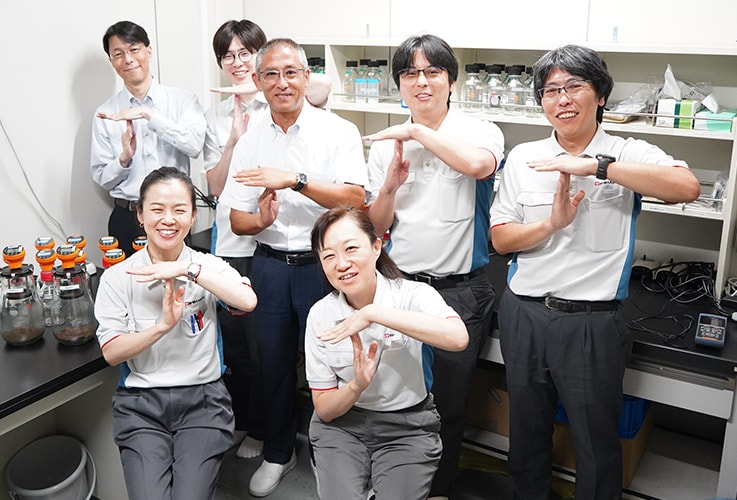
Makoto Yasojima, the third from the left in the back row, photographed with members of the research team at the Shimadzu Techno-Research laboratory
Concerns over the Harmful Effects of Microplastics
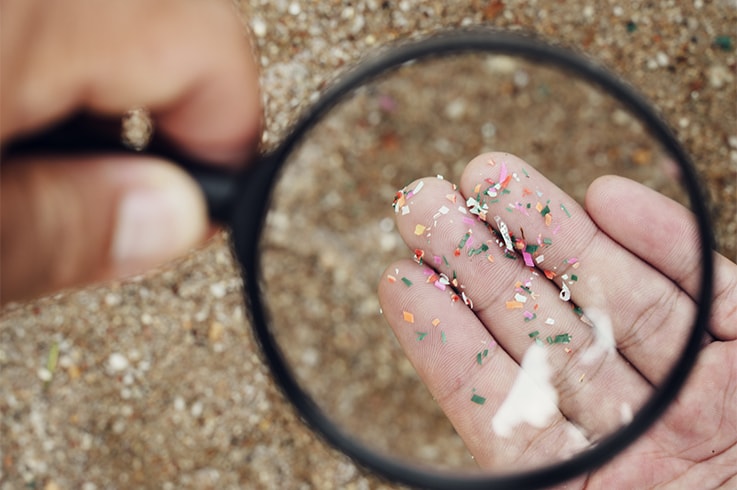
The microplastics highlighted as a societal issue refer to plastic particles with diameters of 5 mm or less. Discarded plastic waste, such as plastic bags and food trays, is believed to break down into microplastics through erosion by wind and waves, as well as chemical effects such as ultraviolet radiation and temperature. When these particles enter the ocean, marine organisms ingest them, leading to the accumulation of harmful substances within their bodies. Studies also suggest that consuming such fish may impact human health. In addition, microplastics drifting in the ocean cannot be completely removed, which is another major concern.
Biodegradable Plastics as a Solution to the Plastic Waste Problem
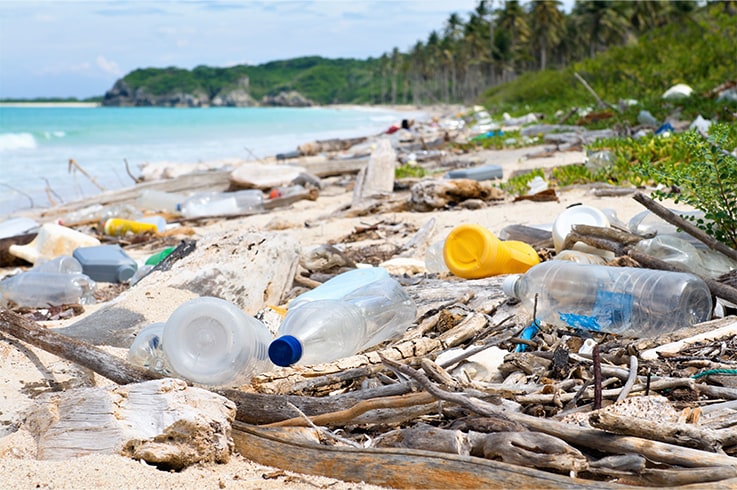
Efforts to address the environmental problems caused by plastics are underway worldwide. One such effort is the development of biodegradable plastics. Biodegradation refers to the process by which organic compounds are broken down into water and carbon dioxide by the action of microorganisms such as bacteria and fungi, and thus returned to nature. However, the details of this mechanism have remained unclear. The same is true for marine biodegradable plastics, which are designed to readily biodegrade in the ocean, but whose safety after release into marine environments has not been scientifically demonstrated.
Yasojima said, “When people hear the phrase ‘marine biodegradable plastics,’ they tend to imagine that even if such materials enter the ocean, they will eventually decompose and disappear, so they are safe. However, the consensus among experts was actually almost the opposite. What exactly is happening in the ocean, and how does it cause degradation? Is it really degrading, or is it simply breaking down into microplastics? At the time, very little was known.”
The Laboratory Erupted with Excitement, “We can See the Degradation Process!”
The research began in 2019. The first step was obtaining marine biodegradable plastic products that had been evaluated using test methods based on ISO standards. At the time, such products were not commercially available. Fortunately, the research team received information that when they bought iced coffee at a convenience store in Kochi Prefecture, marine biodegradable plastic straws were being distributed on a trial basis. “We drove six hours from Kyoto to buy iced coffee and managed to get hold of some of the straws,” Yasojima recalls. Also, since fresh seawater containing microorganisms was needed for experiments, the team traveled from their Kyoto lab to Osaka Bay to collect samples for each test.
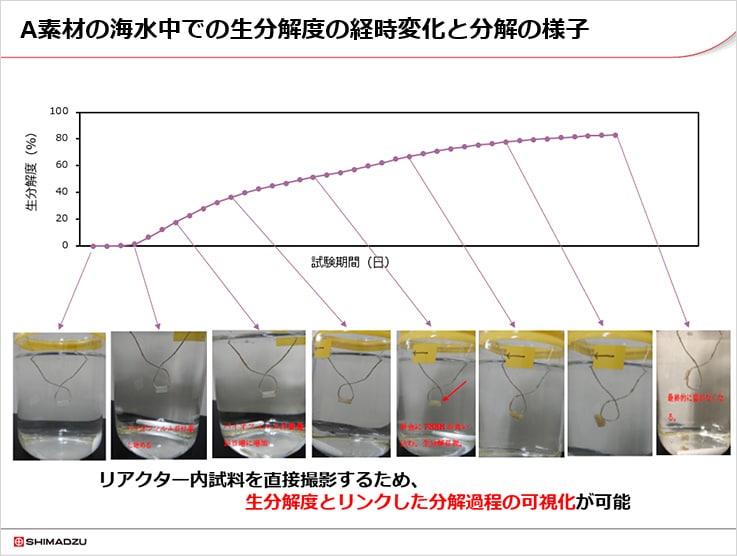
This slide illustrates the biodegradation behavior of material A in seawater (provided by Shimadzu Techno-Research). The vertical axis shows biodegradability (%), and the horizontal axis shows the test period (days). The slide notes that the samples inside the reactor were photographed directly, allowing the degradation process to be visually correlated with the measured biodegradability
When the straws were immersed in seawater, a slime formed around them within about a month, and they completely disappeared in two to three months. After confirming decomposition under experimental conditions, the next challenge was how to effectively collect and analyze only the slime. After trial and error—trying to peel the slime off with tweezers or dissolve it with organic solvents—they finally came up with the “ultrafiltration” method. By filtering water containing the slime, they were able to efficiently recover just the microorganisms and decomposition products. These were then examined using a high-precision mass spectrometer to confirm changes in molecular structure. This marked the first time in the world that the intermediate stages of decomposition had been captured.
This study was selected for funding by the New Energy and Industrial Technology Development Organization (NEDO) in 2020, and Shimadzu Techno-Research participated in the Technology Development Project for Social Implementation of Marine Biodegradable Plastics. The research team is not only continuing further studies on marine biodegradable plastics but is also working to establish evaluation methods for biodegradable plastics in soil environments, which are currently the primary area of the biodegradable plastics market. This project received the “First a Dream Award,” an in-house award within the Shimadzu Group that recognizes employees who proactively take on challenges driven by their dreams and aspirations.
Comment from Makoto Yasojima, Shimadzu Techno-Research
The task of passing on a rich marine environment to future generations is of great concern not only in Japan but also worldwide. I would like to contribute to society through the use of mass spectrometry. Through this research, we have succeeded in gaining key insights into the decomposition process. The technology continues to evolve, and the day is approaching when it can be applied to the evaluation of marine biodegradable plastics composed of three or more monomers. Furthermore, by employing multiple approaches, we will conduct more multifaceted evaluations and continue striving to meet the needs of materials developers.
 Page Title and URL Copied.