



The 13th National Junior Koshien of Science Competition
Chiba Prefecture Team Wins the Overall Championship and Receives the SHIMADZU Award
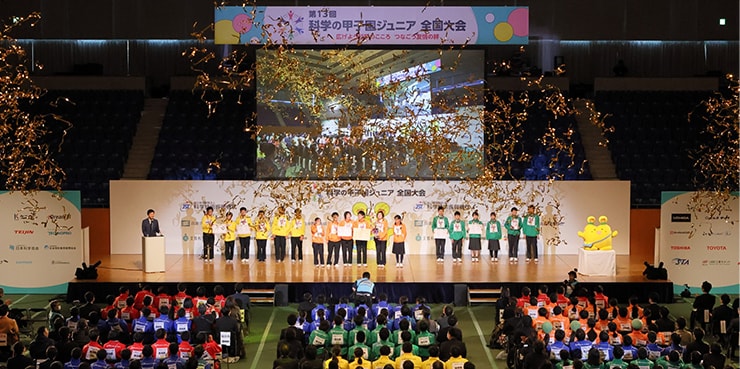
The 13th National Junior Koshien* of Science competition was held in Hyogo Prefecture from December 12 to 14, 2025. Representative teams of six junior high school students from all 47 prefectures across Japan-282 students in total-gathered to take on a series of challenges, drawing on their scientific knowledge, reasoning skills, and teamwork.
* Koshien originally refers to a baseball stadium in Hyogo Prefecture or the Japanese High School Baseball Championship held at the stadium. By extension, it is also used to mean a national tournament.

The competition was established by the Japan Science and Technology Agency (JST) to spark broader interest in science and to nurture curiosity and creativity in young people eager to take on challenges in unexplored fields. The competition consists of a written exam and two hands-on events that are open to the public.
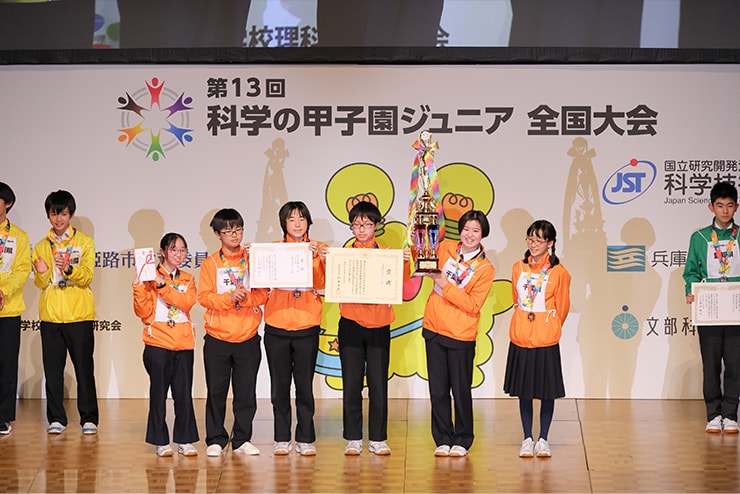
Shimadzu Corporation and Shimadzu Rika Corporation, the latter of which is involved in physics and chemistry education equipment businesses, have supported the competition continuously since the first event in 2013 and present the SHIMADZU Award to the first-place team in Hands-on Event 2. At this year’s competition, the Chiba Prefecture team, which received the SHIMADZU Award, placed first in both the written exam and Hands-on Event 2, and third in Hands-on Event 1, securing the overall championship.
Taking on a Physics–Math Fusion Challenge, Ladle in Hand
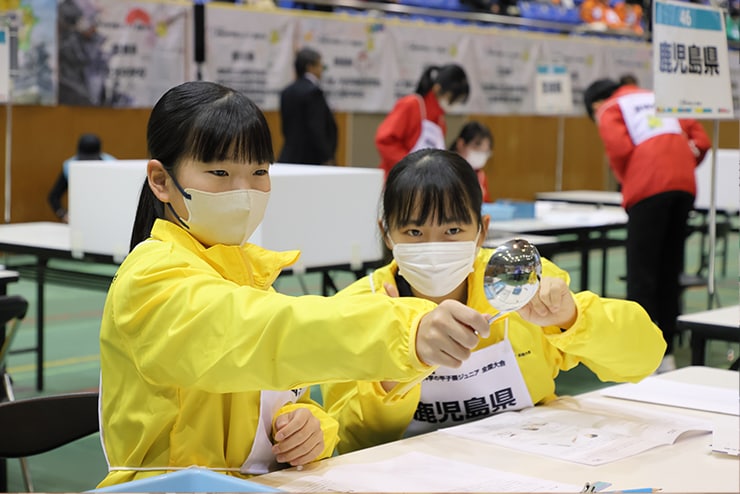
Hands-on Event 1 was titled “The World of Curved Mirrors.” At the starting signal, the junior high school students picked up a kitchen ladle. By moving the curved bowl of the ladle closer to and farther from their faces, the students observed how their reflections changed on the metal surface. This event aimed to develop a deeper understanding of the properties of mirror reflection.
The challenge began by observing how light reflects using a familiar everyday object.
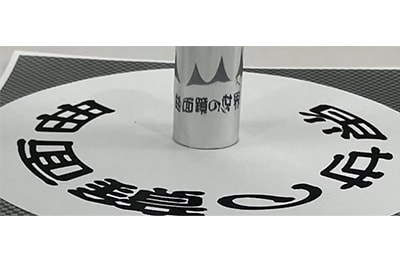
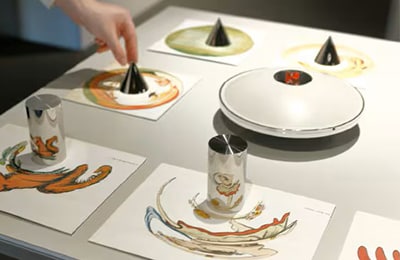
Curved mirrors from Shimadzu Foundation Memorial Museum’s Experiment Lab
In the experiment, students used plane, convex, and concave mirrors, along with laser levels for horizontal and vertical alignment and tablet devices, to measure and record the relationship between angles of incidence and reflection, as well as changes in the reflected image.
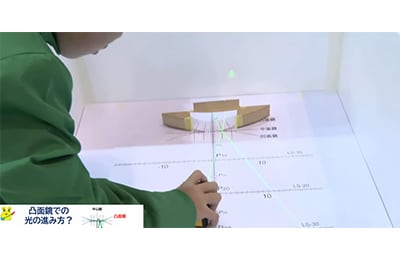
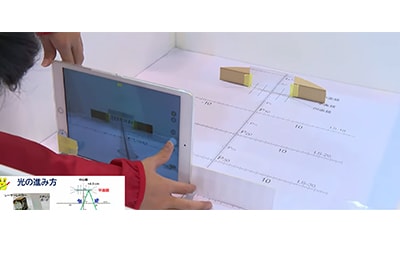
The final task required students to apply the knowledge gained from these observations and experiments to determine the radius of curvature of a cosmetic magnifying mirror (a concave mirror) without using a laser level. The radius of curvature, which indicates how sharply a concave surface curves, becomes smaller as magnification increases and curvature becomes tighter.
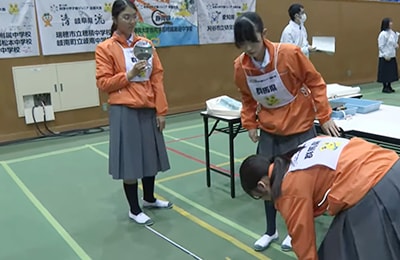
A team working together, magnifying mirror in hand
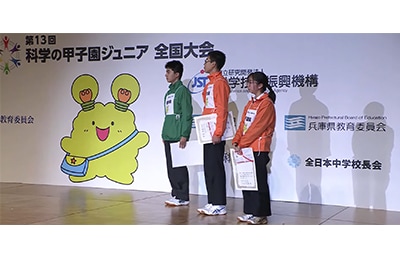
The team from Aichi Prefecture placed first in this event
This challenge is directly connected to the underlying mechanisms behind real-world technologies such as telescopes, convex traffic mirrors, flashlights, and parabolic antennas.
Starting from the basic concept of light reflection, the task progresses into hands-on experimentation and geometric reasoning. In particular, demonstrating reflection using congruent and similar figures requires a solid grasp of both physics and mathematics, as well as close teamwork. In this event, the Aichi Prefecture team took first place.
Controlling Magnets and Electric Current to Drive a Machine with Electromagnetic Force
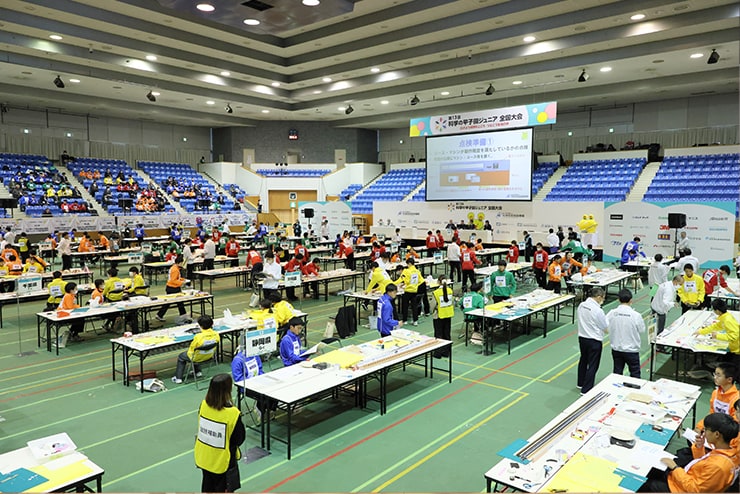
In Hands-on Event 2, titled “Maglev Train, Go!” students applied the principles of maglev trains to build a device that drives a machine using the force generated by magnets and electric current. Within a fixed time and using specified materials, the students designed and built their own course and machine, competing to see how far they could move the heaviest possible machine.
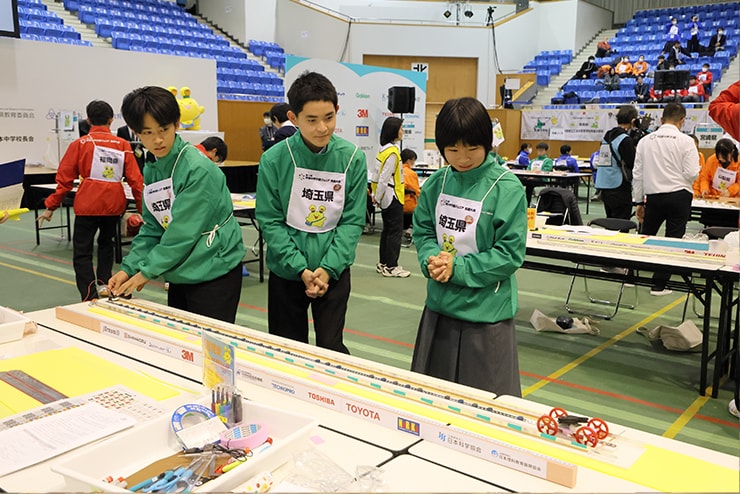
Because the evaluation considered not only the distance traveled but also the machine’s weight and the number of magnets used, the event required an understanding of electromagnetism, design skills, strategic thinking, practical hands-on skills, and teamwork. This event also offered highly practical learning, applying electromagnetic theory directly to real-world engineering.
The creative process at the competition is shown live with commentary on monitors in the spectator area and on YouTube, allowing those watching to deepen their understanding of the competition while cheering on the teams.
When Fleming’s left-hand rule appeared during explanations of the interaction between electric current and magnetic fields, even adults in the audience instinctively extended their left hands, spreading their fingers to check the directions of force, magnetic field, and current.
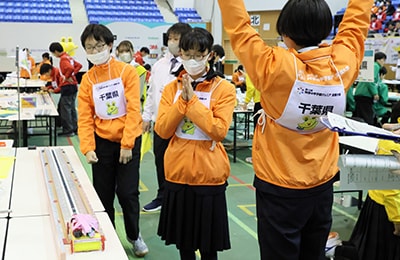
Chiba Prefecture team’s machine, loaded with weights, reaches the goal
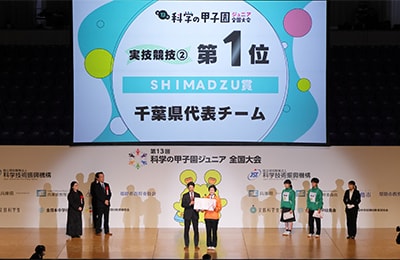
The Chiba Prefecture team took first place in Hands-on Event 2
At the signal marking the end of the competition, some students made small fist pumps, others stretched deeply in relief, and a few quietly wiped tears from their eyes.
The Chiba Prefecture team, which won the event, successfully completed the course with a machine that had additional weights attached. When the competition ended, the venue was filled with warm applause.
Comments from the Persons in Charge
Comment from the Person in Charge at Shimadzu Rika Corporation
The two hands-on events at this competition focused on “light” and “electromagnetic force,” both of which are topics in physics. Physics is often seen as a difficult subject for junior high school students. This may be because it deals with phenomena that are not always obvious in daily life and expresses them using mathematical formulas. However, simply memorizing formulas—even with mathematical understanding—was not enough to solve this year’s challenges. Through repeated trial and error as a team, small creative ideas ultimately determined victory or defeat.
This year, we were once again inspired by the students’ relentless curiosity and creativity, and as a company involved in physics and chemistry education, we also gained valuable motivation. We hope to continue supporting future scientists.
Comment from the Person in Charge at Shimadzu Corporation
Through our involvement in the competition as a supporting company, we could clearly feel the passion of JST, the organizers, and the teachers, as well as the high expectations placed on Japan’s children, who will carry the future of science.
The National Junior Koshien of Science competition is not about competing on theory alone at a desk; it is a practical competition that crosses multiple subjects and cultivates skills applicable to the real world—a true forum for “practical science.” This approach resonates strongly with the philosophy of Genzo Shimadzu Jr., who advocated that “science is a practical endeavor,” and we share that belief deeply.
Guided by our corporate philosophy of “Contributing to Society through Science and Technology,” Shimadzu Corporation will continue to support initiatives like this.
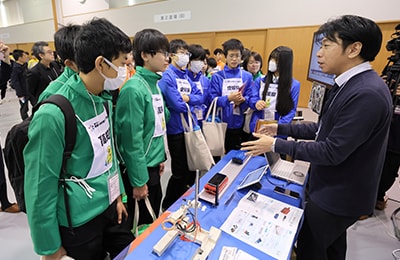
A demonstration of Shimadzu Rika Corporation’s dynamics cart “Smart Cart,” which drew attention due to its strong relevance to Hands-on Event 2
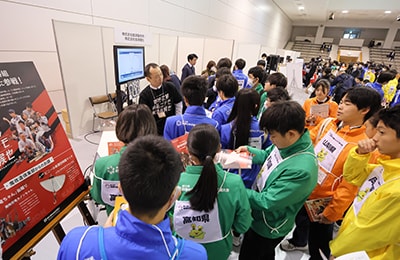
Shimadzu Corporation also introduced activities from its project featured on NHK’s “Night of the Makaizo Society” TV show
Photos and images provided by JST (except for the curved mirror photos from the Shimadzu Foundation Memorial Museum’s Experiment Lab)
 Page Title and URL Copied.