



JAMSTEC Explores the Intersection of the Deep Sea and Deep Space
Solar System Materials Science Driven by Core Measurement Technologies
On December 6, 2020 (Japan Standard Time), a capsule released from JAXA’s Hayabusa2 asteroid explorer landed in the Woomera Desert in Australia. This mission successfully delivered pristine material from the early Solar System to Earth.
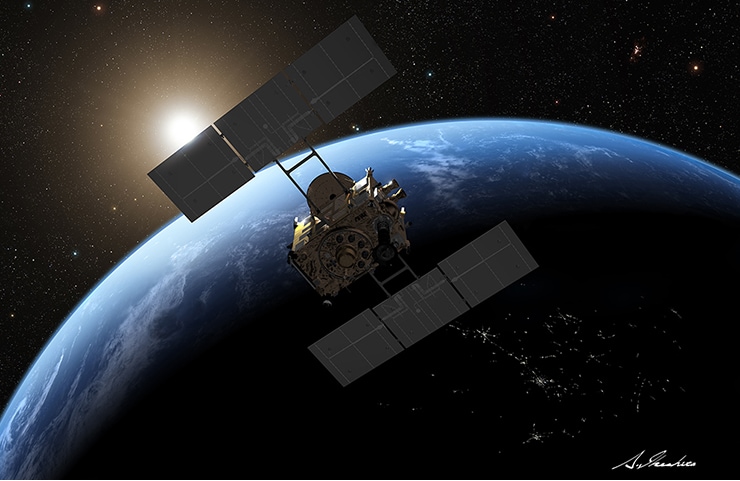
Illustration of the Hayabusa2 asteroid explorer performing an Earth swing-by (© Akihiro Ikeshita)
“When we monitored the gas inside the ‘treasure box’ (sample capsule), we detected rare gases different from Earth’s atmosphere, confirming that the samples originated from the asteroid Ryugu. When I first saw the Ryugu samples that had returned to Earth after six years, I was so moved that I was at a loss for words. The samples, which had come from about 300 million kilometers away, had a dark luster and suggested the presence of abundant organic materials such as carbon and nitrogen. The tension was intense, yet as the entire team resolutely carried out one operation after another, I gradually became fascinated by this precious sample from Ryugu.”
This episode was shared by Yoshinori Takano, Director-General at the Institute for Earth and Material Sciences, Director of the Biogeochemistry Research Center, and Principal Scientist at the Japan Agency for Marine-Earth Science and Technology (JAMSTEC), as well as Visiting Professor at the Japan Aerospace Exploration Agency (JAXA), at the beginning of a lecture he gave at Shimadzu. Dr. Takano has been involved in the Hayabusa2 project since its initial scientific planning before launch, achieving significant results as part of the sampler team and the initial analysis team. He is currently involved in the initial analysis team for NASA’s OSIRIS-REx (Origins, Spectral Interpretation, Resource Identification, Security) mission.
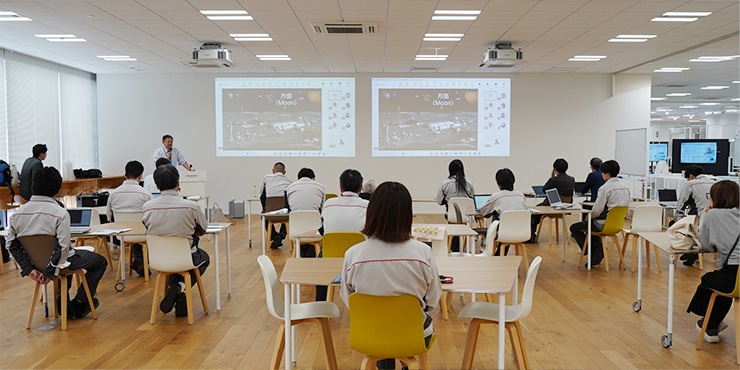
On March 24, 2026, Shimadzu invited Dr. Takano to deliver an in-house hybrid lecture titled “New Areas of Co-Creation between Solar System Material Science and Core Measurement Technologies.” How are the seemingly disparate worlds of the deep sea and deep space (the vast expanse of space beyond the moon) connected through extreme environments and measurement technologies? And what potential lies in the collaborative initiatives with Shimadzu Corporation? This lecture offered a glimpse into those connections and possibilities.
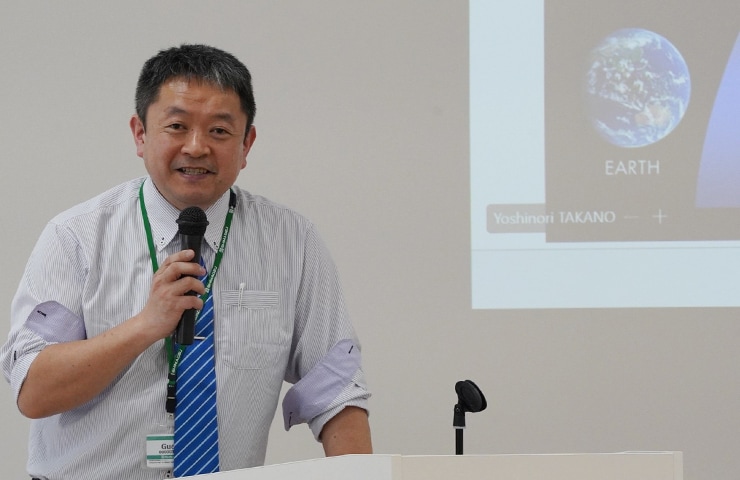
Dr. Yoshinori Takano, Principal Scientist at JAMSTEC / Visiting Professor at JAXA
Co-Creation between JAMSTEC and Shimadzu
JAMSTEC conducts research activities centered at its Yokosuka Headquarters in Kanagawa Prefecture with additional sites in Yokohama, Aomori, Kochi, and Okinawa. Operating the CHIKYU deep-sea drilling vessel and the SHINKAI 6500 deep-sea submersible, JAMSTEC is a core institution of Japanese marine science, advancing research across a wide range of topics, from the mechanisms of massive earthquakes to deep-sea life and marine resources. In collaboration with the JAXA, it is also working to build research infrastructure for materials and life sciences that span the ocean and space, including the analysis of Solar System samples.
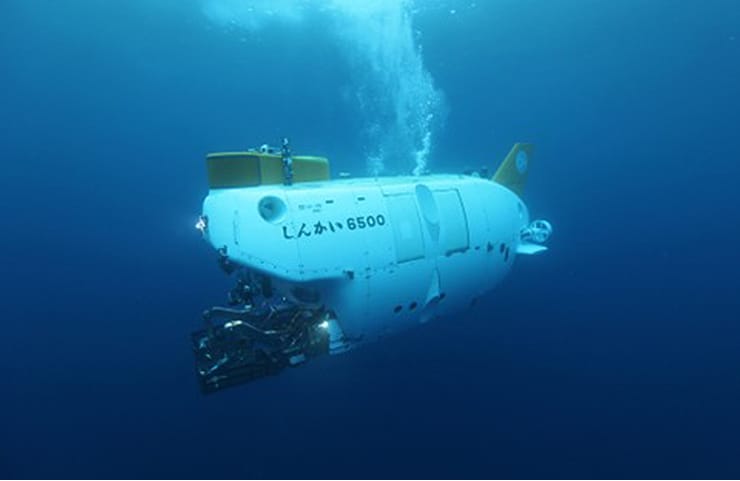
The SHINKAI 6500 manned submersible operated by JAMSTEC (Photo credit: JAMSTEC)
Both the deep sea and deep space are harsh environments characterized by extreme pressure (ultra-high pressure or vacuum), extreme temperatures, darkness, communication constraints, and limited resources (such as power and logistics). The key lies in how to extract reliable information from even the smallest samples or signals.
Shimadzu has collaborated on a demonstration experiment using JAMSTEC’s autonomous underwater vehicle (AUV) to retrieve data from a seafloor observation system automatically. This marked the world’s first successful implementation of a method known as “harvesting,” in which an AUV automatically collects data from seabed equipment while moving through the water.
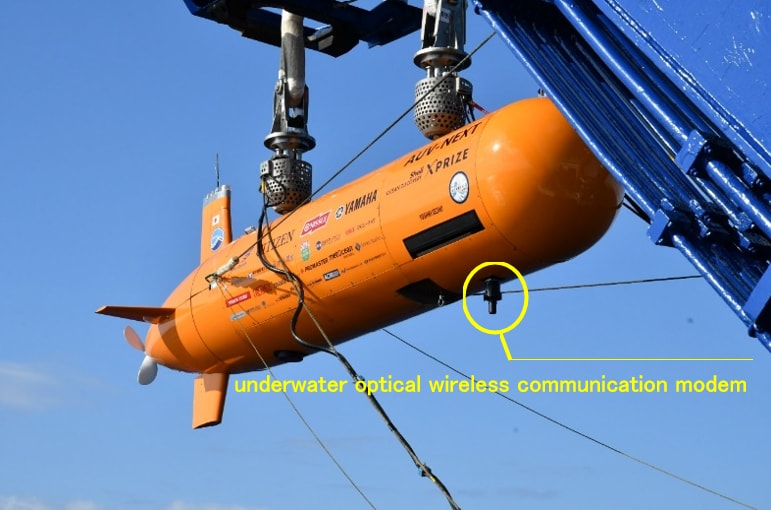
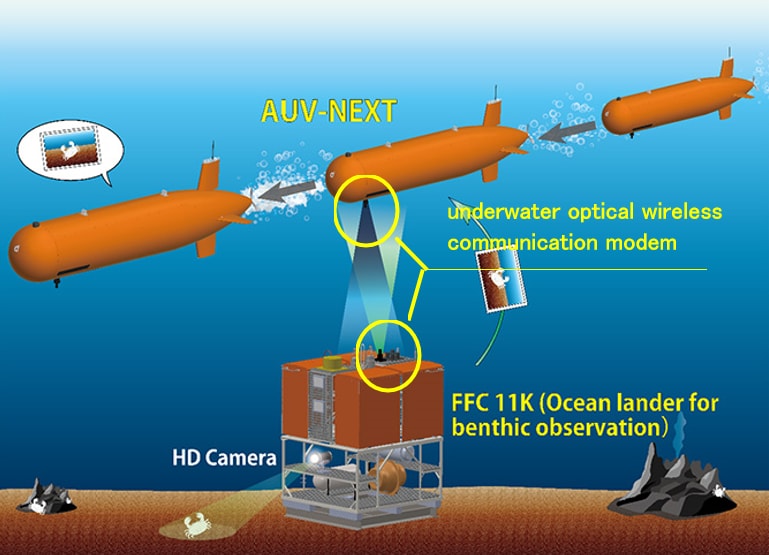
In the experiment, an AUV was equipped with a prototype model that was the successor to the MC100 underwater optical wireless communication modem. The prototype was later commercialized as the MC500 and is now used for data communication in the deep sea, an environment inaccessible to humans.
Solar System Materials Science and High-Precision Measurement Technology
From the perspective of Solar System materials science, the lecture presented representative scientific achievements in the analysis of samples from the asteroid Ryugu, as well as samples from the asteroid Bennu returned by NASA’s OSIRIS-REx. Solar system materials science is a field that investigates the origins, history, and properties of the water, rock, organics and their interaction that make up the Solar System, aiming to understand its formation and to uncover the emergence of life through molecular evolution.
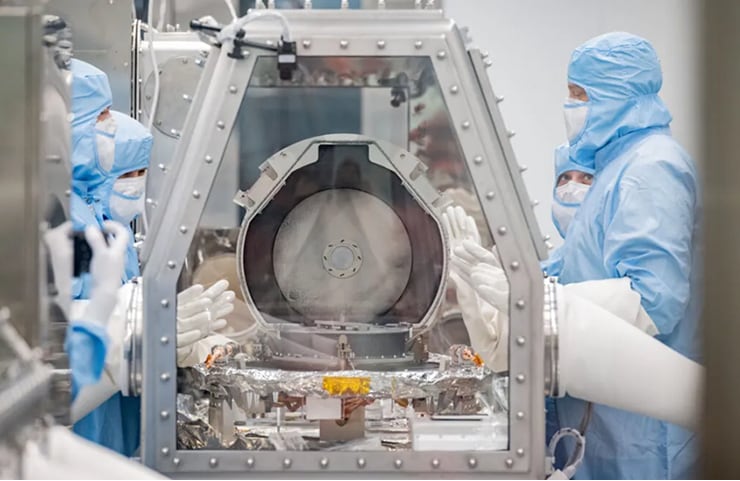
The NASA curation team unsealing the first sample brought back to Earth from the asteroid Bennu
(Photo credit: NASA/Robert Markowitz)
Evidence is emerging that even among asteroids originating in the outer regions of the Solar System, differences in their subsequent history, namely, their evolutionary history may be reflected in their material composition and the diversity of their organic molecules. This research is supported by measurement technologies that combine non-destructive testing methods with methods that involve disassembly for detailed examination.
For example, observing internal structures with X-rays without damaging them and analyzing trace components with a mass spectrometer—this approach, which extracts the maximum amount of information from limited samples, aligns with the core technologies Shimadzu has developed across multiple fields.
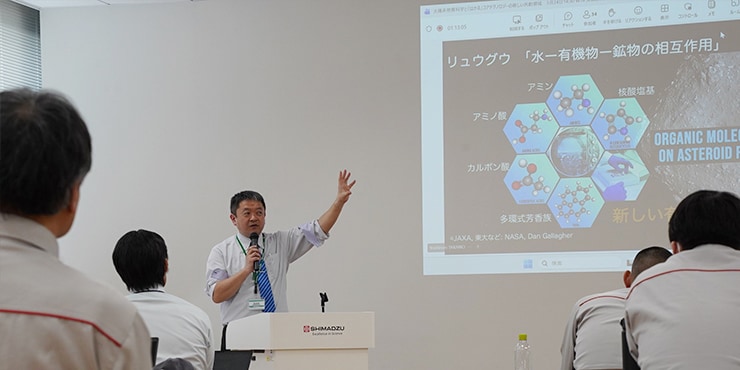
When an employee asked, “What can our company do in collaboration with JAMSTEC?” Dr. Takano pointed to the periodic table and explained, “The hydrogen (H) that our bodies are made from, is an element formed in the Big Bang approximately 13.8 billion years ago. That scientific fact alone is truly awe-inspiring. Precious metals such as gold (Au) and platinum (Pt) are believed to have been created through the collision and merger of multiple neutron stars,” he said, adding, “Every single element in the periodic table has its own epic story. I hope we can unravel these stories together,” he concluded, emphasizing the importance of the international standardization of material measurement methods led by JAMSTEC.
The employees in the audience appeared surprised and excited by the idea that the materials and data they handle every day are connected to the history of the universe, as well as by the possibilities for future initiatives this opens up.
Comments from Attendees
Reflecting on the lecture, Ogawa from the Application Design Unit of the Solutions COE in the Analytical & Measuring Instruments Division, commented:
I majored in space mineralogy when I was a student, so the Hayabusa and Hayabusa2 sample return missions have always been projects I’ve been fascinated by. The footage of the reentry capsule recovery in Australia was especially impressive and really got my heart racing. In light of that, I decided to attend the seminar in the hope that Shimadzu’s analytical instruments might prove useful in some way.
I was once again astonished by how examining traces of life, such as amino acids, allows us to explore our origins, and by how we can infer the formation and differences among celestial bodies from their elemental composition and isotopic ratios.
Based on the grand concept of an “astro-ecosystem” that connects the deep sea to deep space, I look forward to future research uncovering numerous findings that will challenge our conventional understanding of the Solar System and the universe. At the same time, I want to continue exploring how we can contribute to this field.
The Shimadzu sales representative who organized the lecture reflected, “By giving employees a chance to experience the front lines of research, we wanted to provide an opportunity for each of them to consider the extent to which Shimadzu’s technology can contribute to society.”
Deep sea and deep space—. Although these are worlds of vastly different scales and distances, the key to unraveling their mysteries lies in measurement technologies that transform the faint signals and material data generated in extreme environments into reliable data.
Moving forward, Shimadzu is committed to contributing to the advancement of society and science through measurement and analysis technologies that unlock unknown worlds—from the deep sea to deep space—in collaboration with partners such as JAMSTEC.
- NASA | Asteroid Probe OSIRIS-REx Initial Analysis: Organic Matter Analysis Team’s Research Findings Published in the Scientific Journal Nature Geoscience
- NASA | Selection of Initial Analysis Results from the Asteroid Probe OSIRIS-REx for “Physics World Top 10: Breakthroughs of the Year 2025”
- JAMSTEC | Research Results by Institute for Earth and Material Sciences at JAMSTEC toward the International Standardization of Material Measurement Methods (1: Carbon, Nitrogen, and Stable Isotope Reference Materials) (Japan Geoscience Union)
- JAMSTEC | Research Results by Institute for Earth and Material Sciences at JAMSTEC Aimed at the International Standardization of Material Measurement Methods (2: Sulfur and Stable Isotopic Composition at the Ultra-Micro Scale) (Japan Geoscience Union)
Related Links
- JAMSTEC | Japan Agency for Marine-Earth Science and Technology | JAMSTEC
- JAXA | Initial Analysis of the Hayabusa2 Asteroid Explorer: Publication of Research Results by the Soluble Organic Matter Team in the Scientific Journal Science
- Shimadzu cooperated in a demonstration experiment by JAMSTEC AUV equipped with a prototype of our underwater optical wireless communication modem | News
 Page Title and URL Copied.