



Shimadzu Exhibits at Milan Design Week 2026 Showcasing Science Artwork “In-Between Matter”
Shimadzu Corporation participated in the Milan Design Week 2026 held in April, exhibiting the science artwork “In-Between Matter,” created in collaboration with the design studio we+ (Tokyo).
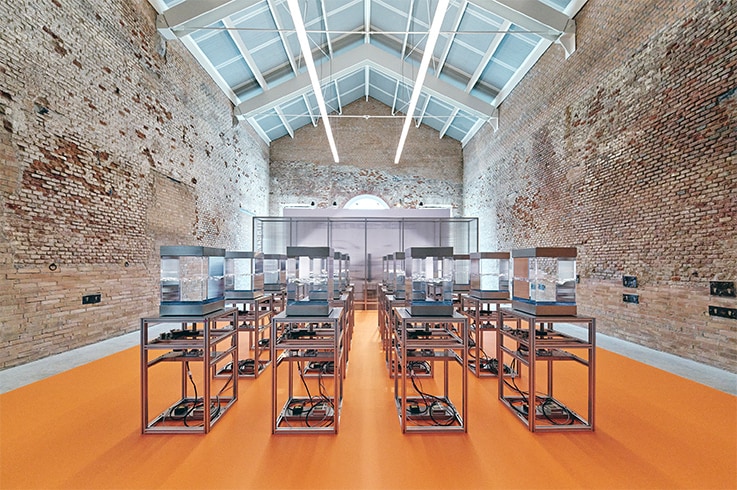
Photo:Masaki Ogawa
Milan Design Week Brings Art to Every Corner of the City
Milan Design Week is the collective name for the world’s largest international furniture fair, Milano Salone (Salone del Mobile.Milano), and the concurrently held Fuorisalone events. Both are held in Milan, Italy, every April. Numerous companies and designers from around the world participate, exhibiting products and artworks that showcase their respective technologies.
This year’s Milano Salone (April 21-26) featured 1,900 exhibitors from 32 countries and attracted over 310,000 visitors. While attendance figures for the Fuorisalone events have not been released, it is estimated that Milan Design Week as a whole drew approximately 1 million visitors. The Fuorisalone events that Shimadzu Corporation participated in took place at various locations throughout Milan, including art museums, historic buildings, and universities, transforming the entire city into a canvas of art.
Science Artwork "In-Between Matter"
Movie: Yuta Sawamura
Shimadzu Corporation participated in Milan Design Week as part of our efforts to foster interest in science and technology. This marks its second exhibition, following “WONDER POWDER” in 2024. The artwork “In-Between Matter” does not limit itself to a specific area of analysis; instead, it focuses on more abstract scientific concepts such as “separating” and “the boundaries between matter.” Through this science artwork, which enabled visitors to experience the essence of analytical and measuring technology—namely, the question of “what analysis is”—it invited viewers into the world of science.
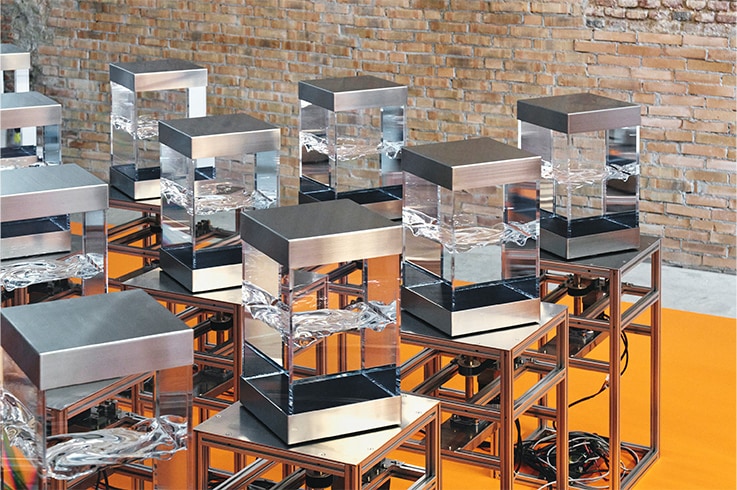
"Liquid Interface"
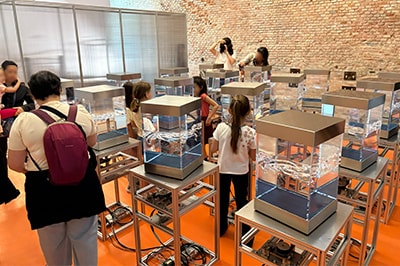
The piece that attracted the most attention at the Shimadzu booth was “Liquid Interface.” Sixteen cases filled with water and silicone oil move in synchrony, each generating its own “transparent wave.” This work, which evokes the beauty of “separating,” drew the attention of many visitors, with numerous people stopping to take videos on their mobile phones.
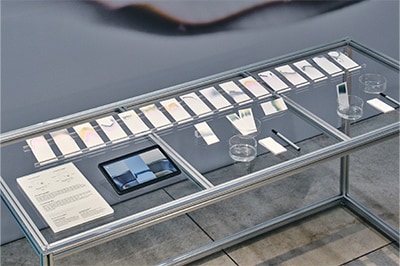
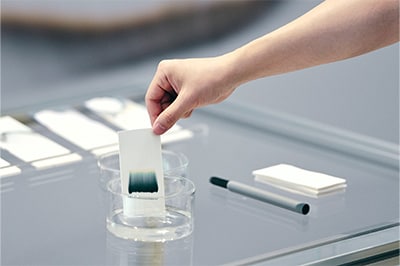
“Chromatography”: Separated pen ink creates evolving patterns on a ceramic plate
“Chromatography” allows visitors to observe, in real time, how black water-based ink separates into a spectrum of colors. This interactive artwork was inspired by paper chromatography, a fundamental separation analysis technique in which ink is separated by paper and water. One visitor described the experience as follows: “Watching the water carry the colors felt almost as if a work of art were coming into being right before my eyes. Yet what makes it so fascinating is that there is no artist involved—only physics and science.”
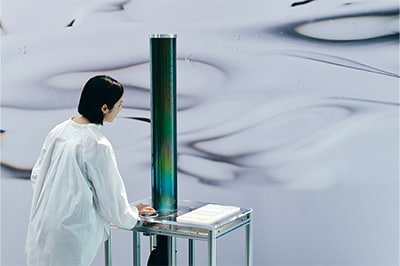
“Optical Rotation” is a work based on sugar’s ability to twist light. As light passes upward through a cylinder filled with sugar water, each color (wavelength) is twisted at a different angle. Turning the dial shifts a polarizing filter that allows only certain light to pass through, changing the colors visible to the viewer
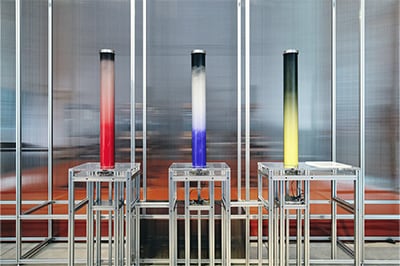
“Particle Settling”: Pressing the button on the stand sends two powdered mineral pigments up through a cylinder, where they mix. As time passes, the particles descend at different speeds because of differences in weight, forming naturally layered color gradients
Note: Photos in the section Science Artwork "In-Between Matter" were taken by Masaki Ogawa.
Comment from the Person in Charge at Shimadzu Corporate Product Design Center
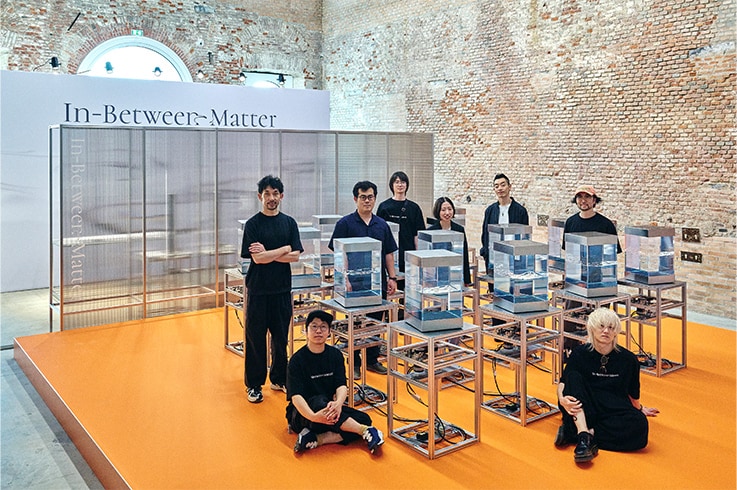
Members of Shimadzu’s Corporate Product Design Center and we+. Nakagawa is second from the left in the back row, and Takegawa is on the far right in the front row (both from the Corporate Product Design Center)
Photo: Masaki Ogawa
For our second exhibition at Milan Design Week, we presented the exhibition under a new theme “In-Between Matter.” We were very pleased to welcome so many visitors.
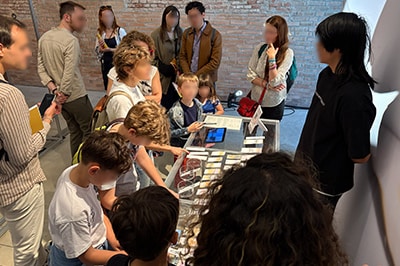
We created these artworks in the hope that they might serve as a catalyst for future scientists, and throughout the exhibition, we received many thoughtful “why?” questions that really got to the heart of the displays. Also, since the venue was the National Museum of Science and Technology Leonardo da Vinci, many children could be seen at the exhibition. We hope we were able to successfully spark curiosity, a powerful driving force behind science.
The title of this artwork, In-Between Matter, literally means “between matter and matter.” Things that exist in between are hidden all around us. We hope each visitor will discover their own In-Between Matter. Our research and activities will continue to contribute to a greater appeal of science and technology. We are considering exhibiting this artwork in Japan in the future. Please be sure to come and see it when that opportunity comes.
 Page Title and URL Copied.