



Fostering an Ability to Connect Science with Society
Shimadzu Launches a Science Communicator Training Program
Shimadzu Corporation has launched a Science Communicator Training Program to develop its human resources in the science communication field. The program is part of re-skilling and skill-up initiatives based on an agreement concluded with Doshisha University. Positioned as a basic course on science communication, the program offers on-demand lectures for Shimadzu Corporation’s employees on the basic knowledge and skills needed to communicate science clearly.
| Theme | Lectures | |
|---|---|---|
| 1 | Creating Press Releases that Make an Impact | Approach for Scientific Press Releases |
| 2 | How to Speak in a Compelling Way and Give Presentations that Convey Information | How to Speak for Conveying Information |
| 3 | How to Live in an AI Era | The Future of AI and Corporations |
| 4 | Newly Emerging and Reemerging Infectious Diseases and Disseminating Information from Experts | Learning from Disseminating Scientific Information about Infectious Diseases |
| 5 | ELSI (Ethical, Legal, and Social Issues of Science and Technology) | The ELSI Perspective |
This article features excerpts from “1. Creating Press Releases that Make an Impact” and “5. ELSI.”
How to Deliver Compelling Press Releases
How do press releases issued by companies and research institutions reach science journalists and lead to media coverage? Those questions are explained by Visiting Professor Yukiko Motomura of the Faculty of Life and Medical Sciences at Doshisha University, who has 25 years of experience as a science reporter.
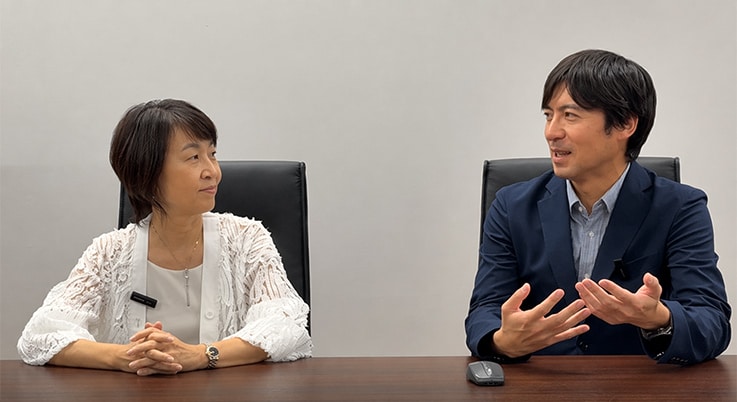
From left: Visiting Professor Motomura, and Assistant Professor Masu
Excerpt from Lecture
Journalists who read press releases are not necessarily experts in the relevant field. A major premise of press releases is that they are based on fact and accurately present research results, but it is also important to communicate the background and story behind the discoveries and results, as well as how they may affect society and the world. Depending on social conditions, such as the global situation, even groundbreaking results may not be reported, so the timing of information release is also an important factor.
Responsible Research and Development
When new science and technology are introduced into society, their effects are not necessarily all positive. Even if the technology is revolutionary, it can involve ethical, legal, and social issues. The dark side of science and technology is referred to by the acronym ELSI, formed from the initial letters of the terms. In this lecture, we considered ELSI in relation to genetic information together with Professor Satoru Funamoto, a life science researcher at the Faculty of Life and Medical Sciences, Doshisha University.
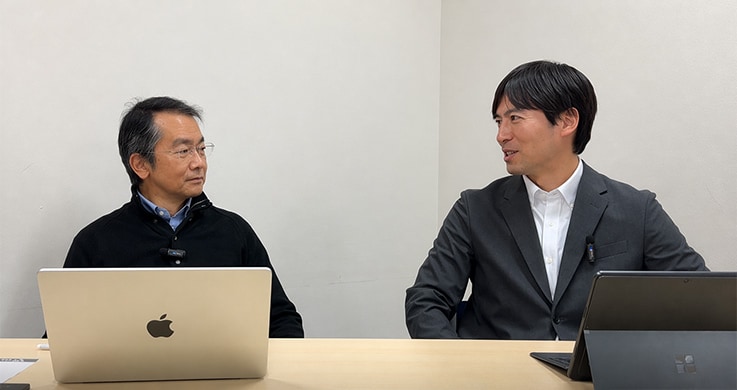
Left: Professor Funamoto
Excerpt from Lecture
Genetic information is the ultimate personal information. On the one hand, it can help predict a person’s diseases, but revealing genetic information also carries the risk of discrimination and prejudice that can affect not only the person but also their relatives. There have already been cases of people being denied employment or unable to obtain insurance, even without developing the disease or experiencing any symptoms. Though many countries are establishing laws to prohibit discrimination based on genetic information, it is too late to think of countermeasures only after a problem occurs.It is important to consider, before social implementation, what kinds of issues may arise from not only genetic information but also any new science or technology. Therefore, responsible research and innovation with an eye to the future is required. This is not just an issue for engineers and scientists. It is an issue that should be considered from legal, ethical, sociological, and other perspectives, while also engaging in communication with citizens.
Comment from the Person in Charge of the Program
Ryoko Kawashita, Manager, Human Resources Development Group, HR Department
To realize Shimadzu’s corporate philosophy, “Contributing to Society through Science and Technology,” it is essential to communicate our specialized knowledge and R&D achievements accurately, while taking their significance and impact on society into account. I believe it is highly meaningful that this program has given employees the opportunity to learn how to communicate science and technology clearly and to consider ways to communicate with diverse audiences.I am especially grateful to those at Doshisha University who generously helped in preparing and providing the on-demand lectures. In the future as well, we intend to continue applying what we learned in our day-to-day work in our efforts to create new value.
To properly advance science and technology and implement them in society, we must go beyond the boundaries between the humanities and sciences, engage with science from a variety of perspectives, and continue communicating toward a better society and future. This requires developing people who can communicate with recipients from diverse backgrounds and who can listen to those around them while keeping in mind the many possible futures. Shimadzu Corporation is committed to continue developing human resources in the field of science communication, based on the corporate philosophy “Contributing to Society through Science and Technology.”
 Page Title and URL Copied.