



Improving the Efficiency of Drug Discovery Research
Joint Development of an HTE Automation System with Astellas Pharma
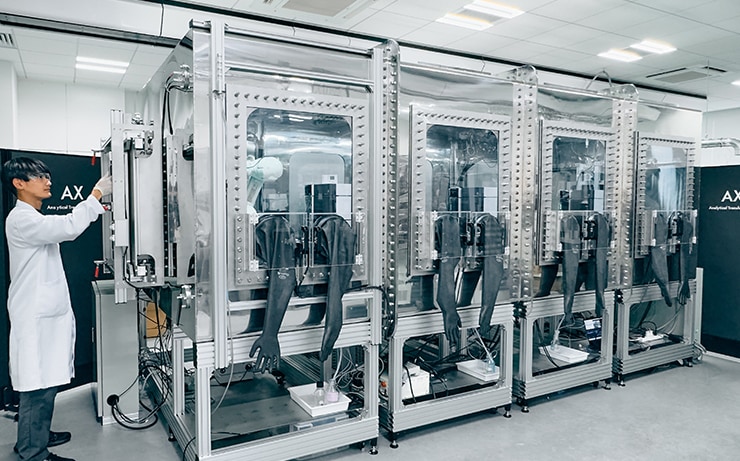
Shimadzu Corporation, in collaboration with Astellas Pharma Inc., has developed AtmosOrchestra, a robotic HTE (high-throughput experimentation) automation system for screening reaction conditions for small- and medium-molecule pharmaceuticals.
Experimental Work Has Become an R&D Bottleneck
Drugs can be broadly classified as small-, medium-, or large-molecule drugs according to their molecular size, and a wide range of technologies and processes are used in drug discovery and manufacturing.


For small- and medium-molecule drugs, CMC (chemistry, manufacturing and controls) research is required from drug discovery through to stable production and supply. Researchers conduct repeated screening experiments to identify optimal synthesis conditions by testing combinations of variables such as raw material types and proportions, reaction temperatures, and reagent concentrations. In recent years, analytical instruments and AI have improved the efficiency of data acquisition and analysis. However, experimental work still requires considerable manual effort, making it a bottleneck in R&D.
Enabling Unmanned Sample Synthesis Operations
To address this challenge, Astellas Pharma and Shimadzu have been working to improve the efficiency of sample synthesis. The result of these efforts is AtmosOrchestra, a robotic HTE automation system.
The AtmosOrchestra introductory video (Japanese). The name “Atmos” is derived from atmosphere, referring to the gaseous environment in an experiment. “Orchestra” represents the way in which multiple modules work together under the direction of software to carry out the experimental process
HTE (high-throughput experimentation) is a method that uses robotics and AI to perform experiments rapidly and in parallel, such as screening compounds in drug discovery and optimizing reaction conditions in process chemistry. AtmosOrchestra automates the complex sample synthesis processes required in the early stages of drug development—including liquid dispensing, reactions, and solvent drying—using industrial robots and Shimadzu dispensing equipment. The system enables the entire process to be performed automatically. The system has been installed at Astellas Pharma’s Tsukuba Research Center since late April 2026.
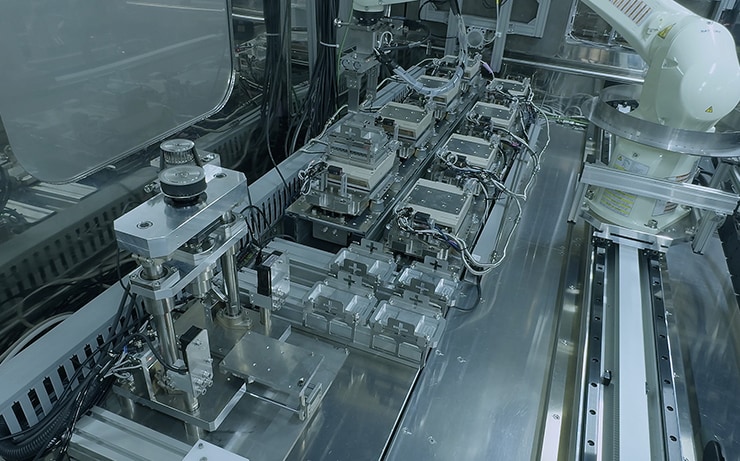
A robotic arm loads samples into the heating and stirring module. The 96 vials contain reagents with highly volatile organic solvents and are sealed before being heated and stirred. The automation of the entire series of processes attracted considerable interest following the press release issued in May.
Comment from the Person in Charge
The following comment is from a developer in the Lab Mechanics Business Unit, Analytical & Measuring Instruments Division, Shimadzu Corporation.
Automation systems have traditionally been developed as customized solutions for individual applications. With AtmosOrchestra, we have standardized the development process by combining functional modules. This project is a good example of the development philosophy of our Lab Mechanics Business Unit. At INTERPHEX, an exhibition for pharmaceutical and cosmetics manufacturing and packaging held in Tokyo in May, Astellas Pharma presented its research results using the system. Many attendees were apparently surprised to learn that Shimadzu also develops automation systems.
One of our key strengths is our ability to provide integrated technical support covering the entire workflow, from sample pretreatment and analytical conditions to data analysis. Building on the experience gained from this project, we plan to standardize our functional modules and robot frames and establish a system for providing semi-custom solutions tailored to individual customer requirements.
 Page Title and URL Copied.