



AAIC 2026: At the Forefront of Global Dementia Research
As populations age worldwide, dementia is one of the major issues affecting not only healthcare and caregiving but society as a whole. In recent years, research and development of new treatments for Alzheimer’s disease have advanced, while the importance of early detection has also grown. Shimadzu has contributed to advances in dementia research and diagnosis through research on blood biomarkers (BM)*1 using mass spectrometry and diagnostic imaging technologies using high-performance PET systems.
*1 Biomarkers: Substances metabolized in the body that can provide clues for the early detection or diagnosis of disease

In July 2026, Shimadzu researchers participated in the Alzheimer’s Association International Conference (AAIC 2026), held in London, England. AAIC is one of the largest international conferences in the field of dementia research. This report shares insights into the current state and future of dementia research gained at AAIC 2026, where more than 10,000 researchers and healthcare professionals from around the world gathered, as well as the efforts of a Shimadzu employee who participated.
A Broader Perspective as a Researcher in London: First Presentation at an International Conference
One of Shimadzu’s participants at the conference was Kae Senoo, a second-year employee in the Application Group of the Koichi Tanaka Mass Spectrometry Research Laboratory. Although she had given a presentation at an academic conference in Japan as a student, this was her first time participating in an international conference. In addition to feeling uneasy about presenting her research in English, she felt the responsibility of participating as a representative of Shimadzu, and so was initially quite nervous. At the same time, she had high expectations about participating, as this was a precious opportunity to get firsthand experience with cutting-edge dementia research, and to explain her own research directly to overseas researchers.
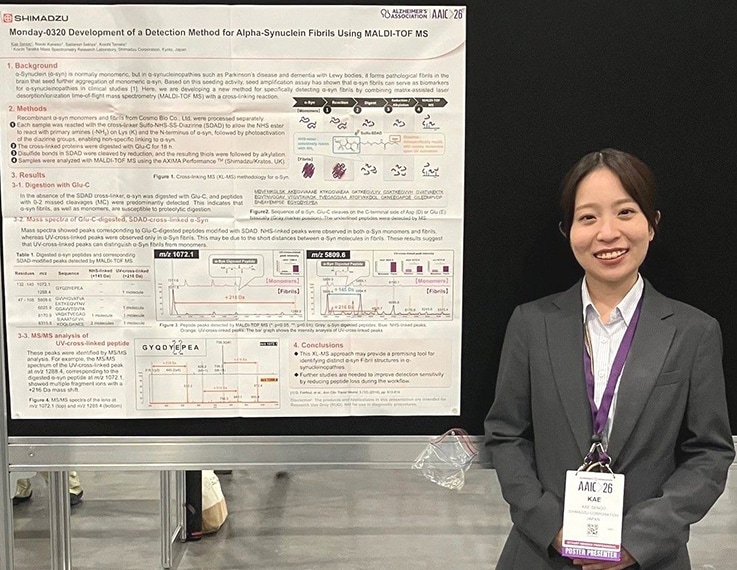
Kae Senoo of the Application Group, Koichi Tanaka Mass Spectrometry Research Laboratory
On the first day, I was overwhelmed by the energy and scale of the venue. Seeing firsthand how many people are working to overcome dementia strengthened my determination to continue growing as one of them.
At the venue, I mainly attended sessions on biomarkers (BM) used in blood or cerebrospinal fluid tests. In particular, I was struck by the steady progress being made toward the clinical application of p-tau217*2, which has long been regarded as a promising BM candidate.
Moreover, some patients diagnosed with Alzheimer’s disease also have dementia with Lewy bodies, and it has been suggested that this comorbidity may go undetected. The presentation I attended suggested that α-synuclein, the subject of my research, could potentially be used as a BM to detect comorbid dementia with Lewy bodies. This presentation renewed my awareness of the importance of my research and provided strong motivation for my future work.
*2 p-tau217: A protein biomarker in the blood that is expected to aid in the early detection of Alzheimer’s disease
Aiming to Establish Techniques Related to Clinical Applications
Senoo presented her research on a new method for detecting α-synuclein using cross-linking MS (XL-MS)*3. α-synuclein is a protein found in large quantities in the tissues of the brain and nervous system. When it accumulates excessively and aggregates for reasons not yet fully understood, it is thought to contribute to neurodegenerative diseases such as Parkinson’s disease and dementia with Lewy bodies. In recent years, it has become clear that aggregate structures differ among diseases. However, distinguishing these structural differences is difficult, and conventional detection methods require considerable time for measurement and analysis.
*3 Cross-linking MS: A mass spectrometry technique for investigating protein structures and interactions. Because it can analyze how disease-related proteins aggregate, this technique is being developed for use in research on dementia and other neurodegenerative diseases.
When she demonstrated that the features of XL-MS could be used with artificially prepared samples to distinguish aggregates from monomers, even researchers unfamiliar with mass spectrometry expressed interest in the approach. There were also many questions about measurements using plasma samples, and Senoo sensed the strong expectations for clinical applications. She says that she plans to improve detection sensitivity, conduct measurements using plasma samples, and distinguish among diseases, with the ultimate goal of supporting clinical diagnosis.
Research cannot Be Conducted Alone
One of the most important things Senoo learned through participation in this year’s AAIC was about relationships with the people who support research.
I became more keenly aware than ever that research cannot be completed alone and depends on the support of many people. I received support from those around me in many ways, from conducting daily experiments and analyzing data to interpreting results, attending study sessions, and preparing my presentation. In addition, participation in the conference provided an opportunity to practice my conversational English. I gained a real sense that little by little, my capabilities were improving through continued practice. In the future, I will further hone my field of expertise. At the same time, while broadening my knowledge and perspective, I hope to become a researcher and engineer who ties distinctive research to social implementation.
Dementia research is progressing through collaboration between researchers in a variety of fields including medicine, pharmacology, and analytical chemistry. Participation in AAIC 2026 gave a young researcher the opportunity to experience the global forefront of research and broaden her career possibilities. Inspired by what she learned in London, she will continue to pursue new opportunities. Shimadzu will also continue its efforts to help address dementia-related issues through science and technology.
 Page Title and URL Copied.