



Reducing Weatherability Tests from Years to Days
A Sample Pretreatment System for More Efficient Material Degradation Analysis
Everyday materials such as paints, resins, and rubber gradually deteriorate when exposed to light, heat, humidity, and other environmental factors. Over time, this can lead to discoloration and cracking. Materials manufacturers conduct tests to assess durability and predict service life, but these tests can take a long time.
Launched in 2025, the CDAS-1000 combined degradation acceleration unit is the world’s first sample pretreatment system designed to accelerate material degradation in just a few days, making weatherability testing more efficient.
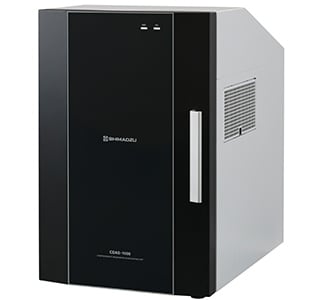
The CDAS-1000 combined degradation acceleration unit. This sample pretreatment system is designed for the analysis of gases released during material degradation and investigates degradation mechanisms at material surfaces. It enables researchers to assess how readily a material degrades in just one to two days
Weatherability Tests that Take Years
For materials commonly used outdoors, weatherability—the ability to withstand environmental conditions such as sunlight, wind and rain, and changes in humidity—is an important consideration. Common evaluation methods include outdoor exposure tests, in which materials are left to deteriorate under natural environmental conditions, and accelerated weathering tests, which use equipment to speed up the deterioration process; however, the former takes several years to several decades, and even the latter takes several thousand hours.
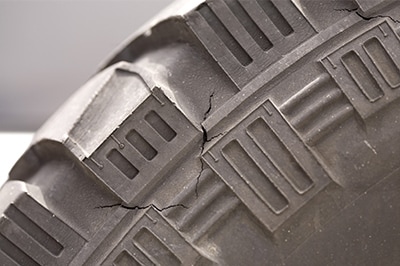
Materials used outdoors deteriorate under the effects of sunlight, rain, and other environmental factors (photo for illustrative purposes)
To address this challenge, the CDAS-1000 combined degradation acceleration unit was developed. Yuki Kato of the Research & Development Department, Analytical & Measuring Instruments Division, who was involved in its development, explains:
The time required for materials to deteriorate was not the only challenge we faced with weatherability testing. Researchers involved in R&D at materials manufacturers and other organizations assessed the degree of degradation by visually checking changes in color and gloss. Although these changes could be observed, it was difficult to determine what had caused the degradation. We wanted to find a way to address this problem.
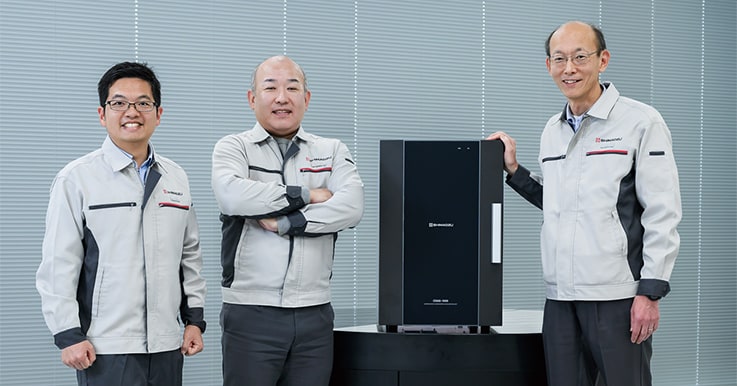
The CDAS-1000 combined degradation acceleration unit with members of the development team from the Research & Development Department, Analytical & Measuring Instruments Division. (From the right) Manager Ryutaro Oda, Assistant Manager Yukinori Hasegawa, and Assistant Manager Yuki Kato
Supporting the Analysis of Degradation Mechanisms
The CDAS-1000 is a sample pretreatment system that accelerates material degradation over a short period. The components of gases released during degradation can be analyzed, and the condition of material surfaces can be examined using Shimadzu instruments such as gas chromatograph mass spectrometers (GC-MS), Fourier transform infrared spectrophotometers (FTIR), and scanning electron microscopes (SEM). The system provides valuable information for identifying degradation mechanisms, helping researchers to streamline materials R&D.
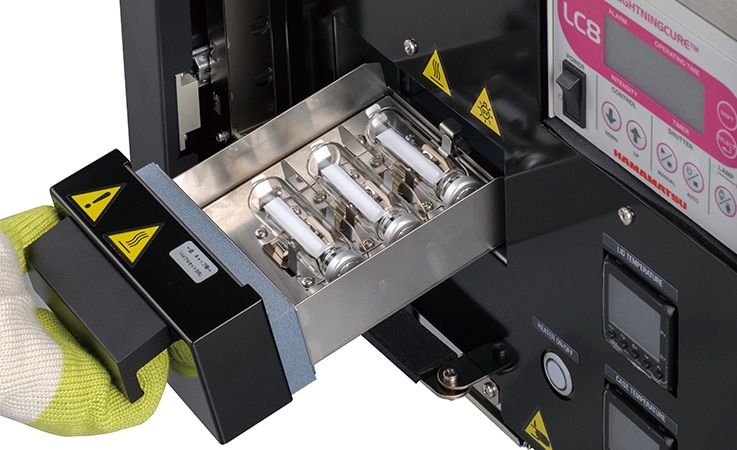
A vial (sealed container) containing a sample is placed in the unit. Adding water to the vial also enables the evaluation of hydrolysis
The development team had materials manufacturers test a prototype and used their feedback to refine the CDAS-1000. Users can choose between two light sources: a UV lamp that emits intense ultraviolet radiation, or a xenon lamp that reproduces the full solar spectrum. The system can also apply controlled temperature and humidity conditions, allowing researchers to conduct tests that more closely simulate the natural environment.
Comment from the Development Team Member
Kato says he has a particular vision for what he hopes to achieve with the CDAS-1000.
Since its launch, the system has attracted interest from researchers working with construction materials, window glass, and urushi lacquer used on cultural heritage objects. When we presented our work at an international conference on material degradation in France, researchers attending the event told us that it was an attractive product.
I believe we have opened up new possibilities in the field of weatherability testing. We want to change the industry’s conventional assumption that material testing takes months or even years.
By going beyond visible changes to scientifically uncover the mechanisms behind degradation, we aim to accelerate our customers’ R&D. That is what we dream of achieving with the CDAS-1000. We will continue to support our customers through science and technology.
 Page Title and URL Copied.