



Exploring the Scientific Relationship between Diet and Dementia
The Ebetsu Active Future Study: Toward a Society where People Live Longer, Healthier Lives
Dementia is a major challenge that Japan is facing as its population ages. In recent years, increasing attention has been paid to the role of daily diet and lifestyle habits in dementia prevention.
The Ebetsu Active Future Study (hereafter EAFS), which was launched in 2023, is a joint cohort study*1 that is investigating the relationship between diet and cognitive function over a 10-year period, involving approximately 1,200 residents of Ebetsu City, Hokkaido. Shimadzu Corporation is participating in this research by using mass spectrometry to measure dementia-related substances in blood. We support the study through our analytical technologies, with the aim of generating new insights that may enable earlier detection of cognitive decline and help extend healthy life expectancy.
*1 A research method in which a group (cohort) sharing certain common characteristics is followed over a given period to investigate the relationship between changes in health or disease status and lifestyle or environmental factors

The EAFS Address the Social Challenge of Dementia
As we enter an era in which people can live to 100, extending healthy life expectancy has become a shared challenge in Japan and around the world. In Japan, an estimated 4.43 million people have dementia, while approximately 5.58 million have mild cognitive impairment (MCI), a condition that can precede dementia*2. Together, these groups account for approximately 10 million people. This means that roughly one in three older adults (aged 65 and older) faces challenges related to cognitive decline.
*2 Cabinet Office, Government of Japan, Annual Report on the Ageing Society FY2024, Chapter 1, Section 2, “Trends of Living of the Elderly” (2)
It was against this backdrop that the EAFS was launched in September 2023. The five parties—Ebetsu City in Hokkaido, Hokkaido Information University, the National Agriculture and Food Research Organization (NARO), the Self Care Food Council (SCFC), and Shimadzu Corporation—are collaborating to build societal systems that reduce and prevent the risk of MCI in an ageing society.
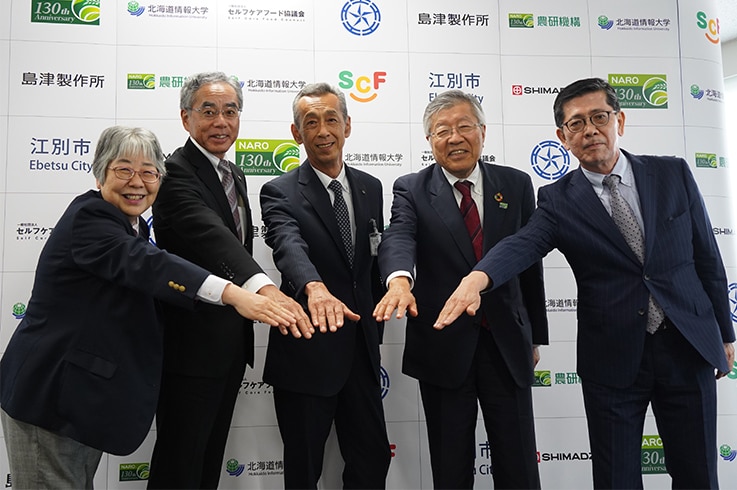
From left to right: Mari Yamamoto, Representative Director of the Self Care Food Council, Yasunori Yamamoto, President and CEO of Shimadzu Corporation, Yoshito Goto, Mayor of Ebetsu City (Hokkaido), Kazuo Kyuma, President of NARO, Jun Nishihira, then President of Hokkaido Information University, at a press conference in 2023
Can Dietary Habits Help Maintain Cognitive Function?
Dementia is thought to be influenced not only by ageing but also by lifestyle factors such as diet, physical activity, and sleep. However, sufficient scientific evidence on the relationship between diet and health has yet to be accumulated.

To bridge this gap, the study is collecting data on dietary intake, physical function, cognitive function, and blood test results on an ongoing basis, and analyzing their associations with the risk of developing MCI.
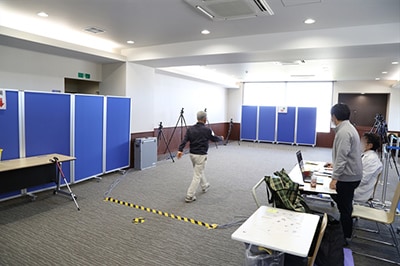
Walking assessment using motion capture technology
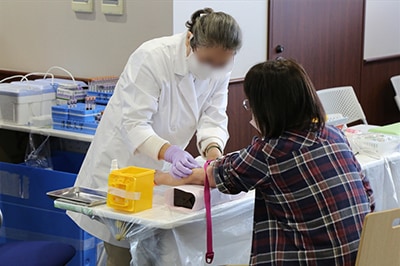
Taking a blood sample
As part of the project, Hokkaido Information University is responsible for health assessments and data analysis, while NARO is investigating the relationships between dietary habits, frailty, and cognitive function. Frailty refers to a state of declining physical and mental function associated with ageing, in which a person is neither fully healthy nor yet in need of long-term care. SCFC is responsible for translating the research findings into practical applications that benefit society. Drawing on their respective areas of expertise, they are working together to clarify the relationship between diet and dementia.
Using Blood Analysis to Identify Dementia Risk at an Early Stage
Shimadzu's role in the study is the early detection of cognitive decline using blood samples and the analysis of the resulting data. The study is measuring levels of amyloid-β, a peptide known to be associated with Alzheimer’s disease, in approximately 1,200 participants. The study is also measuring advanced glycation end products (AGEs), which accumulate in the body, to investigate their relationship with cognitive function.
It is believed that changes in the body associated with dementia begin even before symptoms appear. Consequently, identifying subtle changes in the blood may eventually make it possible to assess the risk of cognitive decline at an earlier stage. Furthermore, this study is expected to lead to the discovery of new blood biomarkers for MCI.
Mass spectrometry—a technology in which Shimadzu excels—is what underpins this research. In this study, MALDI mass spectrometry and other mass spectrometric techniques are being used to estimate amyloid-β accumulation from just a few drops of blood. Looking ahead, liquid chromatography-tandem mass spectrometry (LC-MS/MS) is also expected to be used to analyze metabolites and other substances in blood, potentially providing new insights into the relationship between dietary habits and health.

MALDI-8020 matrix-assisted laser desorption/ionization time-of-flight mass spectrometer

LCMS-8060NX liquid chromatograph mass spectrometer
Shimadzu’s mass spectrometry technology makes trace components in the blood detectable, helping researchers clarify the relationships between diet, health, and cognitive function.
Putting Research Findings into Practice
One of the distinguishing features of the EAFS is its focus on translating research findings into practical solutions. In many large-scale cohort studies, the outcomes may go no further than publication in academic journals. This project, however, aims to take the findings a step further, with SCFC playing a central role in applying the research results to food development.

If the study identifies foods or nutrients that help maintain cognitive function, the findings could be used to develop new recipes and food products. As of October 2026, ten major food companies are participating in the project, and efforts are underway to return the benefits of the research to society.
Comment from a Shimadzu Representative
In an era in which people can live to 100, building a society where people live longer, healthier lives is a shared challenge for Japan and many other countries. Meeting this goal requires focusing on prevention rather than waiting until illness develops, by reassessing lifestyle habits such as exercise, sleep, and diet. One challenge, however, is the lack of sufficient scientific evidence on the relationship between diet and health.
The EAFS is conducting research of great social significance, including measuring amyloid-β levels in approximately 1,200 participants. We also hope to put the findings into practice through food product development and recipe recommendations, thereby bringing the benefits of the research to society.
 Page Title and URL Copied.