


Winning the Junior Koshien of Science Competition
The Secret to “Maglev Train, Go!” Victory
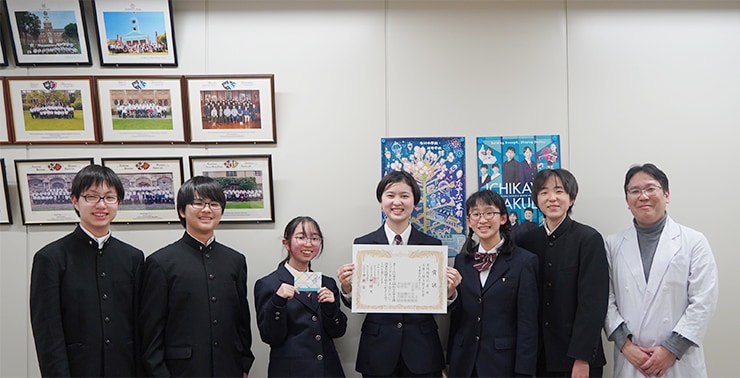
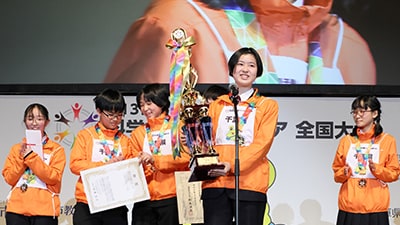
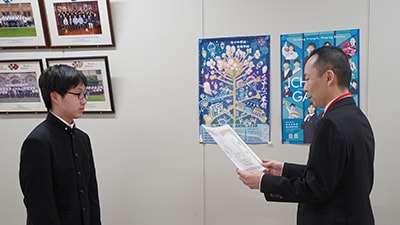
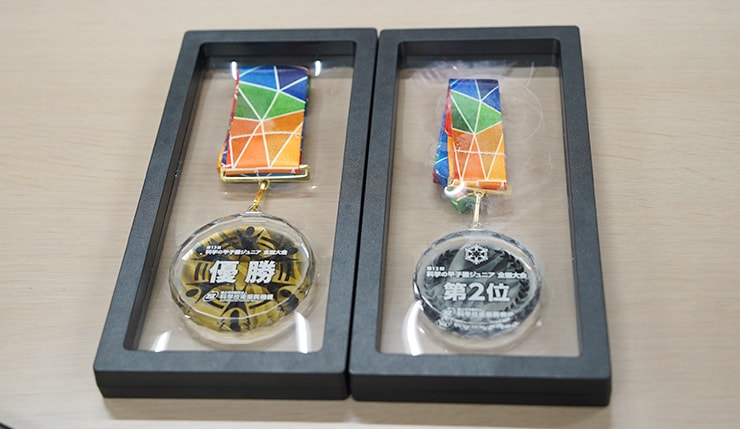
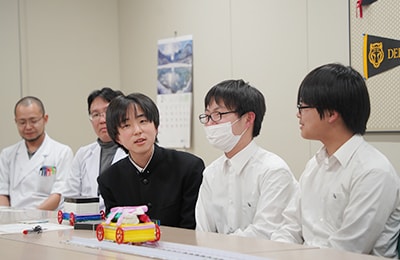
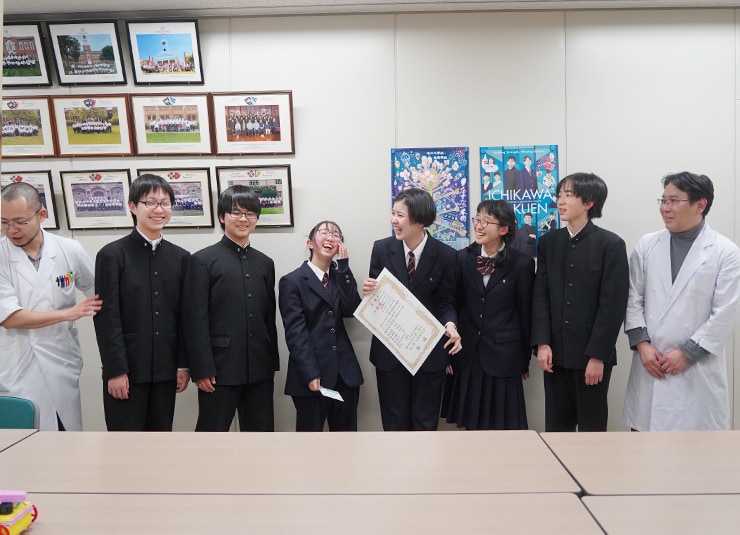
At the 13th National Junior Koshien* of Science competition held in December 2025, the team representing Chiba Prefecture won the overall championship and received six awards, including the SHIMADZU Award presented by Shimadzu Corporation and Shimadzu Rika Corporation. Representatives from the two companies visited Ichikawa Gakuen Ichikawa Junior High School, the Chiba representative team and spoke to the team members and their teachers.
* Koshien originally refers to a baseball stadium in Hyogo Prefecture or the Japanese High School Baseball Championship held at the stadium. By extension, it is also used to mean a national tournament.


Members Selected from 80 Students
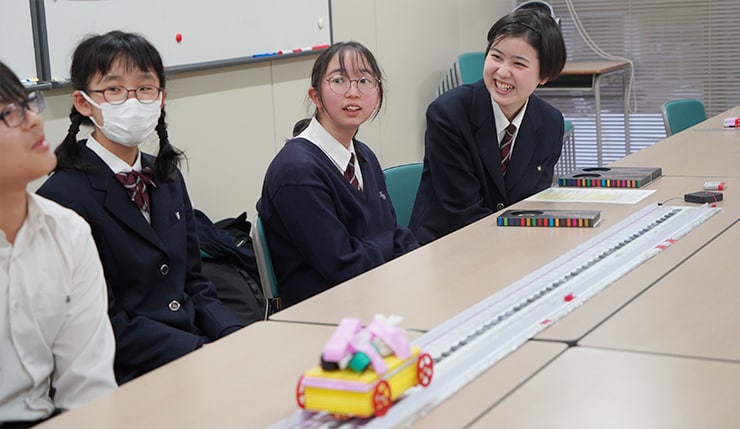
Ichikawa Junior High School is a powerful contender in the Junior Koshien of Science tournament, having participated in the past five tournaments and achieved runner-up twice.
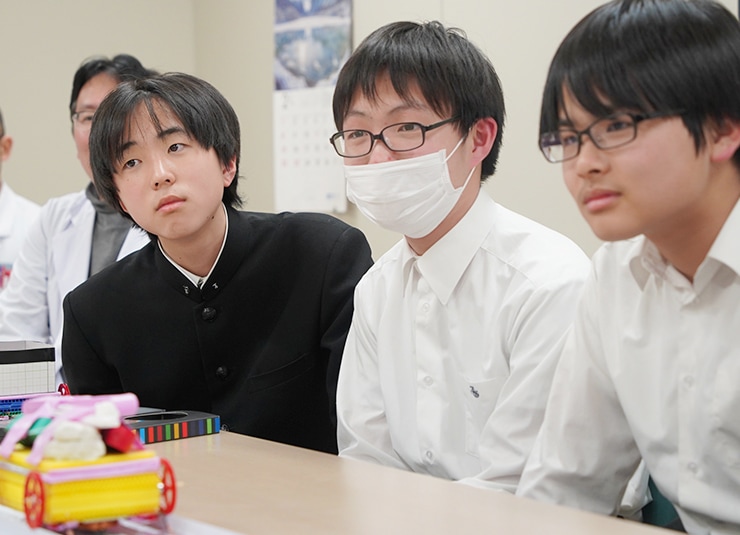
The team consisted of six second-year students selected through an in-school selection process. The selection involved written exams in mathematics, chemistry, biology, physics, earth science, and information science, and the best performer in each subject was chosen. One team member said, “The in-school selection was the most nerve-wracking part.”
Five members had been part of last year’s team, which placed second as the only all-first-year junior high team. The remaining member had the frustrating experience of watching the competition online as a reserve member. For that reason, they felt that winning the championship this year was their only option.

Victory in Hands-on Event 2 “Maglev Train, Go!”
In Hands-on Event 2, in which the winning school is awarded the SHIMADZU Award, a preparation period of about one and a half months is provided for a task announced in advance. On the day of the competition, teams must construct their pre-planned course and machine within 80 minutes before competing.

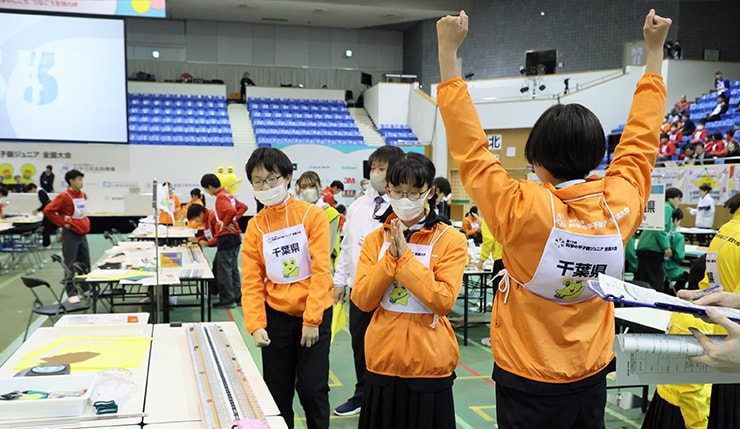
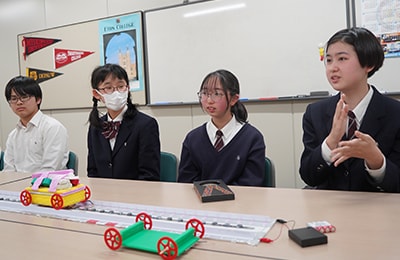
Ichikawa Junior High School in the upper left of the four-way split screen
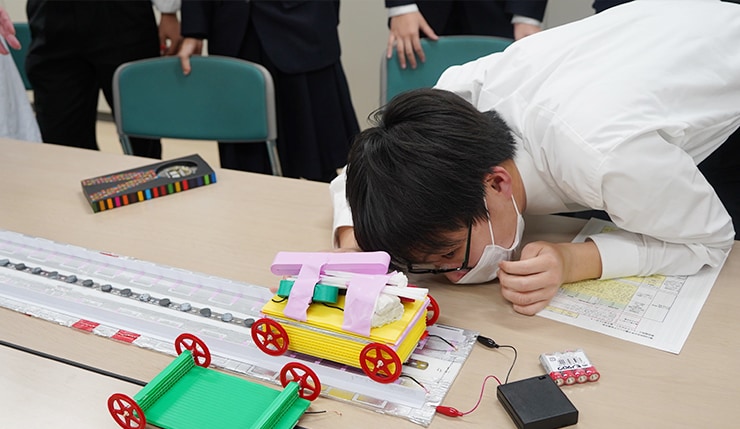
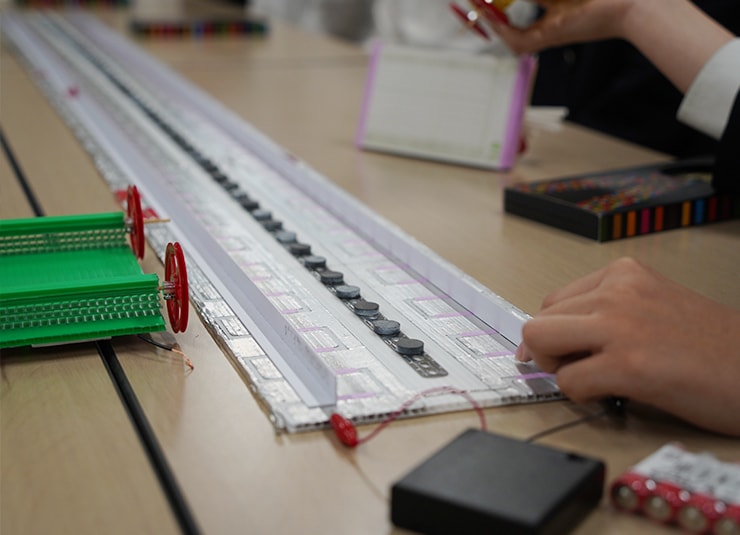
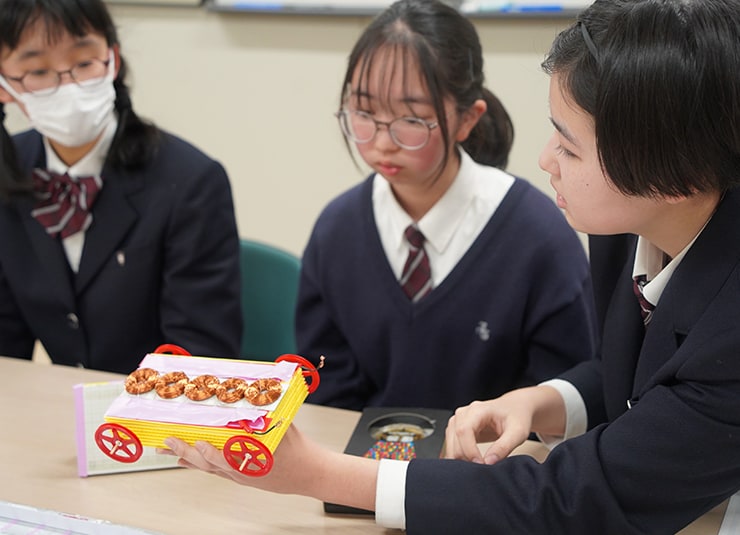
The Hands-on Event “Maglev Train, Go!” involved building a device based on the principle of a maglev train and competing to see how far it could travel while carrying the greatest weight. The scoring was based not only on distance traveled but also on the weight of the machine and the number of magnets used. This demanded a comprehensive understanding of electromagnetism, design ability, strategic thinking, manufacturing skills, and teamwork.
Ichikawa Junior High School achieved outstanding results in this competition. They won with a record running distance of 175 centimeters (the maximum), a machine weight of 702 grams, and 52 unused magnets out of 100.
The Team’s Strategy was “Win with a Heavy Car!”
“The first condition for achieving the highest score was to complete the run. Then, we could either increase the weight or reduce the number of magnets,” explained one of the team members.

Magnets attached to the rail
Therefore, the members considered how to distinguish themselves from other teams before starting their task and reverse-engineered the scoring method from the pre-released information. As a result, they confirmed that making the car heavier would lead to a higher score than slightly reducing the number of magnets. Based on that, they decided, “Let’s complete the course with a heavy car!”

Large magnets on the car
Once this strategy was determined, the car’s shape was narrowed down to a four-wheeled box structure, stable when carrying weight. In addition, they reasoned that since moving a heavy machine would require strong propulsion, it was important to use large magnets (coils with a high number of windings).
Yesterday it Worked, Today it Doesn’t!
“We were troubled by a problem where a machine we built and got working one day would stop working the next. We’d have no choice but to rebuild it, and it would work again—only to fail the very next day. Even though we hadn’t changed a single thing since the previous day…,” a team member recounted their confusion at the time.
To pinpoint the cause, the team conducted controlled experiments, changing one condition at a time. Finally, they discovered the cause. They found that friction heat and electrical reactions caused the copper wire to oxidize in just one day, preventing the machine from running.

Gaining Something Irreplaceable
We asked the students, who had prioritized preparing for the Koshien of Science competition above all else, about their motivation for participating and what they gained from the experience.
They said their motivation stemmed from a senior’s experience shared at a class assembly meeting. Reflecting on the competition, they shared their thoughts. Their replies reflected how they had each grown: “It became an important place to gather after school,” “I made friends I could spend holidays with,” “I gained the ability to approach problems with a focus on logical solutions,” “Learning about control experiments and managing variables gave me insights useful for high school science research (in the Super Science High School program),” and “I gained experience leading a team for the first time, learned how to take the initiative in planning the schedule, and developed management skills.”


Hearing the members speak reaffirmed how participating in the Junior Koshien of Science tournament enriches their school life and contributes to their growth. Although still junior high school students, they have begun to cultivate an interest in science, a mindset for thinking and tackling challenges, and management skills. We concluded the interview by asking about their future aspirations.
“We’re Going to Seriously Beat the High School Teams!”
As the Chiba Prefecture representative team, the Ichikawa Junior High School members participated as an exhibition team in the hands-on event of the Koshien of Science (the high school competition). This event was held in Ibaraki Prefecture from March 20 to March 23, 2026.
“At the Koshien of Science in Tsukuba, we’re going to seriously beat the high school teams!” the leader said about their determination for the competition. True to her word, they advanced to the final round and were on a par with the high school teams.

Comment from the Supervising Teacher, Ichikawa Junior High School
The students’ ability to move strategically stems not only from individual effort but also significantly from the team’s maturity in its second year. The initiative to pass on activities from seniors to juniors, which had taken root, also proved a strength.My guiding principle was to “simply be present alongside them” during their activities. This wasn’t just for safety; I wanted to be able to offer guidance at the precise moment they gained new insights.
Through this approach, the students gained experience. Even when they failed, they learned to calmly identify the issues. They developed the ability to respond as a team, leveraging both intuition and logical thinking, which led to the overall victory.
Under Shimadzu corporation’s corporate philosophy, “Contributing to Society through Science and Technology,” Shimadzu Corporation and Shimadzu Rika Corporation will continue to support the future leaders of science through this competition.
Page Title and URL Copied.