


23 mars 2026 | Actualités et annonces
L'aboutissement de 70 ans de développement GC, avec des détecteurs d'une sensibilité de classe mondiale
Lancement du chromatographe en phase gazeuse Nexis GC-2060
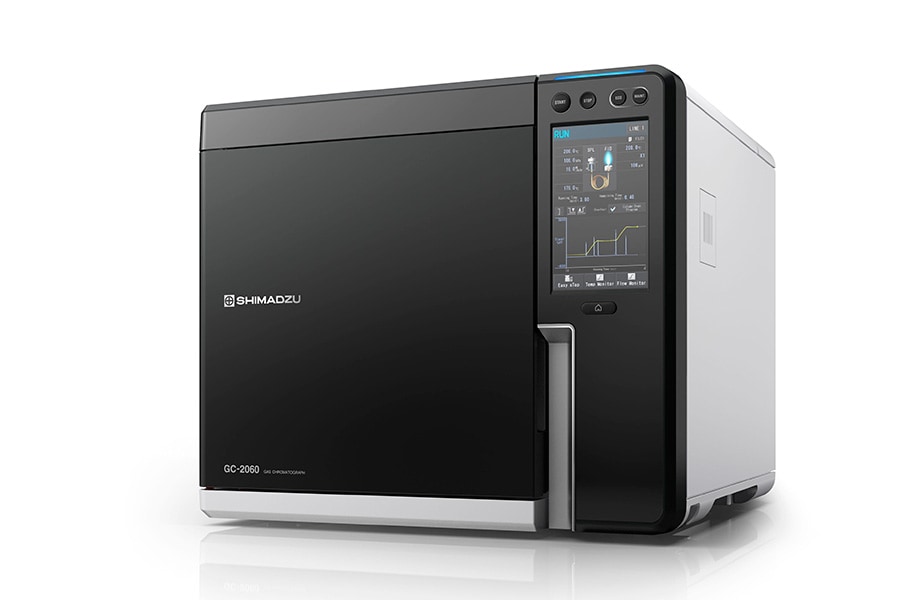
Chromatographe en phase gazeuse Nexis GC-2060
Shimadzu Corporation annonce le lancement du chromatographe en phase gazeuse Nexis GC-2060, modèle phare de sa gamme. Doté de détecteurs d'une sensibilité exceptionnelle, il offre des performances analytiques élevées, simplifie son utilisation et optimise l'efficacité des analyses grâce à des fonctions d'assistance intuitives et une maintenance réduite.
Les chromatographes en phase gazeuse (CPG) sont des instruments d'analyse largement utilisés en recherche et développement ainsi qu'en contrôle qualité dans des domaines tels que la chimie, la pharmacie, l'énergie, l'agroalimentaire et l'environnement. Ces dernières années, la demande en analyse de gaz a fortement augmenté, sous l'impulsion du développement de nouvelles technologies énergétiques et des initiatives de transition écologique visant à atteindre la neutralité carbone. Face à l'évolution constante des exigences analytiques, il existe une forte demande pour des instruments faciles à utiliser, qui permettent de réduire la complexité opérationnelle tout en offrant des performances optimales.
Le Nexis GC-2060 prend en charge les analyses de routine et ponctuelles grâce à une gamme de fonctions d'assistance au flux de travail adaptées aux besoins opérationnels : de l'automatisation des tâches analytiques à l'analyse à la demande, permettant d'analyser précisément ce qui est nécessaire, au moment opportun. La productivité est encore améliorée par un port d'injection d'échantillons et un four à colonne à chauffage et refroidissement rapides, des détecteurs à stabilisation rapide au démarrage et des fonctions de maintenance conçues pour une utilisation simplifiée, contribuant ainsi à maximiser la disponibilité et la productivité. Cette année marque le 70e anniversaire du développement par Shimadzu Corporation du premier chromatographe en phase gazeuse du Japon en 1956. Forts de cette longue tradition d'innovation, nous restons engagés à faire progresser la recherche et le développement ainsi que le contrôle qualité dans de nombreux domaines grâce à nos produits performants et faciles d'utilisation.
Caractéristiques
1. Analyse de traces à haute vitesse avec des détecteurs offrant une sensibilité de classe mondiale
La sensibilité du détecteur FID *1, utilisé pour l'analyse des composés organiques, a été améliorée d'environ 20 % par rapport aux modèles précédents (limite de détection minimale : 1,0 pgC/s). Le détecteur TCD *2, adapté aux gaz inorganiques, a quant à lui été amélioré de 25 % (limite de détection minimale : 300 pg/mL). Ces deux détecteurs offrent des performances de pointe et une stabilité exceptionnelle, permettant des analyses rapides même en cas de démarrages et d'arrêts fréquents. Il en résulte une efficacité énergétique accrue et une sécurité d'utilisation renforcée.
2. Amélioration de l'efficacité opérationnelle grâce à des opérations simples
L'utilisation de plusieurs ports d'injection d'échantillons est parfois nécessaire pour différents types d'analyses. Le nouveau port d'injection d'échantillons MMI *3 répond à ce besoin grâce à ses cinq modes d'injection distincts, offrant une grande polyvalence et permettant à un seul GC de s'adapter à un large éventail d'applications analytiques. Par exemple, le système prend en charge l'injection de volumes importants pour l'analyse des pesticides dans les applications alimentaires et environnementales, ainsi que l'injection fractionnée pour l'évaluation des biocarburants dans le secteur de l'énergie. Sa conception unique à faible inertie thermique réduit le temps de refroidissement lors de la maintenance de 40 à seulement 5 minutes. De plus, une simple pression sur le bouton de maintenance de l'unité principale du GC permet au système de contrôler automatiquement la température, le débit de gaz et d'autres paramètres, contribuant ainsi à minimiser les erreurs de procédure. L'instrument est également doté d'une fonction ECO Idling qui analyse les habitudes d'utilisation et recommande des cycles de fonctionnement optimaux en fonction de la charge de travail. Ceci permet de réduire les coûts d'exploitation liés à la consommation de gaz et d'électricité sans compromettre le confort d'utilisation.
3. Capacité d'expansion en constante évolution
Tout en conservant le même encombrement que les modèles précédents, le GC-2060 augmente le nombre d'unités de prétraitement, de ports d'injection d'échantillons et de détecteurs installables. Il permet ainsi des configurations système très flexibles, adaptées à divers besoins : fonctionnement en parallèle avec analyse double ligne sur une même configuration, couverture multi-applications avec un seul GC et analyse à haute vitesse. Outre le fonctionnement conventionnel, le détecteur FID prend en charge un mode sans bouteille utilisant uniquement de l'hydrogène et de l'oxygène produits à partir d'eau pure. Ce mode facilite l'adoption de la chromatographie en phase gazeuse en minimisant les investissements initiaux dans les équipements liés aux bouteilles et en réduisant la charge de travail de gestion, ce qui diminue les coûts d'exploitation.
- *1 Détecteur à ionisation de flamme
- *2 Détecteur de conductivité thermique
- *3 Port d'injection multimode
Pour plus de détails, consultez
Nexis GC-2060