


18 février 2026 | Actualités et avis
: Inspections de câbles électriques sous-marins avec mesure précise de la profondeur d'enfouissement
Signature d'un accord de développement avec l'Université d'Édimbourg pour un « algorithme de compensation du bruit magnétique »
Shimadzu Corporation a conclu un accord de développement avec l'Université d'Édimbourg, au Royaume-Uni, pour mettre au point un algorithme de compensation du bruit magnétique destiné à améliorer la sécurité et l'efficacité des inspections de câbles électriques sous-marins. Ce projet vise à développer une technologie de capteurs magnétiques de haute précision, indispensable à l'inspection des parcs éoliens offshore et des câbles sous-marins, grâce aux PINN (réseaux de neurones à information physique), une approche d'apprentissage automatique de pointe intégrant les lois de la physique.
Lors de la maintenance et de l'inspection des parcs éoliens offshore et des câbles de transport d'énergie sous-marins, des mesures de profondeur d'enfouissement sont effectuées à l'aide de capteurs magnétiques afin de vérifier que les câbles sont bien enfouis à la position et à la profondeur prescrites. Cependant, les mesures traditionnelles de câbles sous-marins par capteurs magnétiques présentent des difficultés, notamment les interférences magnétiques provenant des véhicules sous-marins, qui nuisent à la précision des mesures.
Ce programme, soutenu par Edinburgh Innovations, le service de commercialisation de l'Université d'Édimbourg, vise à intégrer la technologie de capteurs magnétiques haute sensibilité de Shimadzu à l'expertise de renommée mondiale de l'Université en intelligence artificielle, apprentissage automatique et robotique marine. L'objectif est de développer un algorithme capable de réduire considérablement le bruit magnétique généré par les véhicules sous-marins et leurs composants, permettant ainsi une mesure précise et efficace de la profondeur d'enfouissement et de la position des câbles sous-marins. Le projet envisage des applications non seulement dans le domaine de l'éolien offshore au Japon, mais aussi pour le déploiement de câbles de transport d'énergie sous-marins intercontinentaux sur des marchés mondiaux tels que l'Europe.
En plus de ce projet, Shimadzu propose diverses solutions aux entreprises et aux institutions de recherche opérant dans le domaine marin, telles que le dispositif de communication optique sans fil sous-marine « MC500 » et l’instrument de mesure UEP « CF100 ». Nous continuerons à développer nos activités marines mondiales et visons à réaliser la « transformation numérique (DX) du développement marin ».
- Remarque : Les véhicules sous-marins désignent les AUV (véhicules sous-marins autonomes) et les ROV (véhicules télécommandés).

L'Université d'Édimbourg
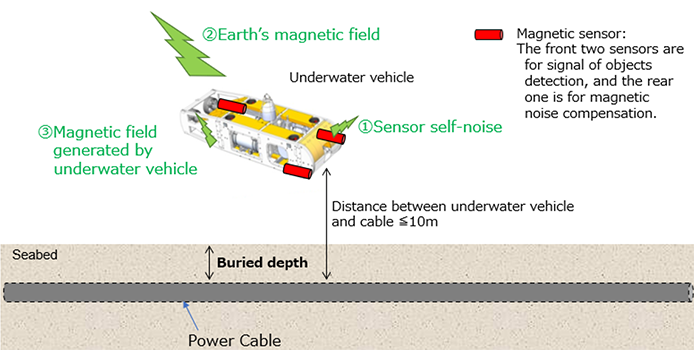
Image de la mesure de la profondeur d'enfouissement des câbles électriques sous-marins à l'aide de capteurs magnétiques
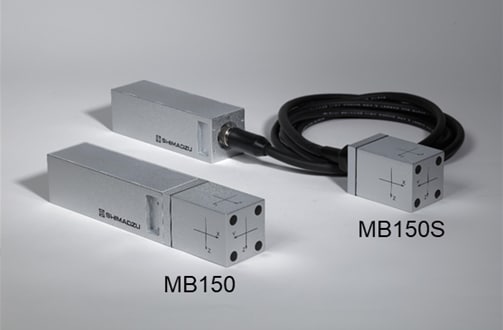
Capteurs magnétiques « MB150 » et « MB150S »