


12 mai 2026 | Actualités et annonces : Le BIPM, le RIKEN et Shimadzu lancent une collaboration pour explorer le rôle des étalons de fréquence optiques transportables
Le Bureau international des poids et mesures (BIPM), RIKEN et Shimadzu Corporation ont signé un protocole d'accord (MoU) en vue d'une collaboration exploratoire sur les étalons de fréquence optique (OFS). La signature a eu lieu le 12 mai 2026 à Kawasaki, au Japon.
Le protocole d’accord établit un cadre préliminaire pour permettre des discussions et des études conjointes sur le rôle potentiel des étalons de fréquence optiques transportables dans la métrologie internationale du temps et des fréquences.
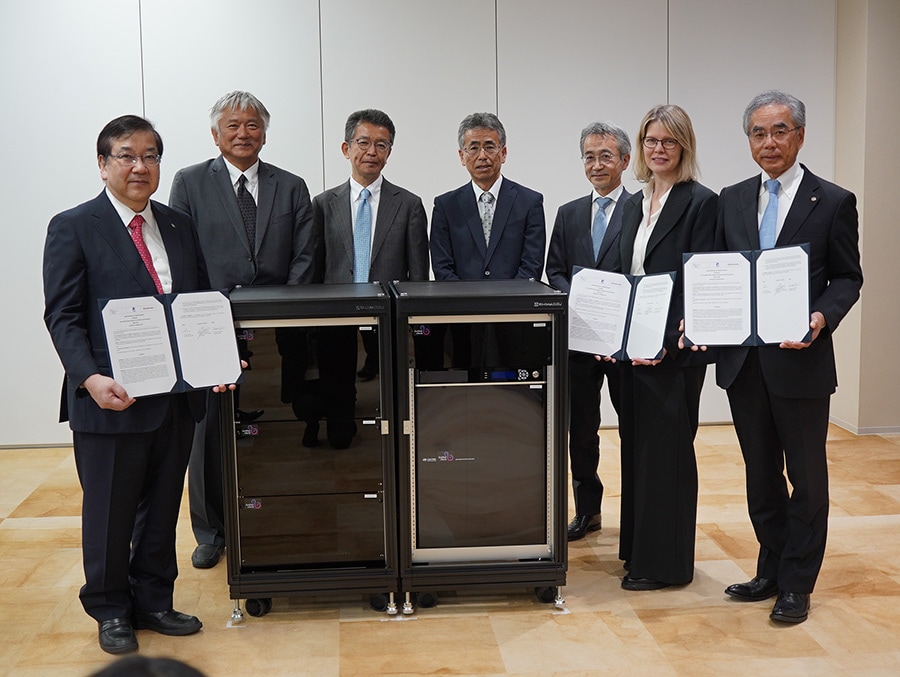
De gauche à droite : Dr Makoto Gonokami, président de RIKEN ; Dr Koichiro Tanaka, directeur du Centre RIKEN pour la photonique avancée (RAP) ; Prof. Hidetoshi Katori, École doctorale d’ingénierie, Université de Tokyo / Directeur de l’équipe de recherche en ingénierie spatio-temporelle, RIKEN ; Dr Takashi Usuda, directeur général de l’Institut national des sciences et technologies industrielles avancées (AIST), directeur de l’Institut national de métrologie du Japon (NMIJ), secrétaire du CIPM ; Takahiro Nishimoto, directeur général et directeur technique Shimadzu Corporation ; Dr Annette Koo, directrice du Bureau international des poids et mesures (BIPM) ; Yasunori Yamamoto, président-directeur général de Shimadzu Corporation
Contexte
Les travaux en vue d'une éventuelle redéfinition future de la seconde nécessitent des comparaisons fiables entre les étalons de fréquence optique (OFS). Une exigence clé identifiée par le Comité consultatif du temps et de la fréquence (CCTF) est la capacité de comparer des réalisations indépendantes de la seconde à la précision de 10⁻¹⁸ et d'obtenir une contribution cohérente au Temps universel coordonné (UTC).
Les systèmes de stockage d'huile transportables constituent une des pistes envisagées pour faciliter ces comparaisons. L'évaluation de leur faisabilité et la réalisation d'études techniques relatives aux exigences opérationnelles et environnementales représentent une étape importante dans la feuille de route plus large visant à redéfinir le second.
Lisez l'article de Metrologia intitulé « Feuille de route pour la redéfinition de la seconde ».
Cette collaboration devrait impliquer l'Institut national de métrologie du Japon (NMIJ), ainsi que le BIPM, le RIKEN et Shimadzu Corporation, et rester ouverte, dans des conditions égales, à d'autres instituts nationaux de métrologie et organisations partenaires ayant un intérêt raisonnable.
Arrière-plan
Les étalons de fréquence optique, notamment les horloges à réseau optique et les horloges optiques à ion unique, reposent sur les transitions optiques des atomes ou des ions et offrent une stabilité et une précision supérieures aux étalons micro-ondes actuels utilisés pour la mesure de la seconde. Garantir leur comparabilité internationale est une condition essentielle à toute évolution future de la définition de l'unité SI de temps.