


July 14, 2026 | News & Notices
Industry-Leading Detection Performance and Flexibility for Diverse Analytical Needs
Shimadzu Releases the GCMS-TQ RX Series Gas Chromatograph-Mass Spectrometer
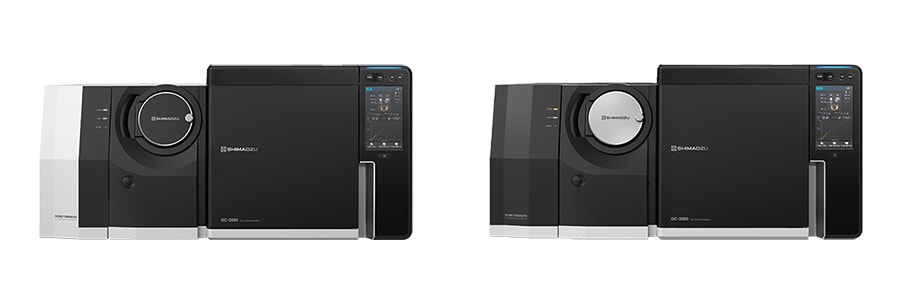
GCMS-TQ8040 RX (Left) and GCMS-TQ8050 RX (Right) Gas Chromatograph-Mass Spectrometers
On July 8, Shimadzu Corporation announced the release of the GCMS-TQ8040 RX and GCMS-TQ8050 RX gas chromatograph-mass spectrometers. The two models in the GCMS-TQ RX Series are triple quadrupole (TQ) gas chromatograph-mass spectrometers that combine industry-leading analytical performance with flexibility to meet diverse laboratory needs. The systems support simultaneous multi-component analysis, as well as highly accurate quantitative and qualitative analysis, in applications ranging from pesticide residue testing to the analysis of hazardous substances such as PFAS and dioxins. By expanding analytical capabilities and improving laboratory productivity, the GCMS-TQ RX Series helps laboratories meet increasingly demanding analytical challenges.
Gas chromatograph-mass spectrometers (GC-MS) separate volatile compounds in samples and identify and quantify them by measuring the mass of ionized components. GC-MS systems are widely used in environmental monitoring, including testing of air, water, and soil; food safety analysis; and quality control of chemical products and materials. In recent years, stricter regulations, rising quality standards, and labor shortages have increased demand for rapid, highly accurate multi-component analysis, as well as greater automation and efficiency in laboratory operations.
The GCMS-TQ RX Series is designed to integrate seamlessly with the Nexis GC-2060 gas chromatograph, released on March 17, to manage the entire analytical workflow from sample introduction and separation to detection and data analysis. Equipped with a Multi-Mode Inlet (MMI) and Shimadzu's proprietary ion source technology, the systems provide the flexibility needed for a broad range of applications, including pesticide residue analysis in food, analysis of environmental contaminants such as dioxins and PFAS, and pharmaceutical raw material analysis. The series also delivers industry-leading sensitivity capable of detecting trace-level compounds at the femtogram level*, with up to a 25% improvement in sensitivity compared to previous models.In addition, AI-powered data analysis supports functions that improve analytical quality while reducing operator workload, accelerating the digital transformation of analytical laboratories.
- * One quadrillionth (10⁻¹⁵) of a gram.
Features
1. Flexibility to Support Multiple Analytical Needs
The optional Multi-Mode Injection Unit (MMI) supports a variety of sample introduction techniques, enabling flexible analysis in compliance with international analytical standards and industry guidelines. The MMI supports thermal desorption analysis, which typically requires dedicated instrumentation, while also enables flexible method optimization for applications such as pesticide residue analysis in food, aroma analysis, and environmental testing. Shimadzu’s proprietary thermal insulation technology combines excellent temperature stability with rapid heating performance, ensuring the reliable analysis of thermally labile compounds and trace-level components. Furthermore, rapid cooling capabilities reduce maintenance downtime from 40 minutes to just 5 minutes, significantly improving analytical efficiency. The systems also offer single quadrupole GC-MS functionality, enabling users to perform everything from compound identification to quantitative evaluation on a single platform.
2. High Sensitivity and Excellent Long-Term Stability
The GCMS-TQ8050 RX features newly developed detector that integrates advanced noise reduction technology with high amplification performance. This combination enables highly sensitive detection of trace-level compounds while maintaining exceptional accuracy in simultaneous multi-component analyses. The system also incorporates a highly stable ion source and filaments with more than five times the service life of conventional models, ensuring stable analytical performance over extended periods of operation.
3. Workflow Automation and Improved Efficiency
The GCMS-TQ RX Series includes Peakintelligence for GCMS, an AI-powered peak processing function, and Smart MRM+, an automated method development tool. By learning from the analysis results of experienced operators, AI assists with peak processing and can reduce data analysis time to approximately one-quarter of that required by conventional methods. The systems also streamline the creation and modification of analytical methods, boosting productivity across the laboratory.
For more details, visit
GCMS-TQ RX Series