


Getting the true measure of a powerful metabolite
A new method promises to settle old debates and guide the future of nicotinamide mononucleotide (NMN) research.
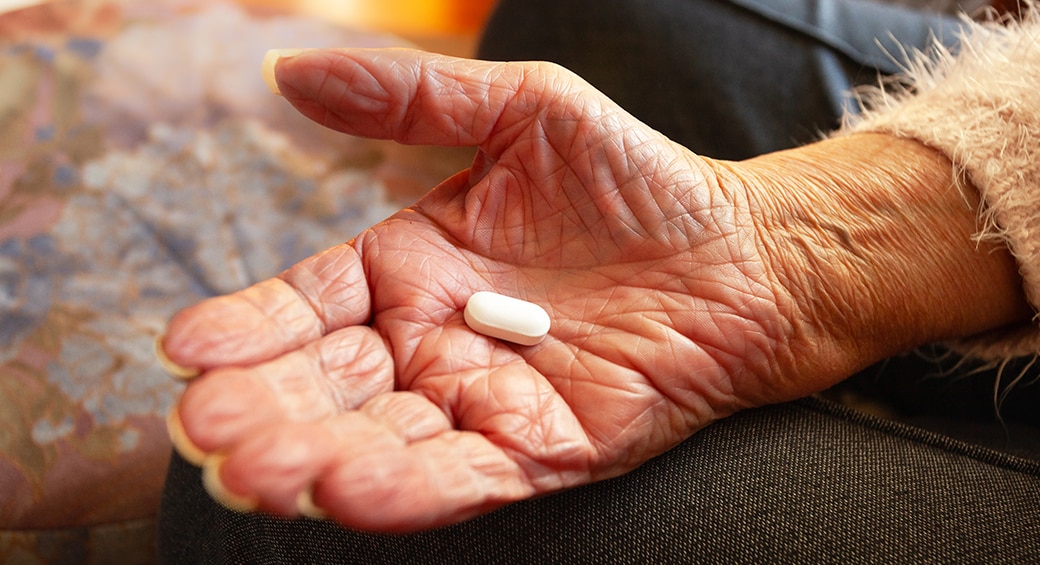 Being able to correctly measure the amount of NMN in blood or plasma is essential for researchers to be able to actively study it.
Insulin, critical for energy regulation, declines naturally with age. In 2008, scientists at the Washington University School of Medicine in St. Louis, the United States, discovered that supplementing aged mice with nicotinamide mononucleotide (NMN), a naturally occurring metabolite, improved glucose tolerance by increasing insulin secretion.1 This finding hinted at NMN’s potential to treat age-related metabolic disorders.
Since then, NMN has been a focus of ageing research, with labs worldwide exploring its health benefits. Meanwhile, the global market has seen a surge in NMN-based ‘anti-ageing’ supplements, which were approved by some jurisdictions around the world, including the EU and the United Kingdom.
“However, many of these supplements were bogus, often containing far less NMN than claimed,” says Shin-ichiro Imai, the lead author of the 2008 study and a professor of developmental biology and medicine at Washington University. For a number of reasons, the US Food and Drug Administration (FDA) removed approval for the marketing of NMN as a dietary supplement in the US in 2022.
NMN’s role in ageing
Despite the issues surrounding NMN commercialization, extensive research underscores its potential benefits. The key is that NMN serves as a precursor to nicotinamide adenine dinucleotide (NAD+), a molecule essential for cellular energy production and repair.
“There is now a consensus among researchers that systemic decline in NAD+ levels in multiple tissues over time and the associated increase in chronic inflammation, is a really important driving force for ageing,” Imai explains.
“It’s a very simple concept,” he says. “To counteract age-associated changes in body function driven by the decrease in NAD+ levels, you must boost NAD+ levels. One of the most promising ways to do that is NMN supplementation.”

Multiple studies confirm NMN’s ability to combat ageing, promote vitality and extend healthspan in mice.
Since 2008, hundreds of studies across the world have highlighted NMN’s positive impacts on age-related conditions in rodents, including Alzheimer’s disease and heart failure. While there are fewer human studies, ongoing research is poised to expand our understanding of NMN’s potential in addressing age-related decline. Imai estimates that there have been 10 or so papers published so far on the impact of NMN on humans, and a number of other studies are underway2.
However, for NMN research to be useful for the ageing human population, scientists must be sure they can accurately quantify the metabolite.
Measuring NMN
To advance NMN research and understand its health potential, accurately measuring NMN in biological samples, such as blood or plasma, is imperative. Historically, however, this has been a challenging task.
Researchers have long struggled to quantify NMN levels due to technical limitations. “Traditional methods, like using methanol for sample preparation, often resulted in the degradation of NMN, yielding inconsistent results.” says Masayuki Nishimura, director of New Strategy Department at Shimadzu Scientific Instruments, who is based in Maryland, USA.
Furthermore, techniques such as high-performance liquid chromatography (HPLC) with UV detection lacked the sensitivity and selectivity needed. Nishimura notes that higher sensitivity and selectivity were desirable for precise measurements of NMN.
In collaboration with Shimadzu Corporation, headquartered in Kyoto, Japan, and its US subsidiary, Imai’s team developed a revolutionary technique: double isotope-mediated liquid chromatography-tandem mass spectrometry (dimeLC-MS/MS). This method overcomes previous challenges, enabling highly accurate measurement of NMN and related metabolites.
Key advances include the use of perchloric acid, which preserves NMN during sample preparation, replacing methanol. After preparation, researchers employ liquid chromatography-triple quadrupole mass spectrometry (LC-MS/MS). Here the target compounds are passed through three different quadrupoles — four parallel metal rods which act like sieves and filter ions based on their molecular weight and charge. The spectral properties of the material that remains after filtering is then measured by mass spectrometry.
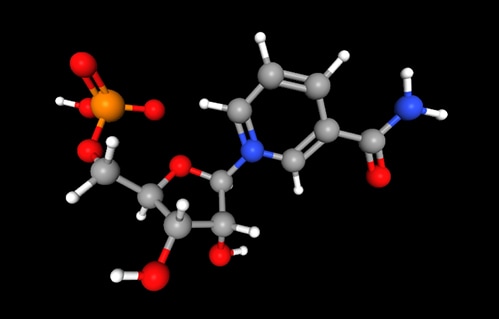
The molecular structure of the naturally occurring NMN metabolite. PubChem Identifier: CID 14180
https://pubchem.ncbi.nlm.nih.gov/compound/14180#section=3D-Conformer
LC-MS/MS leverages synthesized stable non-radioactive isotopes of NMN as an internal standard. With this process, a synthesized stable version of the target compound is added to the sample. The synthesized version has a different molecular weight to its natural non-labelled counterpart, but it behaves in the same way.
“The critical innovation is using two different stable isotopes of NMN,” says Junya Unno, a scientist at Shimadzu Corporation’s Technology Research Laboratory3. It took researchers at Alsachim, a Shimadzu group company in France, several months to create the two stable isotopic versions of NMN. One isotope monitors the accuracy of the extraction process, while the other quantifies NMN concentration. By adding these isotopes at different stages — before the sample preparation and then before the LC-MS/MS process — researchers can track the fate of NMN during the entire process of sample handling and accurately determine its original concentration in the sample.
Next steps
The new dimeLC-MS/MS method promises to resolve longstanding debates, such as the pharmacokinetics of NMN. For instance, Imai’s team states that NMN enters the bloodstream and is absorbed quickly4. Other groups argue that NMN converts to a dephosphorylated form called nicotinamide riboside (NR) before entering the bloodstream. Accurate measurement will now allow researchers to settle such discrepancies.
“We are confident that dimeLC-MS/MS will help design better and more precise treatments for ageing,” says Unno.
This collaboration between Shimadzu Corporation and Imai’s lab exemplifies Shimadzu’s commitment to advancing ageing and longevity research. With tools such as dimeLC-MS/MS, scientists are one step closer to unlocking the secrets of healthy ageing and extending healthspan.
Learn more about liquid chromatography-tandem mass spectrometry (LC-MS/MS) at Shimadzu.
References
- Ramsey, K. M. et al., Aging Cell 7, 78 (2008).
- Yoshino, M. et al., Science 372, 1224 (2021).
- Unno, J. et. al. npj Aging 10, 2 (2024).
- Grozio, A. et al., Nat. Metab. 1, 47 (2019).
 Copied


