



Shimadzu Wins the Social Value Award at Nikkei SDGs Management Awards for the First Time
Educational Support Activities by the Shimadzu Group
Shimadzu Corporation received the Social Value Award for the first time at the 7th Nikkei SDGs Management Awards, announced in November 2025. This article introduces the Shimadzu Group’s social contribution initiatives, focusing in particular on environmental and science education programs for children.
- Shimadzu Receives the Social Value Award at the Nikkei SDGs Management Awards for the First Time
- Japan: Environmental Education Support Program Eco-Club
- Japan: Science Education Support Program “Shimadzu Hands-On Analysis School”
- United States: Special Science Classes at a Local Japanese Language School
Shimadzu Receives the Social Value Award at the Nikkei SDGs Management Awards for the First Time
The Nikkei SDGs Management Awards is an award program organized by Nikkei Inc. that recognizes leading companies that successfully balance contributions to the United Nations’ Sustainable Development Goals (SDGs) with enhanced corporate value. Based on the results of the Nikkei Comprehensive Sustainability Survey, a panel of experts comprehensively evaluates the initiatives of 830 Japanese companies that responded to the survey.
The Social Value Award, which Shimadzu Corporation received this time, is presented to companies demonstrating outstanding initiatives in the areas of respect for human rights, social contribution activities, working hours and leave practices, diversity, and human capital management. In 2024, Shimadzu received the SDGs Strategy/Economic Value Award, which evaluates corporate messaging by top management, contributions through business activities, and performance indicators. This marks the first time Shimadzu has received the Social Value Award.
Japan: Environmental Education Support Program Eco-Club
In 1999, the environmental activity team Eco-Club was established to promote environmental awareness within Shimadzu. Since 2001, it has been conducting environmental outreach lectures focused on environmental issues, primarily targeting elementary schools in Kyoto Prefecture. By 2025, classes had been delivered to a total of 173 schools and 12,125 children.
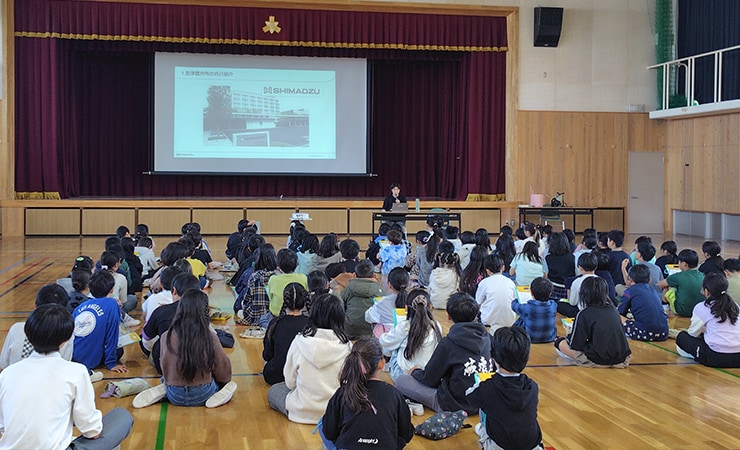
The program offers two types of classes: “Waste and Recycling,” which explores environmental pollution caused by waste and its impact on living organisms, and “Biodiversity,” which examines the relationship between species extinction and our daily lives. Classes are tailored to meet each school’s needs. Both classes are designed to encourage children to think about “what they can do starting today.” In post-class feedback, children have commented, “I want to take better care of things and reduce waste,” and “I want to tell my family what I learned today when I get home.”
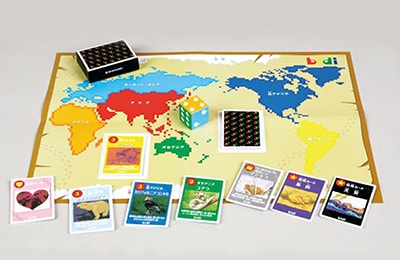
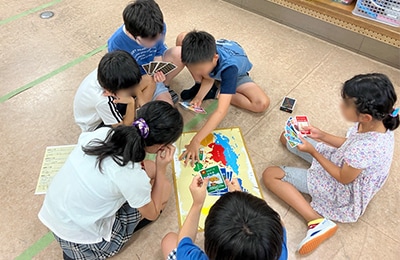
After the lecture on Biodiversity, students learn more about the subject by playing Shimadzu original card game “bidi” (created in collaboration with students from Doshisha University and Kyoto Seika University) with their classmates. The children are always very enthusiastic
Japan: Science Education Support Program “Shimadzu Hands-On Analysis School”
In the field of science education, driven by the desire to spark children’s interest in science, Shimadzu Corporation run the Shimadzu Hands-On Analysis School, a science program for children.
The program offers courses tailored to different levels, from elementary school to high school and is held both in response to requests from schools and at science events across Japan. Since its launch in 2007, total participation has grown to exceed 10,000 students. Students have commented that the program broadened their perspective and that they learned how studying science at school is useful in society. Within the Shimadzu Group, some employees chose science-related career paths because they were inspired by their experience in the program during their elementary school years.
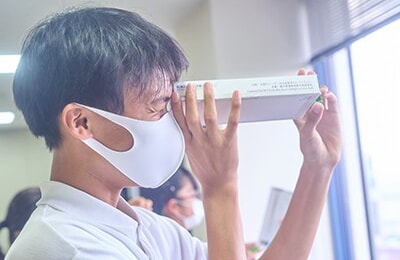
Spectroscopy Course: After learning about light and color using a handmade paper spectroscope, students analyze differences in the color of liquids such as tea and shaved-ice syrup using a spectrophotometer
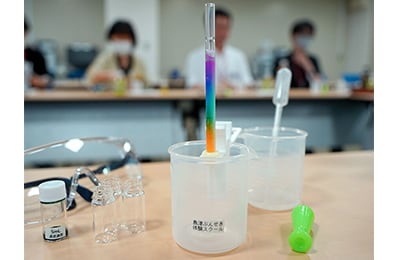
Chromatography Course: Students experience separating and isolating pigments (chromatography) using water-based pens, as well as measuring caffeine content in commercial beverages using a high-performance liquid chromatograph
United States: Special Science Classes at a Local Japanese Language School
In 2025, an employee at Shimadzu Scientific Instruments, Inc. (SSI; Maryland), which handles Shimadzu’s analytical instruments business in the United States, was an instructor for special science classes for junior high school students at the Washington Japanese Language School.
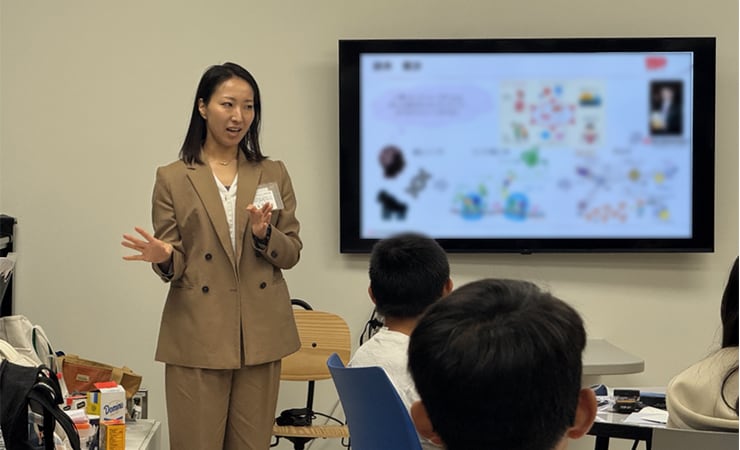
An expatriate from Japan at SSI who introduces Shimadzu’s technologies
The Washington Japanese Language School was established to help children attending local schools maintain and improve their Japanese language skills and to learn Japanese customs and culture. All classes are conducted in Japanese, and enrollment is open to children of Japanese school-age equivalence regardless of race or nationality. This special class was organized by the Maryland Chamber of Commerce, whose members include Shimadzu Corporation expatriate employees stationed at SSI, as part of their community outreach activities.
On this day, the first period for junior high school students was led by a teacher from the Washington Japanese Language School under the theme “Learning about different substances and their properties.” Students worked in groups to discuss and devise experimental methods to identify five visually similar white powders (starch, sugar, sodium bicarbonate, salt, and alum). They then estimated the substances based on their experimental results. In the second period led by SSI, students learned how analytical instruments and technologies developed by Shimadzu are used and contribute to society.
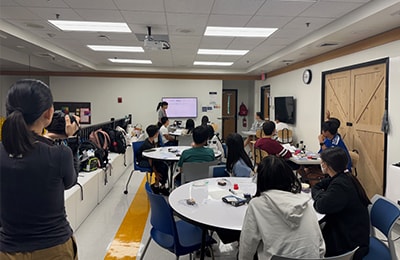
Students listen attentively during the class
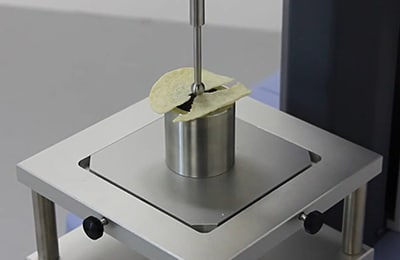
Products such as universal testing machines were introduced as examples of Shimadzu’s technologies. The photo shows a demonstration of measuring the hardness of snack foods
Comment from the SSI Instructor
Science is a subject that teaches us how to understand the phenomena around us. I prepared for the lesson hoping it would be an opportunity for the children to focus on questions close to their daily lives and spark their interest and curiosity in science. On that day, it was impressive to see students listening intently and working diligently on the experiments. Not only students but also parents asked many thoughtful and imaginative questions, which served as valuable inspiration for us as well. Through this, we were reminded of our mission to nurture ideas sparked by curiosity and questioning, and to contribute, through science and technology, to building a brighter future for people and the planet. We will continue to actively make use of opportunities like this to contribute to society through science and technology now and in the future.
 Page Title and URL Copied.