



Shimadzu’s Optical Lattice Clock Wins Awards for Excellence in Nikkei Excellent Products and Services Awards
Shimadzu Corporation’s Aetherclock OC020 strontium optical lattice clock which we have now commercialized, received the Awards for Excellence (Production Goods Category) in the 2025 Nikkei Excellent Products and Services Awards.
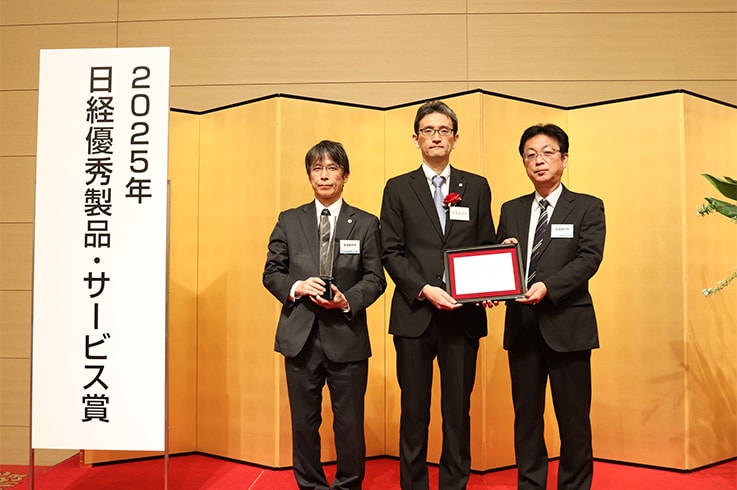
From left: Koji Tojo, General Manager of Advanced Analysis Unit, Technology Research Laboratory; Toshiyuki Kawano, General Manager of Technology Research Laboratory; and Naoki Nishimura, General Manager of Geoscience Department, Industrial Machinery Division at the award ceremony held in Tokyo in February 2026
An Award Program by Nikkei Inc. Recognizing Outstanding New Products and Services
The Nikkei Excellent Products and Services Awards recognize outstanding new products and services, with candidates selected exclusively by Nikkei Inc. and award-winning products and services finalized by the Awards Review Committee. Awards are decided based on an overall assessment of technology development, cost-effectiveness, contribution to business performance, growth potential, originality, and impact on industry and society. Shimadzu also received the Awards for Excellence for the AXIMA-QIT mass spectrometer in 2002 and the Nikkei Business Daily Awards for the AutoAmp genetic analyzer in 2021.
Hiroshi Komiyama, Chairman of the Institute, Mitsubishi Research Institute and Chair of the 2025 Nikkei Excellent Products and Services Awards Review Committee, explained the reason for the award: “If optical lattice clocks are put into practical use, it will be possible to measure elevations with an uncertainty of just 1 centimeter. This opens up a wide range of applications, including the detection of ground uplift caused by magma activity.”
Maintaining “One Second in Ten Billion Years” Accuracy while Achieving Miniaturization, Leading to the World’s First Commercial Model
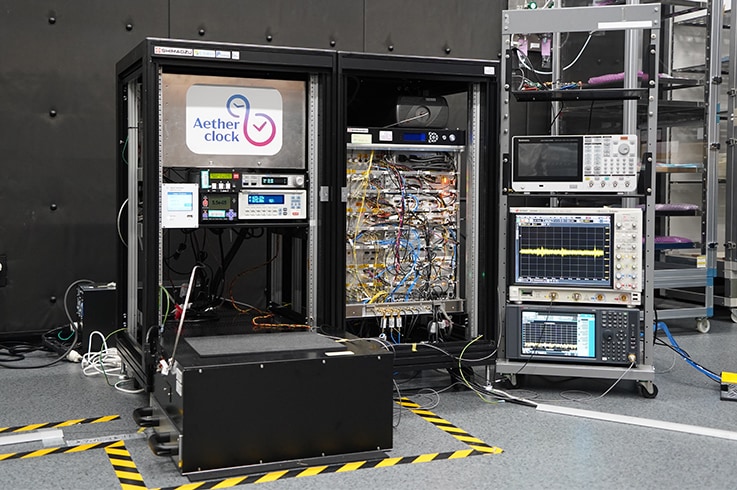
The Aetherclock OC020 achieves 18-digit precision—more than 100 times the accuracy of the cesium atomic clock that currently defines the second—equivalent to an error of just one second in ten billion years. This technology was developed by Professor Hidetoshi Katori of the University of Tokyo and is considered Nobel Prize-worthy. Shimadzu began joint research in 2017 to commercialize this technology.
When Professor Katori’s group first completed the optical lattice clock, a single unit was large enough to occupy an entire laboratory. Miniaturization was therefore essential for practical use. As an initial step toward verifying the general theory of relativity* by installing optical lattice clocks at Tokyo Skytree tower and at ground level, the system was reduced in 2020 to approximately one-twentieth of its original size, or 920 liters in volume. Subsequently, the design of the optical lattice clock was fundamentally reconsidered. By adopting a modular development approach to accelerate development speed and consolidating more than 100 control-system circuit boards into one-fifth of their original number, the team succeeded in reducing the size to approximately one-quarter of the original—250 liters—by 2024. In March 2025, the product was finally launched as the world’s first commercial optical lattice clock.
An initial unit has now been ordered from the National Institute of Information and Communications Technology (NICT).
*The theory proposed by Albert Einstein. General relativity introduced the concept of gravitational time dilation—the phenomenon where time passes more quickly at higher altitudes, further from the center of the Earth. Previously considered mainly at cosmic scales, this time difference was successfully measured using optical lattice clocks between Tokyo Skytree tower and ground level—an ordinary height difference. The demonstration experiment was conducted by a group comprising the University of Tokyo, RIKEN, the Geospatial Information Authority of Japan, Osaka Institute of Technology, and Shimadzu Corporation.
Koji Tojo, General Manager of the Advanced Analysis Unit at Shimadzu’s Technology Research Laboratory, who led the commercialization of the product, expressed his enthusiasm and determination for the future:
We were able to advance our research and development thanks to the support of the Japan Science and Technology Agency (JST). We are very pleased that this award recognizes the efforts of our entire team and all those who have supported us. We were deeply honored to receive congratulatory messages from Professor Katori and Yoshihiro Oishi, Program Officer at JST, on receiving this award, and are keenly aware of the responsibility it brings with it. Going forward, we intend to further enhance precision, pursue additional miniaturization, and improve reliability so that the technology can be adopted by a wide range of customers.
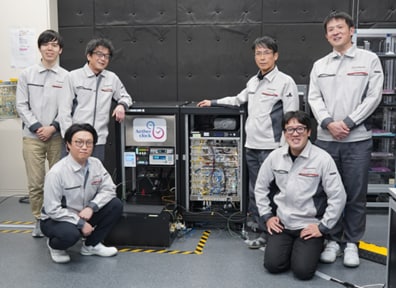
The Aetherclock OC020 optical lattice clock and members of the development team. Back row, from left: Kazuki Nigo, Tetsuo Furumiya, Koji Tojo, Bunta Matsuhana. Front row from left: Yuya Sakai, Takashi Muramatsu (both from Technology Research Laboratory, Shimadzu Corporation)
 Page Title and URL Copied.