



Transforming Physics Questions from University Entrance Exams into Experiment Kits
A New Project Reimagining High-School Physics Classes
University entrance physics questions often assume an abstract “idealized world”—for example, a frictionless floor or negligible air resistance—that exists only as a thought experiment. Anyone who has studied physics has probably struggled with such assumptions at least once.
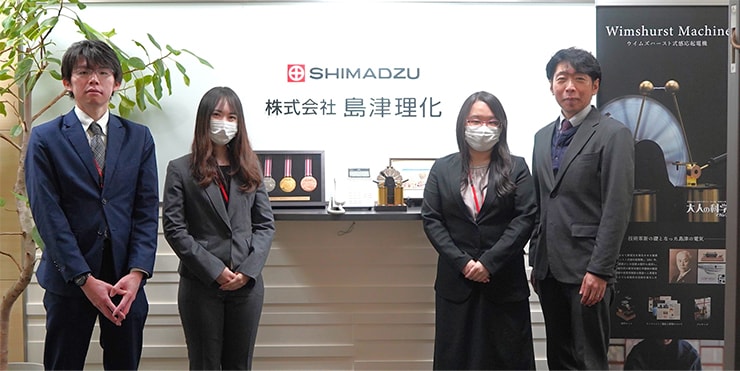
Project members of the Physics Exam Lab: Physics Exam Lab Series™. From left: Ueno, Iwata, Kawasaki, and Matsumoto of Shimadzu Rika Corporation
Shimadzu Rika Corporation, which handles the Shimadzu Group’s physics and chemistry education business, has launched an initiative in collaboration with the International Physics Olympiad 2023 Commemorative Association to transform physics questions from past university entrance exams into experiment kits. We talked to members of Shimadzu Rika about the Physics Exam Lab: Physics Exam Lab Series™, a project designed to deliver the joy of physics to students.
Bringing Thought Experiments to Life in the Classroom
“Answering entrance exam questions and performing experiments have become two entirely separate things in the classroom.” We often hear this concern from high-school teachers. At the same time, the Common Test for University Admissions and entrance exams for top universities increasingly include questions based on experiments or observations,” says Takashi Matsumoto, Manager at Shimadzu Rika Corporation’s Science Lab. Equipment Section and leader of the project.
Matsumoto’s team was responsible for producing 450 experiment kits for the 2023 International Physics Olympiad. To achieve this, they overcame various challenges—including budget constraints, ensuring consistent quality through mass production, and maintaining the confidentiality of the exam questions—and successfully delivered the kits. Overseas participants reportedly praised the kits, noting that they were of exceptionally high quality.
This led to an invitation to join the Physics Exam Lab, a new project launched primarily by teachers who organized the 2023 International Physics Olympiad in Japan. That invitation marked the start of developing the Physics Exam Lab Series, which transforms entrance exam questions into experiment kits.

The team is currently developing experiment kits based on the following three entrance exam questions.
- “Magnet Train Passing Through the Coil” (The 2022 Common Test, Physics Question 3)
- “Terminal Velocity of an Aluminum Cup” (The 2023 Common Test, Physics Question 2)
- “Trolley Pendulum Attachment” (The University of Tokyo 2018 First-Round Entrance Exam, Physics Question 1)
1. Magnet Train Passing Through the Coil: Moving Magnets Generate Electricity
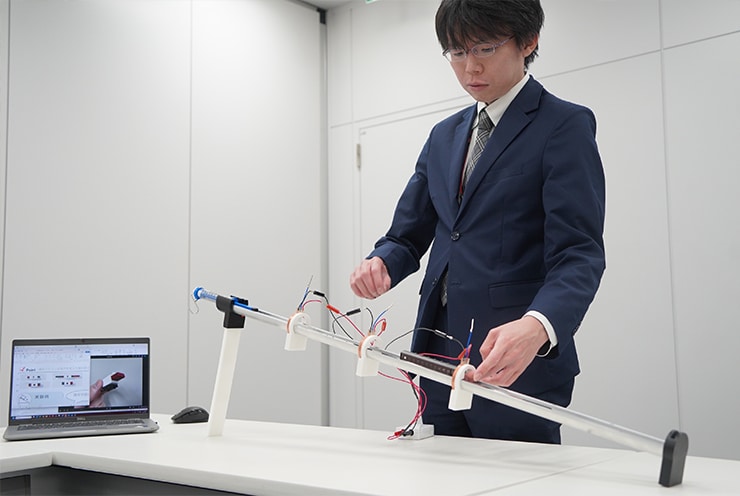
Ueno, the team leader for the development
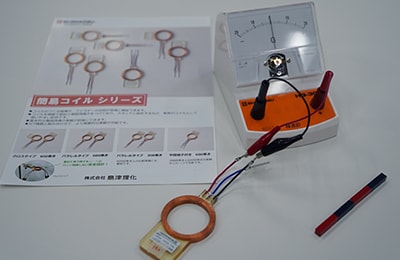
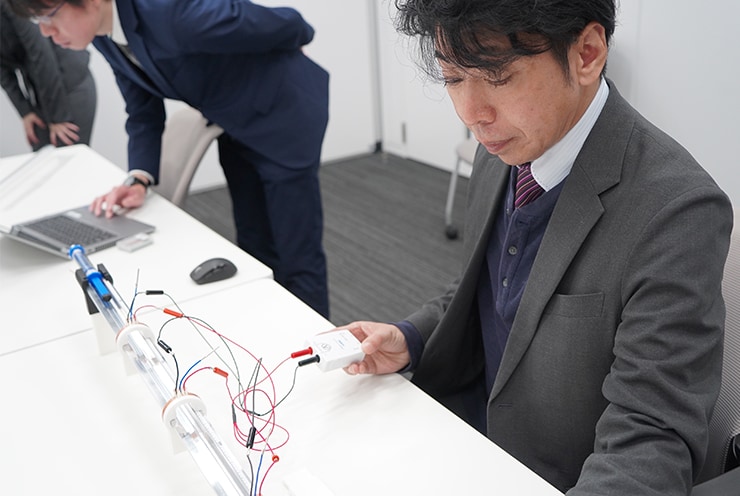
Ueno, the team leader in charge of development, said, “We developed a kit in which a magnet—representing a train—passes through a conductive pipe, allowing students to observe both changes in motion and electromagnetic induction. Electromagnetic induction, where a voltage is generated when a magnet passes through a coil, increases with the speed at which the magnet moves through the coil. Changing the magnet’s orientation reverses the polarity of the voltage. Students can also observe how the voltage changes as the number of turns in the coil varies.”
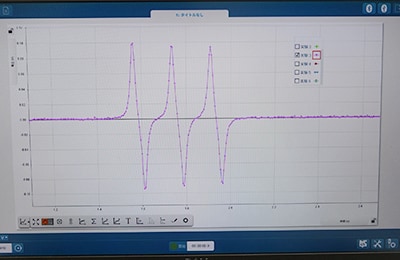
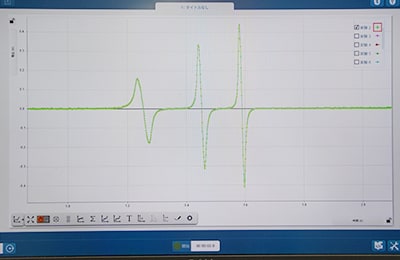
Photos of PC screens showing voltage changes due to electromagnetic induction
They adopted Shimadzu Rika Corporation’s proprietary coil for use in the experiment. These coils recently marked their 10th anniversary on the market. A key feature is that the winding remains stable, ensuring reliable data acquisition. Furthermore, a single coil allows switching between 600 and 300 turns for experiments, allowing students to compare waveform changes under different conditions.
Assembly video for the Magnet Train Passing Through the Coil experiment (from the Physics Exam Lab YouTube channel), in Japanese
2. Video Analysis Grid Screen for Terminal Velocity of an Aluminum Cup
Kawasaki, who developed the Video Analysis Grid Screen, said, “This kit is based on Question 2 of the 2023 Common Test in Physics. This question focuses on the terminal velocity—the point where the acceleration of the falling aluminum cup becomes zero. When actually conducting experiments, we record videos and analyze them using an app, but I developed a screen to assist with this process. The grid lines printed on the screen facilitate analysis and make it easier to observe changes in the distance fallen in the video. The material used is non-curl tarpaulin, chosen because it does not crease easily. In addition, a free analysis app that can be used in a browser will be developed by a Physics Exam Lab teacher.”
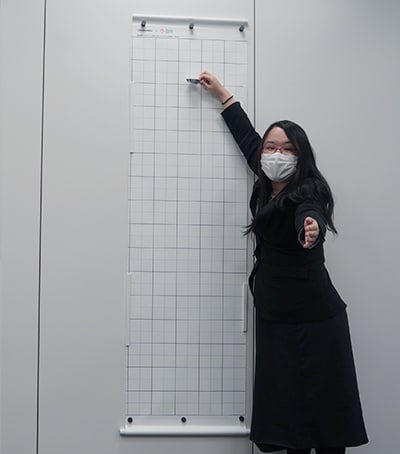
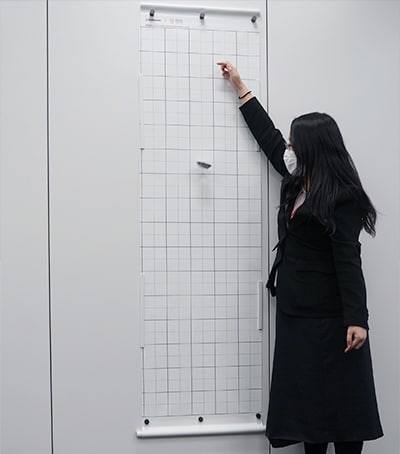
Kawasaki explains how to use the screen she developed
Instructional video for the aluminum cup falling motion experiment kit (from the Physics Exam Lab YouTube channel), in Japanese
3. Trolley Pendulum Attachment Oscillating on a Frictionless Floor
Iwata, who designed the Trolley Pendulum Attachment, said, “This kit corresponds to Question 1, physics, from the 2018 first-round entrance exam at the University of Tokyo. This question explores the overall motion of a pendulum suspended from a pillar on a cart placed on a horizontal floor, assuming there is no friction between the floor and the cart. By mounting the unit on our Smart Cart platform, we approximated the conditions of a frictionless floor. We made it so students can think through the questions and verify the results themselves. We focused on classroom usability, incorporating features such as adjustable string lengths and angle scales to ensure the kit is easy to handle during lessons.”

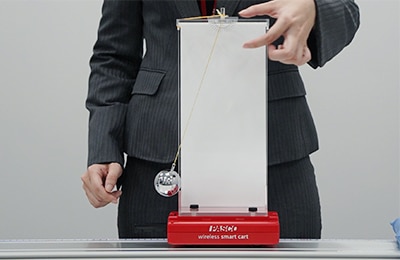
She also explained that “Students can visually confirm the stationary point that forms on the pendulum string as a result of the combined motion of the cart and the pendulum, just as theory predicts.”
Experiment Kits Developed through Team Collaboration
In developing the kits, each member takes responsibility for a specific device, while the entire team conducts the design reviews. The team also consults with Physics Exam Lab teachers and tests prototypes with university and high-school students, incorporating their feedback to refine the design.
Comment from the Person in Charge at Shimadzu Rika Corporation
When the Physics Olympiad teachers approached us about adapting the entrance exam questions directly into experiment kits, I felt, “This is precisely the kind of work Shimadzu Rika should be doing.”
Our goal was to recreate, as faithfully as possible, the “impossible devices” shown in exam diagrams by combining existing equipment and innovative new approaches. When students reread the exam question with the intuition gained from the experiment, the meaning of the formulas naturally begins to make sense. Students who perform the experiment before answering the exam questions are likely to gain a deeper understanding and a more positive impression of physics than those working from the text alone.
Until now, it was often the case that even after conducting experiments and spending time plotting results, there was insufficient time to verify the crucial findings. Today, high-precision sensors can capture experimental results and convert them into data, enabling us to provide teaching materials that help students analyze the results more efficiently and learn more effectively.
We would be delighted if our kits could serve as a vital solution for teachers struggling to find time for experiments. Above all, we hope these kits will inspire students to discover just how fascinating physics can be.
 Page Title and URL Copied.