



Supporting Young Researchers at Chinese Universities
Shimadzu Holds 15th Sichuan University-Shimadzu Science and Technology Innovation Speech Contest
Shimadzu (China) Co., Ltd. (SSL), a Shimadzu Group company, held the finals of the 15th Sichuan University-Shimadzu Science and Technology Innovation Speech Contest at Sichuan University’s Wangjiang Campus in November 2025.
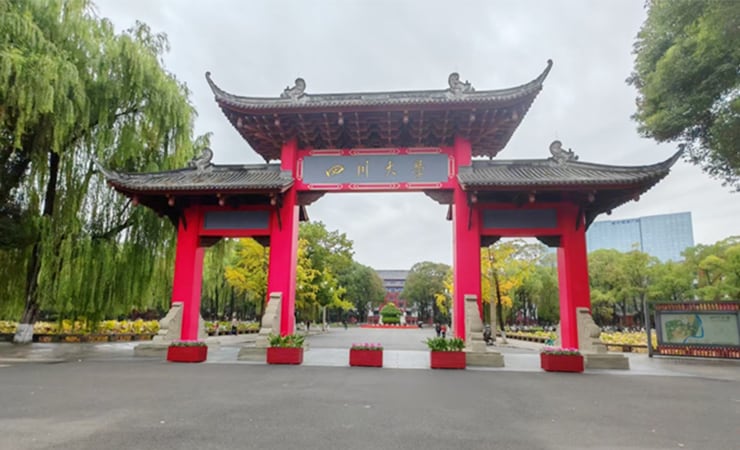
Sichuan University
Promoting Innovation through the Integration of Knowledge and Practice
This contest is held to promote innovation by integrating the knowledge and theories students learn every day with practical applications based on market needs, while also improving educational effectiveness. The kickoff event was held in June 2025 at Sichuan University’s Jiangan Campus, and students from 15 universities—including Sichuan University, Zhejiang University, and Tongji University—prepared their presentations based on knowledge in their respective disciplines. Sixteen teams participated in the preliminary round held in September, and six teams selected by SSL representatives and professors from the College of Chemistry at Sichuan University advanced to the finals. After the preliminary round, SSL’s technical team provided students with expert guidance and helped them refine their presentation content in preparation for the finals.
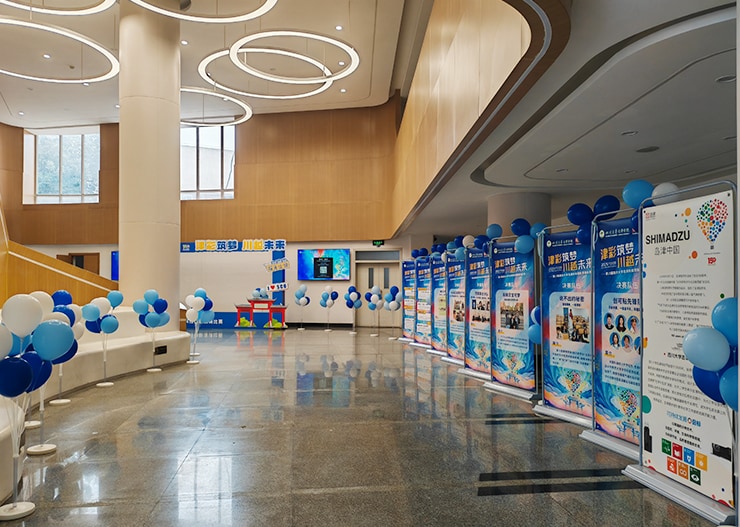
Panels by participants for their presentations
Themes and Evaluation Results of the Six Teams that Advanced to the Finals
| Theme | Details | |
|---|---|---|
| 1 | Purification of Automotive Exhaust Gas |
By applying nano-catalyst material coating technology to the three-way catalytic converter used for the oxidation-reduction of harmful substances in the exhaust gas of gasoline-engine vehicles, the volume of the catalytic converter can be reduced by 40% and the conversion efficiency of nitrogen oxides in the exhaust gas can be increased to 98%*. This method can be flexibly applied to a wide range of vehicle models regardless of design.
|
| 2 | Infant Health Monitoring Using a Pacifier | A smart pacifier featuring a Y-shaped flow path is used to test components in an infant’s saliva, such as electrolytes, urea nitrogen, and immunoglobulins. By sending the result data to a connected device, the infant’s health status can be monitored in real time. |
| 3 | Using Blood Biomarkers and AI for Detection of Alzheimer’s Dementia | The latest FraC nanochannel technology can be used to achieve ultra-early detection of Alzheimer’s dementia. By integrating blood biomarkers with AI technology, more efficient and rapid testing can be enabled, leading to earlier treatment from just a single drop of blood collected from a fingertip. |
| 4 | Treatment of Menopausal Disorders Using Traditional Chinese Medicine | Hypericin, an active ingredient extracted from St. John’s wort, a medicinal plant effective against menopausal disorders and depression, is combined with glycerin contained in black cohosh, another medicinal plant used for women’s health problems. This approach aims to develop a safe, plant-derived treatment for alleviating menopausal symptoms without using hormone therapy. |
| 5 | Smart Glasses | Using multiple sensors attached to eyeglasses, the system measures and monitors the eye movements, body posture, light levels, and other parameters of middle-aged and older adults, helping to protect their eye health and safety, thereby contributing to improved QOL. |
| 6 | Simple Food Safety Testing Using Test Strips | By using two types of test strips to detect pathogenic bacteria and E. coli, and photographing the results with a smartphone, AI can compare them in the cloud to monitor and manage food safety. |
During the final round of the contest, a rigorous evaluation was conducted based on various criteria, including technical feasibility, market demand, innovativeness, and responses during the presentation. Combined with the votes of public judges selected at the venue, the team that proposed Infant Health Monitoring Using a Pacifier was chosen as the winner. The idea was highly praised for its ability to perform testing simply by having infants suck on a pacifier, potentially enabling earlier disease detection while reducing the need for clinic visits.
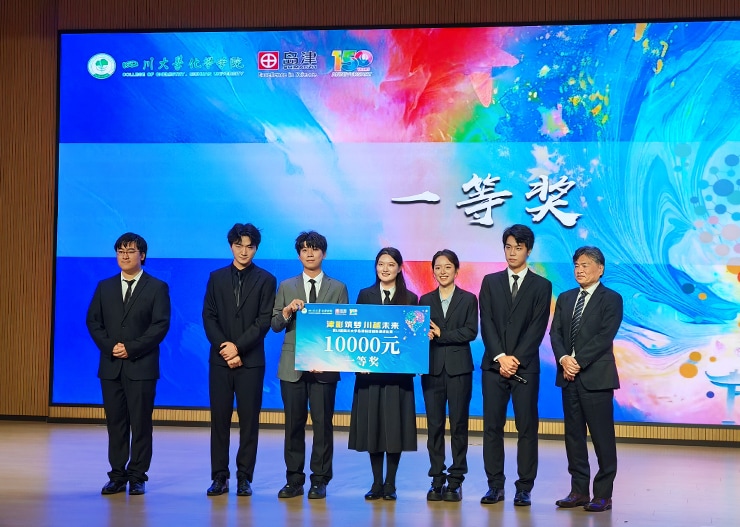
The winning team and SSL Vice President Ichiro Ogura (far right)
The team that gave the presentation on Using Blood Biomarkers and AI for Detection of Alzheimer’s Dementia was selected as the runner-up.
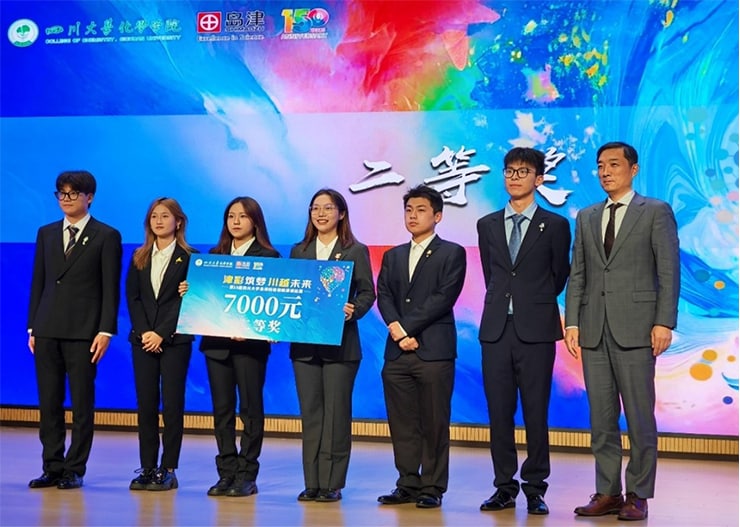
The runner-up team and Taohong Huang (far right), General Manager of PR at SSL’s Regional Corporate Head Office
In addition, SSL Vice President Ogura selected the recipient of the Individual Excellence Award, which was presented to Wenjie Zhou of Sichuan University.
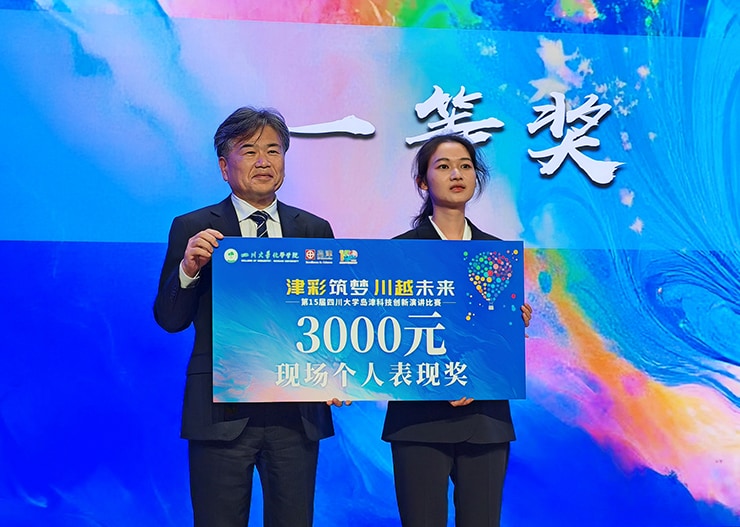
SSL Vice President Ogura (left) and Wenjie Zhou of Sichuan University
Guided by its corporate philosophy of “Contributing to Society through Science and Technology,” Shimadzu Group will continue to support the development of scientific talent around the world.
 Page Title and URL Copied.