



Automating Intellectual Property Operations to Contribute to the Future of Science and Technology
At companies, universities, and research institutions, people involved in research and product development devote significant effort to intellectual property (IP)-related work. Shimadzu Corporation is no exception; it has been working to reduce the workload on engineers and staff while streamlining internal operations. The result was Genzo AI, an IP operations automation platform. The system has drawn praise and high expectations from all quarters for its accuracy and speed, which exceed even those of experienced professionals.
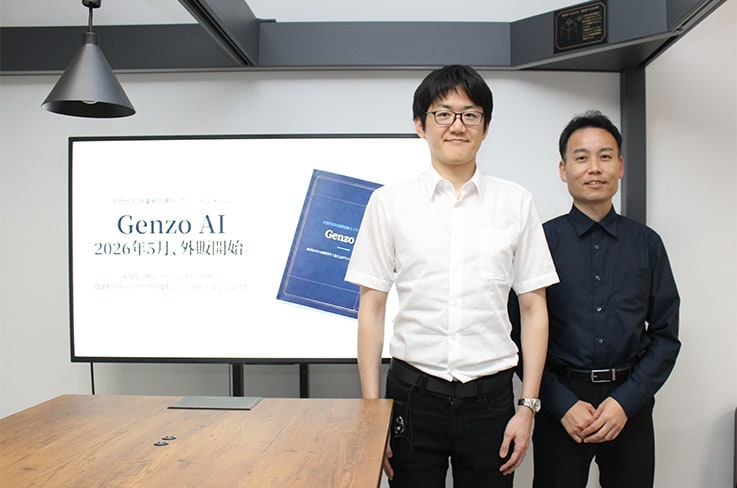
Ryota Kawamura (left), President of Genzo AI, Inc. on secondment from Intellectual Property Department at Shimadzu Corporation, and Koji Akutsu (right), General Manager of Intellectual Property Department and a Genzo AI outside director
Failure with Deep Learning AI
Protecting a company’s inventions, ideas, and designs, and avoiding infringement of others’ IP rights require enormous amounts of patent-related procedures and research work in Japan and overseas. In new product development, reviewing relevant third-party patents is essential to avoid patent infringement. At Shimadzu Corporation, approximately 100,000 documents are individually reviewed and evaluated each year. While most of these did not constitute infringement, the fact that it could not afford to overlook any potential issues meant the process was time-consuming and placed a significant burden on its team.
These reviewed patent documents accumulated, reaching 700,000 cases at the time. Akutsu of Shimadzu Corporation’s Intellectual Property Department thought that using deep learning to train AI might enable the quick determination of whether new development ideas infringe existing patents. This was in 2020. Kawamura, who was in the same department, joined the effort, and they began evaluating the system. However, the approach proved impractical because it could not cope with even slight differences in wording from the materials used for deep learning.
The Arrival of Generative AI
Meanwhile, as part of the department’s three-year plan beginning in 2023, Akutsu set a major goal: increase IP capabilities by 50 % while reducing workload by 30 %. He believed that analyzing patent data could contribute not only to the formulation and revision of business strategies, as well as joint research and M&A, but also to further supporting the development of existing businesses and new business initiatives. Rather than simply responding to requests from business divisions, he wanted the department to strengthen its consulting capabilities by actively proposing directions for technology development.
The initiative began with a task-by-task review of all departmental activities to identify areas where workload reductions might be possible. However, patent reviews accounted for such a large portion of the workload that achieving a 30 % reduction seemed extremely difficult.
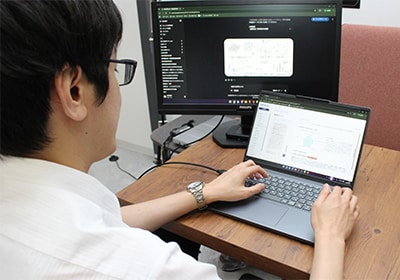
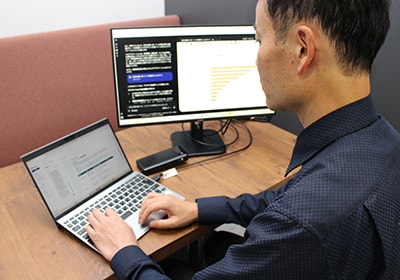
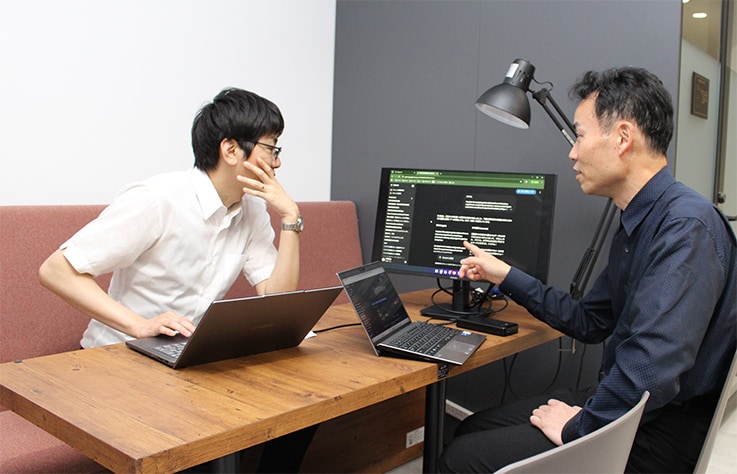
Around that time, ChatGPT, a generative AI tool, appeared, and it became available for internal use. Akutsu and Kawamura immediately loaded a massive volume of patent materials into the tool. Naturally, the generative AI system made errors in its initial judgments, but there were reasons for those errors. They carefully examined the basis for each error and exchanged ideas on what logic to use when designing prompts (instructions for the AI) so that the system would make correct judgments.
Building a Generative AI Capable of Expert-Level Judgments
In July 2023, the team conducted its first formal validation test. Because the AI’s assessments showed relatively stable results, they began teaching it the complex logic that veteran IP professionals had developed over many years. Their conviction that “generative AI can do this” continued to strengthen, driving them to further refine and optimize the system.
By the autumn of that year, the system was finally rolled out company-wide. However, the initial operating policy required that a staff member review every assessment made by the AI tool. The following year, in 2024, an upgrade to the generative AI significantly improved its ability to interpret text, leading to further refinements and greater reliability in its judgments. By the autumn of 2025, the department switched to a policy in which patent documents judged by the AI to not constitute infringement no longer required human review.
Strong Expectations Lead to a New Business Venture
In August 2024, Akutsu introduced how generative AI could improve operational efficiency at a networking event for people involved in patent departments at companies and other organizations in Osaka and Kyoto. The presentation made a strong impression on participants, and requests soon began flowing in for him to present at other gatherings of patent professionals and give lectures.
As the word spread, meeting Kenichi Nagasawa of IP AGENT CORPORATION became a turning point. “Why not start a company and make these benefits available outside Shimadzu?” Encouraged by this suggestion from Nagasawa and with the support of IP AGENT CORPORATION, the move toward an internal startup gradually became a reality. As a result, Genzo AI, Inc. was established and began operations on April 1, 2026.
Today, Shimadzu Corporation relies on generative AI to handle most of the document preparation work for invention disclosures. Users simply upload development materials as-is, and the tool automatically gathers relevant external patents to identify potential infringement risks, then completes the document in the required language. If information is missing, the AI asks for it.
Akutsu and Kawamura believe that reforming intellectual property operations can contribute to strengthening Japan’s industrial competitiveness through a range of combined effects, including stronger protection of their own rights, a significantly lower risk of infringing others’ rights, and greater focus of resources on research and development.
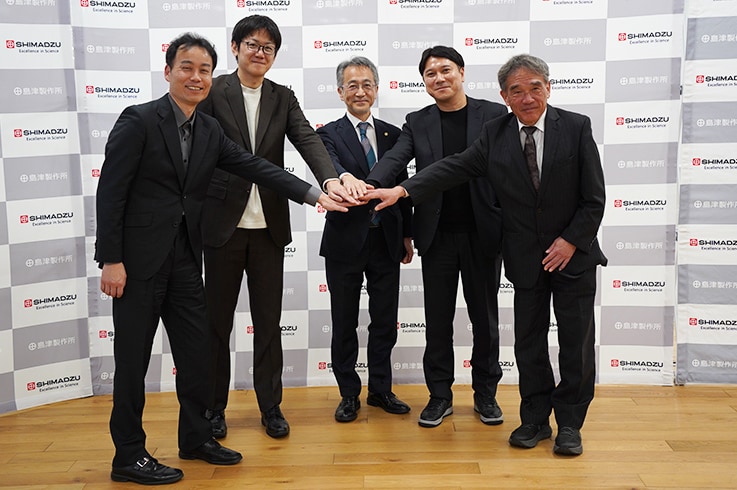
Press conference announcing the establishment of Genzo AI, Inc. (March 25)
From left: Akutsu and Kawamura; Takahiro Nishimoto (Managing Executive Officer and CTO of Shimadzu Corporation); Satoshi Sakamoto (President of IP AGENT CORPORATION); and Kenichi Nagasawa (Corporate Advisor of IP AGENT CORPORATION and former Senior Managing Executive Officer and Head of Corporate Intellectual Property & Legal HQ at Canon Inc.)
Comment from Koji Akutsu and Ryota Kawamura
Our efforts to promote the use of generative AI have been driven by two motivations: a passion for technological innovation and a commitment to supporting others. While generative AI is often limited to individual use in many companies, making it difficult to establish it as business infrastructure, Shimadzu Corporation’s Intellectual Property Department was able to establish generative AI as part of our operational infrastructure because every member of the department embraced the initiative and worked together to evaluate and improve the system. Our sincere hope is that this momentum will spread beyond Shimadzu and reach companies across Japan.
 Page Title and URL Copied.