



AAIC 2026: Blood Tests Pave the Way for the Future of Diagnostic Technology
Dementia has long been an illness that is fundamentally difficult to treat. In recent years however, with the advent of new therapeutic drugs, research into Alzheimer's and other forms of dementia has reached a major turning point. As treatment options have begun to expand, hopes are pinned on diagnostic techniques, enabling disease detection at the earliest possible stage, leading to appropriate treatment.
In July 2026, the Alzheimer’s Association International Conference (AAIC 2026) was held in London, England. AAIC is one of the largest international conferences in the field of dementia research. More than 10,000 researchers and medical personnel from a variety of countries attended, where they engaged in lively discussions on the latest research into diagnostic technology and therapeutic methods. Naoki Kaneko, Manager of the Application Group at the Koichi Tanaka Mass Spectrometry Research Laboratory, represented Shimadzu at this conference. We asked him about the changes he had observed in research worldwide, as well as the future of dementia research.
Trends in Dementia Research Resulting from Therapeutic Drugs
In dementia treatment to date, the focus has been on diagnosis once the symptoms appear, and then temporarily improving the reduced cognitive functions. Now, however, antibody medicine*1, which has a direct impact on the cause of the disease, has arrived. Rather than simply treating symptoms, there is now the possibility of controlling the disease's progression itself. Dementia research is entering a new stage.
- *1. Antibody medicine: Pharmaceuticals that make use of immune mechanisms built into our bodies. This medicine acts by binding to specific disease-causing substances. As a result, these medicines are more likely to act on their intended targets and are expected to provide high therapeutic efficacy while limiting side effects.
At AAIC 2026 as well, cases were reported in which the disease stage did not progress after treatment began, as well as cases showing signs of improvement. As far as patients are concerned, hopeful results are gradually accumulating. If the risk of dementia as well as the patient’s condition can be ascertained from a blood test, many more people could be screened at an early stage. In this context, there are once again high expectations for Shimadzu’s research into blood biomarkers (BM)*2, an initiative at the company for many years that utilizes mass spectrometry techniques.
- *2. Biomarkers (BM): Substances metabolized within the body that can provide clues for the early detection and diagnosis of disease
Naoki Kaneko, Manager of the Application Group, Koichi Tanaka Mass Spectrometry Research Laboratory
Until a little over a decade ago, many researchers were skeptical about blood biomarkers. However, after Shimadzu and Japan’s National Center for Geriatrics and Gerontology published a paper in 2018 demonstrating the utility of blood amyloid beta, research findings on blood biomarkers began to be reported worldwide. Also, with the advent of new therapeutic drugs, the importance of blood tests has heightened. At this year’s AAIC, a number of announcements were made regarding research on blood BM consisting of protein molecules, such as phosphorylated tau and GFAP.
At the same time, many expressed the view that individual molecules alone cannot fully capture complex disease states. Alzheimer's disease progresses over many years, and the changes that occur within the body differ with the stage of the disease. Additionally, a number of neurodegenerative diseases are sometimes present at the same time. Molecules for evaluating the side effects and efficacy of drugs have yet to be found, so new BM need to be discovered and more progress in analytical techniques is needed to achieve more accurate diagnoses and to evaluate therapeutic effects.
What can be Seen with Mass Spectrometry
Kaneko's presentation at this year's AAIC involved techniques for analyzing amyloid beta, a biomarker associated with Alzheimer’s disease. In the progress to date in research and development related to amyloid beta, measurements have been performed using large mass spectrometers. When these measurements are performed with benchtop models*3, it has been confirmed that even higher analytical performance is obtained. This result represents a significant step toward the future practical implementation and widespread adoption of blood tests. The presentation reaffirmed the high expectations for mass spectrometry technology in dementia research.
- *3. Benchtop instruments: Comparatively small analytical instruments that can fit on top of a desk in a laboratory. They are easier to introduce than larger models, and are expected to make the popularization and operation of future tests easier.
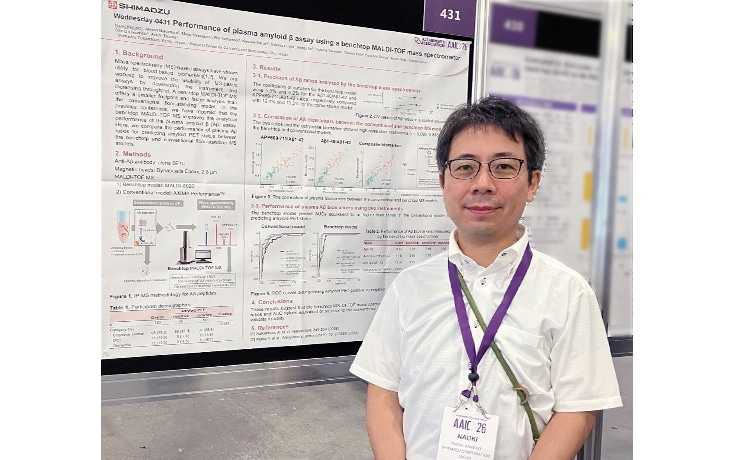
Naoki Kaneko, Manager of the Application Group, Koichi Tanaka Mass Spectrometry Research Laboratory
At present, immunological methods*4 are the primary analytical methods used in blood tests for dementia. At this year's AAIC 2026, there was a real sense of heightened interest in mass spectrometry as a promising technique for more reliable measurements. In particular, mass spectrometry is expected to play a significant role in evaluating molecules that cannot be adequately assessed using immunological methods and in searching for new biomarkers. In response, we will further advance mass spectrometry and sample preparation techniques, develop new methods for analyzing aggregates, and search for clinically useful biomarkers.
- *4. Immunological methods: Analytical methods used to measure proteins in the blood, using the tendency for antibodies to bind to specific substances
What Only Shimadzu can Do
At Shimadzu, in addition to mass spectrometry techniques and pretreatment techniques to support blood tests, we also have TOF-PET systems for imaging lesions in the brain. Combining the two techniques of blood tests and diagnostic imaging enables Shimadzu to provide solutions supporting the entire range from diagnosis to treatment evaluation. In the future, as dementia research accelerates and therapeutic drugs become more widely available, there will need to be a means of providing patients with a diagnosis in a timely manner, leading to suitable treatment on an individual basis. The knowledge obtained at AAIC 2026 provided a real sense of progress towards this sort of future. Shimadzu will continue to support dementia research from the perspective of both mass spectrometry techniques and diagnostic imaging techniques, and contribute to the advancement of healthcare.
 Page Title and URL Copied.