

Product

Medical Systems & Equipment

Angiography

FPD Cardiovascular System

BRANSIST safire HB9

Introducing the optimal bi-plane system for PCI procedures, based on Shimadzu's superior direct-conversion flat panel detector (FPD)

BRANSIST safire HB9

Shimadzu, a pioneer in cardiovascular systems equipped with direct-conversion FPD, has now developed the BRANSIST safire bi-plane system, which offers even higher image quality and ralizes even safer and smoother PCI procedures.
Bransist safire provides a wide range of features and capabilities, all required of cardiovascular systems that support medical treatments.

Equipped with a Next-Generatin X-ray Detector to Create the Ideal Imaging Chain

Direct-conversion detection, which converts X-rays directly to electrical signals, eliminates the blurring that results from the scattered light generated in conventional imaging processes.
It also featurs the smallest pixel size in its class - 150µm - to provide fluoroscopy/radiography images with exceptional visibility.
The FPD has a 9 x 9 inch field of view, which accommodates sleep cardiac angles and also provides an optimal view of peripheral regions.

Upgraded Digital Filter Provides Improved Visibility

To make viewing the direct-conversion FPD even easier, Shimadzu now has equipped the upgraded digital filter (Power-RSM digital filter) with image processing parameters optimized based on Shimadzu's extensive experience at clinical sites.
Compared to previous FPD filters, this new filter maintains the same high visibility levels offered by conventional FPDs, but is able to provide an easire-to-see image by improving the graininess of the fluoroscopic image and making the differences in background contrast even more uniform.

Flexible C-Arm Settings

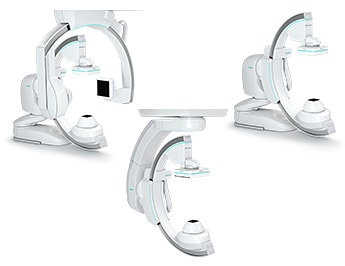
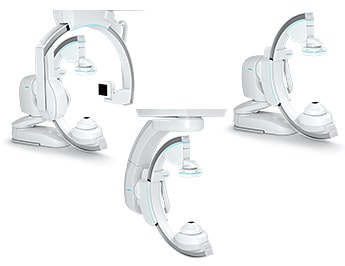
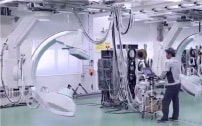
The base of the frontal C-arm features a triple-pivot design that allows easy movement of the C-arm to a wide variety of positins. In particular, the Hand Access feature moves the floor-mounted frontal C-arm laterally, prallel to the table and is especially useful for both transradial and brachial catheterizations. Furthermore, the Multi Position setting provides a large space at the head, which makes approaching the patient and handling equipment easy, even when the units are used as a bi-plane system.

Technical Report

Clinical Report