Polymer Additives Library Ver.2 - Features
GC/MS Mass Spectra Library
Contains Approximately 5,800 Mass Spectra
This library consists of a library*, which contains 5,775 mass spectra for 590 types of polymer additives and GC/MS pyrolysates from the pyrolysis GC/MS analysis of additives, and a library containing the mass spectra for 65 compounds often targeted for analysis, selected based on their usage in the commercial market, and chemical substance regulatory information. In total, this product contains 5,840 mass spectra, which provides strong support for the analysis of polymer additives. In Ver.2, the compound registration has been newly enhanced, for example vulcanizing accelerators utilized in the rubber filed. Approximately 1,000 spectra have been added.
*ADD-MS22B F-Search Additives Library from Frontier Laboratories
Ready-to-Use Methods
This library provides GC/MS and PY methods; both contain all necessary conditions and measurement parameters. Anyone can easily start analysis with optimal analysis conditions.
Includes Retention Indices and Classification Information of Additives
Retention indices are registered for all compounds. Compounds can be identified with a high degree of accuracy by reducing the library search results using retention indices. In addition, information on the classification of additives is included, so even without detailed knowledge of additives, users can see which additive is associated with a compound found in the library.
Can Be Used with a Variety of GC/MS Systems
The library can be used for a variety of GC/MS applications, including pyrolysis GC/MS, which is widely used for the analysis of additives in polymer materials, and liquid sample injection GC/MS. It supports a wide range of additive analysis for customers.
Application
Analysis of additives contained in polymer materials (Resin parts, rubber, food packaging, ink, etc.).
Function
Filtering with Retention Index
Multiple compounds with similar mass spectra are listed as candidates when performing a library search using only the mass spectrum. Filtering with the retention index sorts the candidates by retention index, thereby providing highly accurate identification results
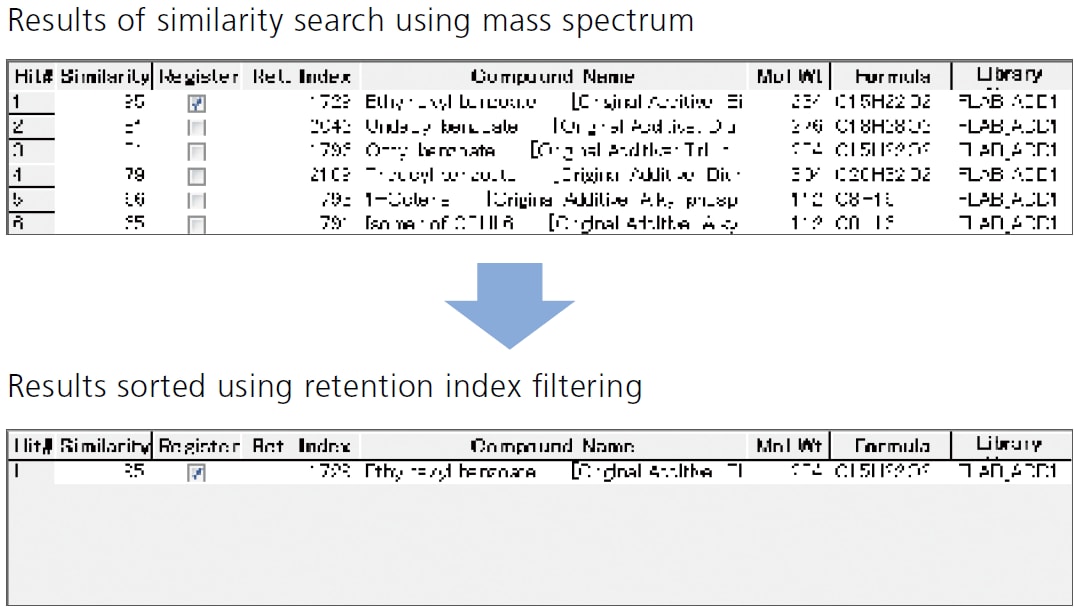
Results of similarity search using mass spectrum
Confirming the Additive Classification Information
The additive classification information (such as plasticizers and flame retardants) registered in the library plays a role in confirming the type of additive associated with the compounds included in search results.
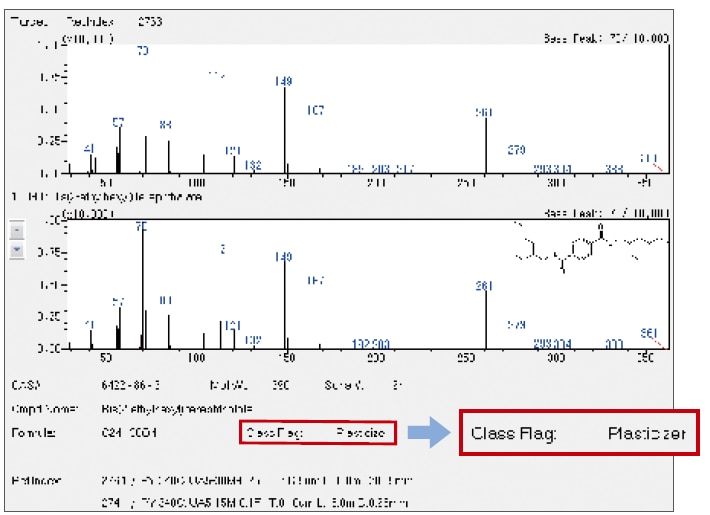
caption
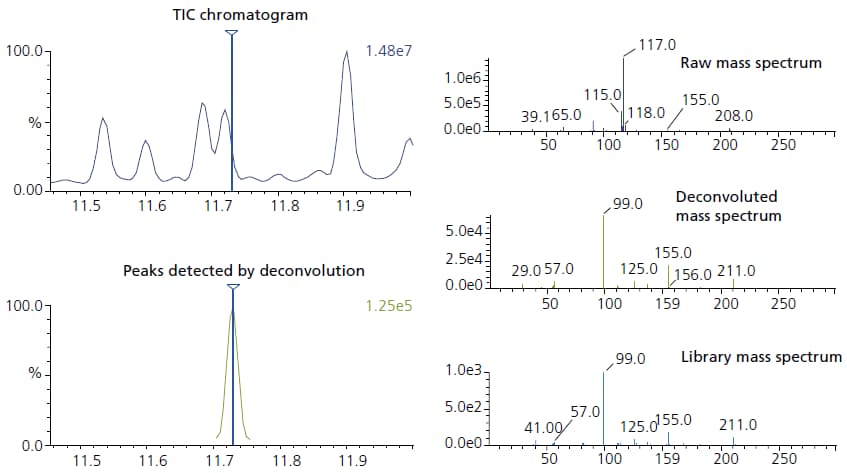
Deconvolution Analysis with LabSolutions Insight Explore™ GCMS
Even more accurate additive analysis is achieved by combining deconvolution analysis, which is capable of separating out impurities and detecting trace compounds, with this library.