DUH-211/210 Series - Applications

Dynamic Ultra Micro Hardness Tester

{"title":"Applications","columnTitle":"Applications","source":"product","key":3462,"filter_types":["applications","application_note","posters"],"config_list":[{"document_id":12617,"config_id":304},{"document_id":13171,"config_id":299}],"anchor":"table_anchor_applications","filter":true} {"title":"Technical Documents","columnTitle":"Technical Documents","source":"product","key":3462,"filter_types":["technical","technical_reports","white_papers","primers"],"config_list":[],"anchor":"table_anchor_technical","filter":true} {"title":"Manuals","columnTitle":"Manuals","source":"product","key":3462,"filter_types":["manuals"],"config_list":[],"anchor":"table_anchor_manual","filter":true}
adobe

Most of the documents on the LITERATURE is available in PDF format. You will need Adobe Acrobat Reader to open and read PDF documents. If you do not already have Acrobat Reader, you can download it free at the Adobe's Website. Click the GET ADOBE READER icon on the left to download a free copy of Adobe Acrobat Reader.

Materials and Applications

Thin Films Such as Vapor-Deposited Films and Semiconductor Materials, and 
Surface-Treated Layers Such as Ion-Implanted Layers and Nitride Layers

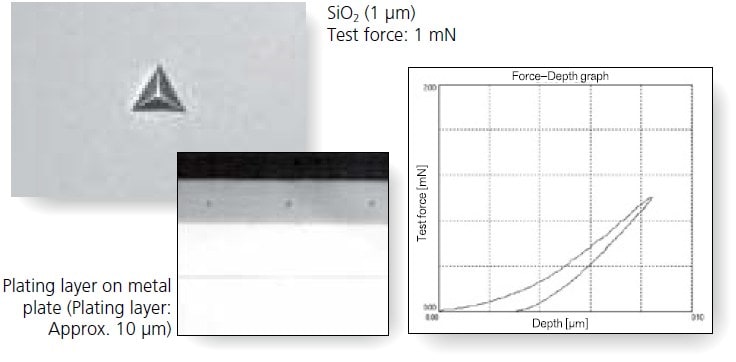
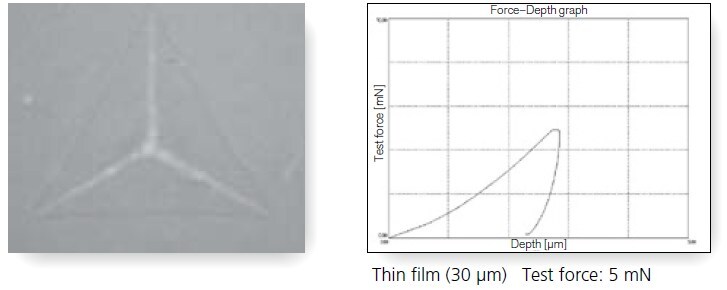
  • As film production technology improves and diversifies, it is becoming increasingly important to evaluate the hardness of thin films and coatings on the surface of materials. These include ion-implanted layers, DLC (diamond-like carbon) films, vapor-deposited films produced by CVD (chemical vapor deposition), PVD (physical vapor deposition) and alumite layer. By using an ultra micro test force to measure depths of less than one tenth of a film’s thickness, the DUH tester makes it easy to evaluate the hardness of only the film, without influence from underlying materials.

  • Thin Films

DLC Films

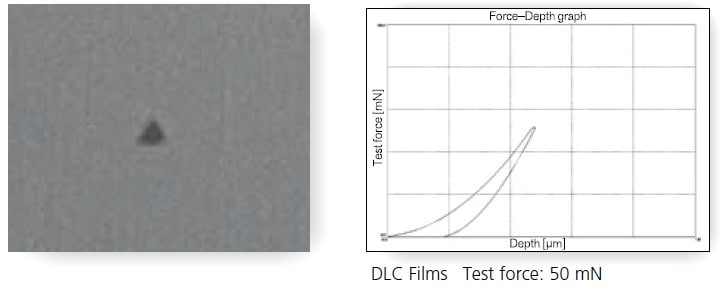
  • DLC films offer properties such as high hardness, low friction coefficients, wear resistance, electrical insulation, chemical resistance, and infrared light permeability, and are widely used in tools, automotive parts, semiconductor manufacturing equipment parts, and household goods. Measuring the hardness of such films is necessary for determining the optimal film manufacturing parameters and for monitoring their quality, but creating large indentations is not possible. The DUH is perfect for these types of application, because it can evaluate hardness based on the indentation depth using only a small test force.

  • DLC Films


Plastics

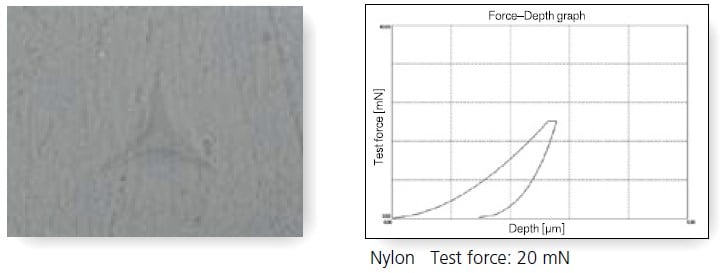
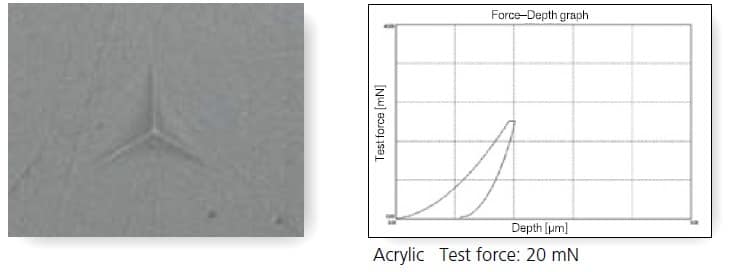
  • An important feature of engineering plastics is hardness. The DUH can measure the hardness of even highly light-absorbent materials, which are difficult to measure using conventional testers.
    Engineering plastics offer high strength, heat resistance, and other properties while still providing the advantages of plastics in general such as superior plasticity and ease of processing. As a result, they are commonly used for internal mechanical parts (such as gears and bearings) in consumer electronic products. They provide higher wear resistance, lighter weight, and lower cost than metal parts, and can be mass produced, where hardness is used to improve performance and control quality. However, the low reflectivity of plastics makes it difficult to measure the size of indentations when using conventional hardness testers. In contrast, the DUH is perfect for these applications, because it evaluates hardness based on the test force applied and the resulting indentation depth.

  • Plastics


  •  
  • Plastics


  •  
  • Plastics


Rubbers and Elastomers

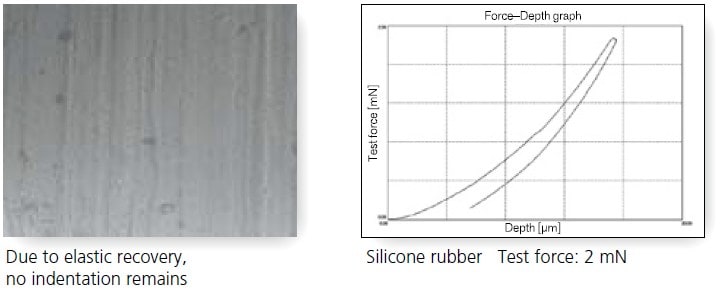
  • Because indentation depth is used to determine hardness, hardness can be measured using a variety of test forces and the tester can even be used to evaluate deterioration in material surfaces of materials.
    Rubber provides a low elastic modulus, high elongation in response to small forces, and high repulsion. Consequently, its raw materials are often mixed with various chemical ingredients to make a variety of products, such as tires, vibration absorbing rubber, and O-rings. Due to the harsh environments where such products are typically used, in addition to evaluating durability, hardness is used to also evaluate surface deterioration. However, conventional hardness testers cannot evaluate the elastic characteristics of rubber because of the indentation after testing. In contrast, the DUH measures both the test force and indentation depth, which makes it the perfect method for evaluating rubber, including its elasticity.

  • Rubbers and Elastomers


Metallic Materials

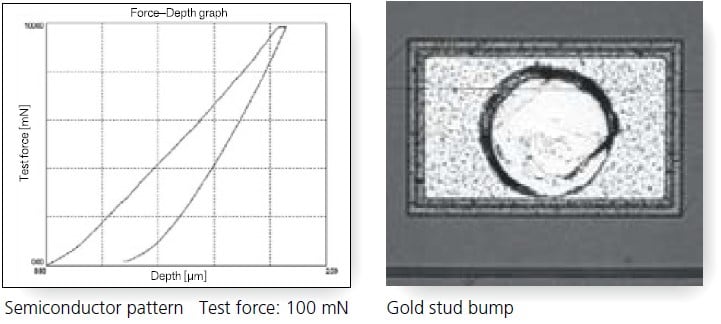
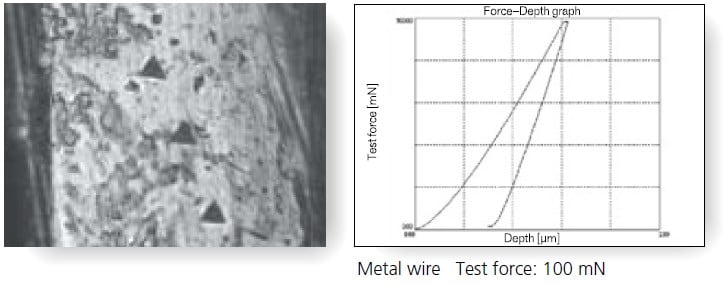
  • Perform micro-region hardness measurement, which has become increasingly difficult as feature sizes have become ever smaller.

    Metallic Materials


  • Metallic Materials


Brittle Materials Such as Glass and Ceramics

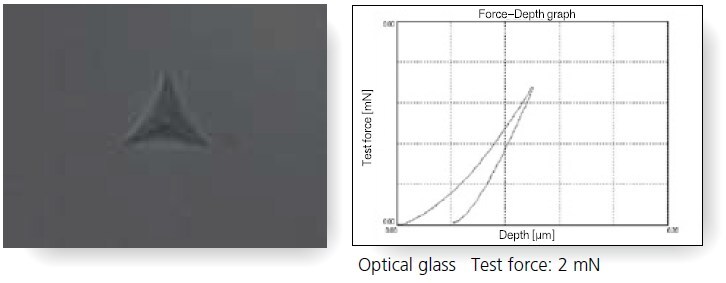
  • Use a small test force to evaluate the hardness of brittle materials without generating cracks. Measure the test force required to generate cracks.
    Because glass is clear, hard, highly resistant to thermal deformation, and a good electrical insulator, it is used for a wide range of applications, from window glazing and display screens to various substrate materials, such as for CDs. On the other hand, glass also tends to be brittle and thus requires various material and processing method modifications for it to be used in, for example, large thin display applications. Hardness is used to evaluate glass, but large test forces cause cracks and the indentations are not clearly visible. Therefore, the DUH is ideal for evaluating glass, because it determines hardness based on the indentation depth using a small test force.

  • Brittle Materials Such as Glass and Ceramics


Ultra-Fine Fibers Such as Optical Fibers and Carbon Fibers

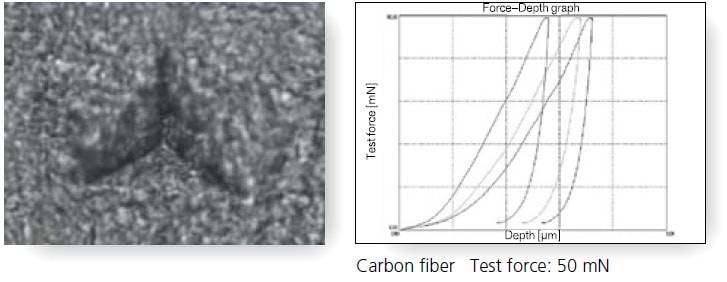
  • Evaluate the strength of specimens taken from composite fiber materials and obtain important information. Measure the hardness of fibers.

  • Ultra-Fine Fibers Such as Optical Fibers and Carbon Fibers


  •  
  • Ultra-Fine Fibers Such as Optical Fibers and Carbon Fibers


Micro Powders

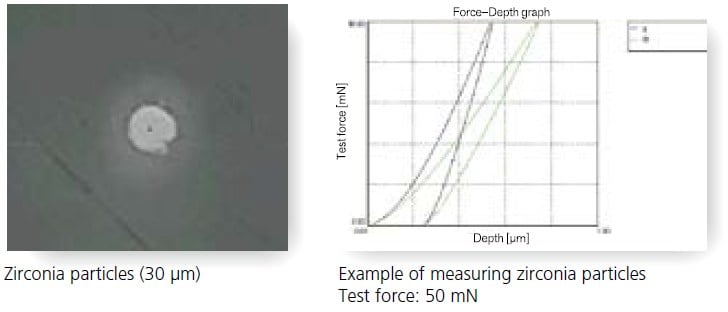
  • Advances are being made to create ever finer micro powders in an effort to increase their surface area-to-volume ratios. The strength of powders is evaluated using compression testing, but due to the size of the particles, the DUH is ideal for measuring their hardness in more detail.

  • Micro Powders