



Shimadzu Group Employee Receives ASTM Standard Development Award from Committee D19 on Water
Enabling Universal Standards for Water Measurement Worldwide
William Lipps, of Shimadzu Scientific Instruments, Inc. (SSI), a Group Company that consolidates analytical and measuring instruments businesses by Shimadzu in the United States, has received the Standard Development Award from Committee D19 on Water at ASTM International. He has led water quality analysis and international standardization activities at ASTM for over 40 years.
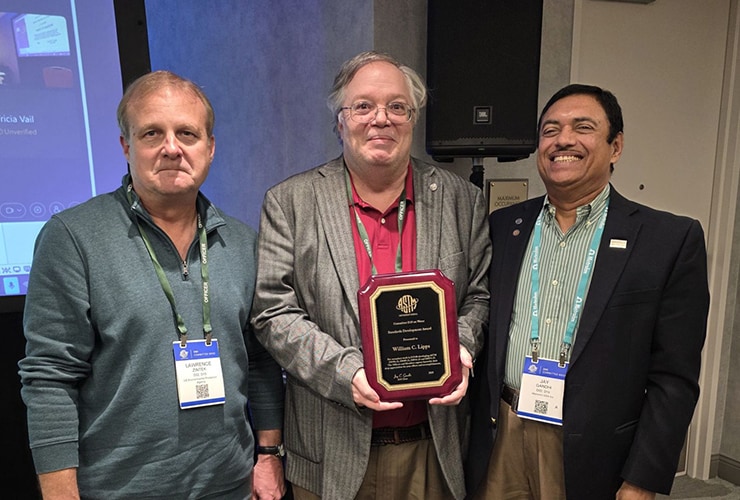
William Lipps at center, holding the plaque
- ASTM International: Establishing the Standards and Specifications Used in Industries throughout the World
- Ensuring that Evaluations are Performed with the Same Methods and Standards Regardless of Where or Who is Taking the Measurements
- In Pursuit of Planetary Health by Providing the World with Better Measurement Methods
ASTM International: Establishing the Standards and Specifications Used in Industries throughout the World
ASTM International is a U.S.-based nonprofit organization that develops standards (specifications) for materials, products, test methods, and safety specifications. It publishes ASTM standards, which are widely used primarily in industrial sectors.
More than 30,000 members from 150 countries participate as volunteers. They are apportioned to approximately 150 technical committees, where they develop and maintain standards (specifications).
One of these, Committee D19 on Water, promotes the establishment of standard testing methods for the comprehensive evaluation of water characteristics and components. Because of standard testing methods, water is measured using the same methods the world over, enabling the determination of safety with the same standards. The safety of the tap water that we use daily is supported by an invisible infrastructure of such standardization.
In addition to the formation of a consensus among many relevant parties, the thorough verification of whether the methods are scientifically accurate, and the reconciliation of international interests are indispensable for the establishment of standards. Lipps served as the chair of Committee D19 on Water from 2017 to 2023, and continues to play a central role in supporting the committee as Vice-Chair.
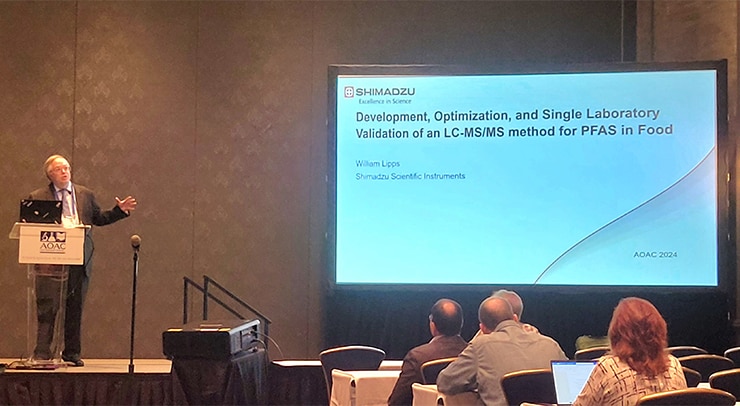
Lipps is active on a variety of committees, not only at ASTM. As a specialist examiner, he is also involved in the standardization of analytical methods for foods and agriculture at AOAC INTERNATIONAL.
Ensuring that Evaluations are Performed with the Same Methods and Standards Regardless of Where or Who is Taking the Measurements
The Standard Development Award received by Lipps on this occasion involved the following four analytical techniques, which have been developed under the leadership of the Shimadzu Group over the past three years.
All are methods designed to accurately identify and measure trace amounts of hazardous substances in water. If these techniques become widely used, they will enable water safety to be checked using the same standards in various international regions.
Four Methods Associated with This Award
| Overview of Methods | Analytical Targets | Social Significance | Development Partners | |
|---|---|---|---|---|
| 1. | High-sensitivity measurements of trace components in water with LC-MS/MS (triple quadrupole liquid chromatograph mass spectrometers) | Nitrosamines (Potentially carcinogenic compounds) | Contributes to water safety evaluations | Shimadzu India Private Limited |
| 2. | Testing methods for measuring the size and shape of microplastics in water, using dynamic imaging particle size and shape analyzers | Microplastics | Objective assessment of the extent of contamination of oceans and rivers | Solutions COE, Analytical & Measuring Instruments Division, Shimadzu Corporation |
| 3. | Methods for quantitating pesticides and PCBs in water with GC-MS/MS (triple quadrupole gas chromatograph mass spectrometers) | Pesticides and PCBs (polychlorinated biphenyls) | Monitoring of contaminants derived from pesticides and manufacturing | Solutions COE, Analytical & Measuring Instruments Division, Shimadzu Corporation |
| 4. | Methods for quantitating pesticides and herbicides in water with LC-MS/MS | Pesticides and herbicides | Contributes to both the effective use of pesticides and the protection of water environments | Solutions COE, Analytical & Measuring Instruments Division, Shimadzu Corporation |
In Pursuit of Planetary Health by Providing the World with Better Measurement Methods
With the aim of pursuing planetary health (the well-being of mankind and the Earth), the international standardization of cutting-edge analytical measurement techniques is an important theme in initiatives by the Shimadzu Group.
In addition to establishing international standards that serve as a "global yardstick" for environmental measurement, Shimadzu provides comprehensive measurement solutions, including analytical methods, pretreatments, reagents, and software, to ensure improvements to water quality and the environment.
To pass these initiatives on to the future, we are also putting our efforts into the training of human resources capable of taking an active role in international standardization.
Lipps began his initial participation at ASTM with voting on proposed specifications and responsibility for interlaboratory study (ILS), collaborative testing in which the same tests are performed in multiple labs. With experience, he took the lead in developing international standard testing methods as committee chairman. Such experience paves the way for younger generations to take on the challenge of developing international standards.
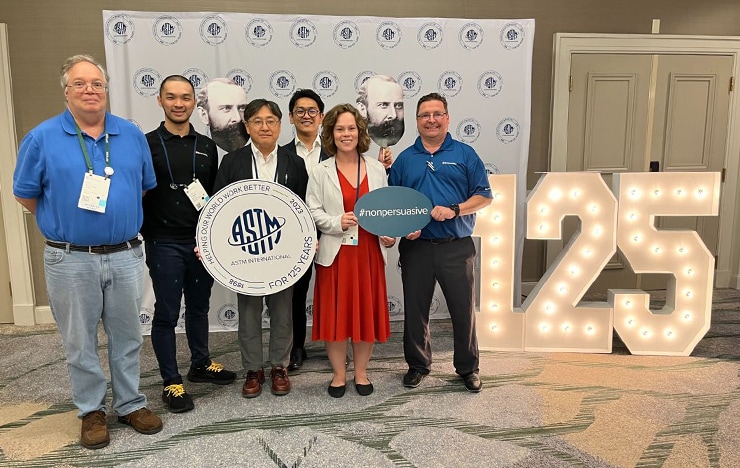
Comment from William Lipps
I could not have won this award without the support of my colleagues at SSI and Shimadzu Corporation, as well as our international teams. The development of new testing methods is certainly not accomplished by a single person.
Our aim is to provide better measurement methods that will serve society through standardization. It is our hope that these testing methods will ultimately obtain the approval of the United States Environmental Protection Agency (EPA) and become widely utilized.
Standardization is a time-consuming initiative, but we are making reliable progress through our efforts. I would like to continue to work with my colleagues to provide the world with better analysis methods.
 Page Title and URL Copied.