
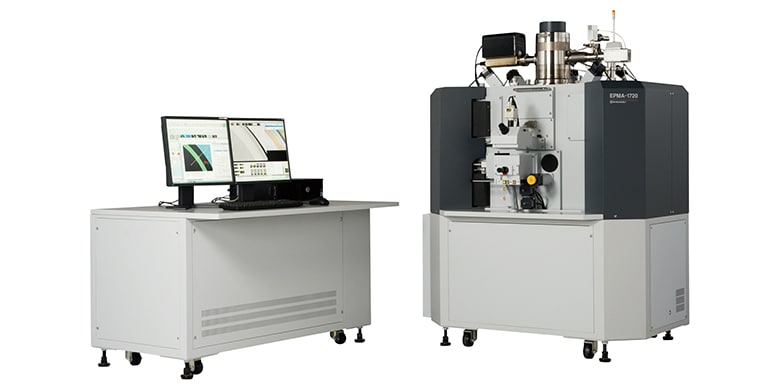
EPMA-1720


EPMA-8050G Electron Probe Microanalyzer High-Speed Impact Testing Machine
In recent years, plastic materials have been used in various industrial fields and applications ranging from small gears to automobiles and aircraft, taking advantage of the thermal characteristics and light weight of plastics. These materials may be subjected to dynamic deformation, for example, in collisions involving transportation equipment and when products are dropped. Therefore, in addition to the conventional static testing, impact testing is necessary in order to ensure reliability. In particular, because the polymers that make up plastics display a viscoelastic property, having both viscosity and elasticity, their mechanical characteristics show dependency on the environmental temperature, time, and deformation rate. On the other hand, when damages/failure accidents or deterioration phenomenon occur, investigation and countermeasures are urgently required. Failure of plastics takes a variety of forms, including static fracture, impact fracture, fatigue fracture, creep fracture, fracture due to environmental factors, and fracture due to deterioration, and fracture surfaces with distinctive features can be observed, depending on these various types of fracture. This suggests the possibility that the cause of damage can be designated and solutions to the cause can be studied by fracture surface observation. In this study, the test speed dependencies of an acrylic resin (PMMA) and polypropylene (PP) were evaluated by using a Shimadzu AG-Xplus autograph precision universal testing machine and a HITS-TX high-speed impact testing machine. In addition, the fracture surfaces of the test pieces after tests under various conditions were observed with a Shimadzu EPMA electron probe microanalyzer.
December 27, 2018 GMT