
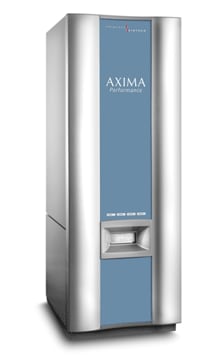
AXIMA Performance


- Analysis of synthetic polymers by MALDI-TOF MS - Polymer Analysis software for the characterisation of polymers and co-polymers using MALDI data - Automatically generate useful information (e.g. monomer mass, residual mass (end groups), polymer statistics, etc.) regarding the sample
Synthetic polymers are widespread in everyday life. Whether they are used as containers for household products and foodstuffs to the construction of car components and electronic devices, plastics now play important roles in our day-to-day activities. Matrix assisted laser desorption/ionization mass spectrometry (MALDI-MS) is becoming increasingly popular for the analysis of synthetic polymers. The Polymer Division of the National Institute of Standards and Technology (NIST) is dedicated to gathering information regarding methods used in the analysis of polymers. One of the resources of the Polymer Division includes a collection of sample preparation methods specifically for samples which are to be analyzed by MALDI-TOF mass spectrometry, (http://polymers.msel.nist.gov/maldirecipes/index.cfm), highlighting the importance of MALDI in polymer analysis. The word polymer is derived from the Greek for ‘many parts’ and is used to describe any material which is composed of repeating subunits (‘monomers’). In synthetic polymers, if the repeating units are identical (e.g. (CH2CH2O) n), the polymer is referred to as a homopolymer . Alternatively, the polymer can consist of different monomer units (e.g. (C2H4O) m(C3H 6O) n), in which case the polymer is referred to as a copolymer. The synthesis of polymers can be difficult to precisely control. Typically, a polymer sample will not contain molecules with the exact same number of monomer units, but rather will contain polymer chains of differing lengths which were formed during the synthesis. Analysis of such a sample results in the detection of a polymer distribution, which is typical in the analysis of polymers. For a homopolymer, adjacent peaks in the polymer distribution differ in length by one monomer unit. If the peaks are sufficiently resolved, it may be possible to calculate the mass of the monomer units. If the sample contains a copolymer, the spectrum can quickly become very complex due to the overlapping nature of the various chain compositions and chain lengths that may be present in the sample. In such cases, polymer analysis tools which can process the large number of peaks and identify the species which are present are essential. In this application note, we present results obtained following the analysis of two polymer samples. The examples shown include MALDI spectra obtained for a homopolymer (PEG) and a more complex copolymer sample. Results are presented demonstrating thePolymer Analysistools for processing MALDI polymer data.
December 6, 2013 GMT