
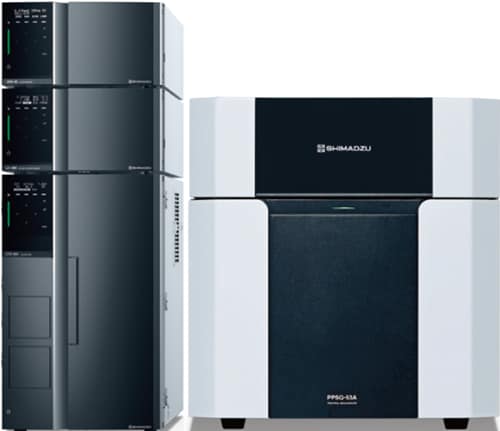
PPSQ-51A/53A


Protein Sequencer
As genome analysis technology has evolved, the genome database has become more comprehensive, and proteome analysis which is one form of post-genome analysis using the database - has grown by leaps and bounds. As a result of technical developments in mass spectrometers, we were able to achieve high-throughput analysis in the amino acid sequencing of proteins by using a mass spectrometer and its database. Although many proteins in the genome database are registered as precursor proteins, the various proteins expressed in cells are transported into the body as mature proteins that result from processing of these precursor proteins. For this reason, when the amino acid sequences of mature proteins are identified using a mass spectrometer and its database, the mass numbers may differ from the theoretical ones, leading to lower scores as the searching results. In addition, identification of the amino acid sequence using a mass spectrometer may be troublesome for species of living organism whose genome database has not yet been completed, and the sequences obtained may be unreliable. On the other hand, the conventional method for protein sequencing using the Edman degradation technique takes time, but the sequencing results are highly reliable and it is extremely effective for analysis of the amino acid sequences of samples for which no database has been established yet. This article introduces amino acid sequencing using a trace protein of IgG (derived from mouse serum). The PPSQ- 51A/53A Gradient System is an indispensable instrument for proteome analysis for its reliable and easy identification of amino acid sequences.
June 12, 2019 GMT