
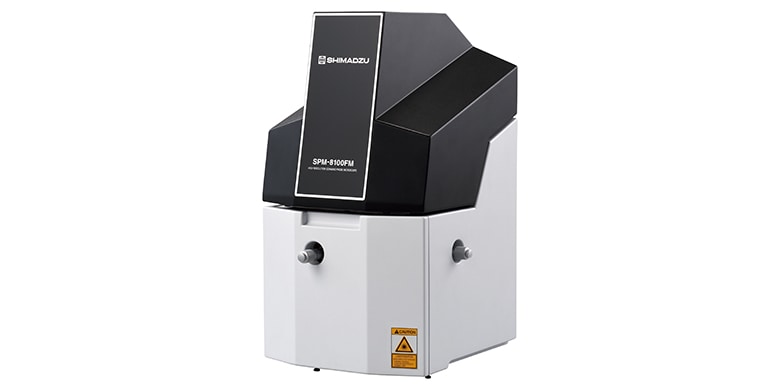
SPM-8100FM


High Resolution Scanning Probe Microscopy FM-AFM
By using the SPM-8100FM, it was possible to evaluate a comparatively hard adsorption film that formed on an iron oxide surface in a lubricant from changes in surface shape, and a flexible adsorption layer, which cannot be captured as shape change, by crosssectional imaging. Liquid lubricants are oils which are used for purposes such as lubrication, cooling, and rust prevention of internal parts of machinery, and consist of a base oil and additives. For example, the component parts in engines operate at high speed, and metal wear and seizure (phenomenon in which cylinders or pistons are damaged) may occur. At this time, the additive contained in the lubricant (engine oil) forms an adsorption film on the metal surfaces, which reduces friction and prevents metal wear by preventing direct metal-to-metal contact. Fig. 1 shows a schematic diagram of the action of the lubricant additives.
March 5, 2020 GMT