
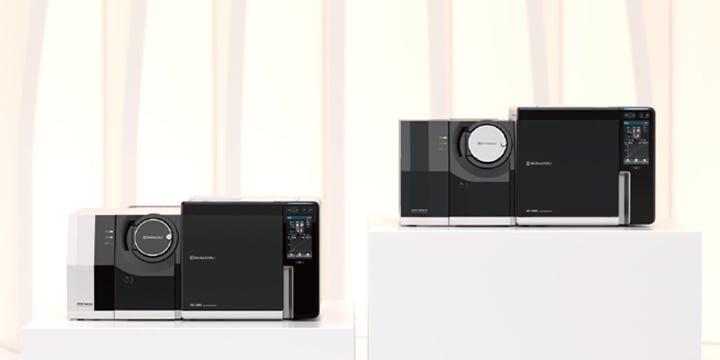
GCMS-TQ RX Series


Environmental monitoring of volatile organic compounds in the atmosphere has been carried out for the purposes of understanding the health effects and inferring the sources of photochemical ozone and PM2.5 particulates. Multi-component simultaneous analysis using a canister-based by GC/MS (SIM mode) is widely used as an analytical method for these purposes. 248 substances have been listed as potentially hazardous air pollutants (1), and wider application of multi-component simultaneous analysis is being expected. With the GC/MS (SIM) method, increasing the number of substances subject to measurement can make analysis difficult due to interference among the substances being analyzed or with contaminants. On the other hand, a multiple reaction monitoring (MRM) method has excellent selectivity and is used as an alternative method to the SIM method, but the number of reports about its application to volatile organic compound analysis is limited (2). In addition, although analytical methods using GCxGC equipment or high-resolution mass spectrometers, such as double focusing and time of flight mass spectrometers, are excellent in terms of selectivity, the application of the GC/MS/MS (MRM) method is considered more practical in the light of the widespread adoption of the equipment. In this paper, we developed a simultaneous analysis method using a GC/MS/MS (MRM) method for 51 kinds of substances classified as hazardous air pollutants and 55 kinds of photoozone precursors (10 kinds belong to both categories, so 96 kinds) and reported the results of its application to the analysis of environmental samples.
November 8, 2019 GMT