
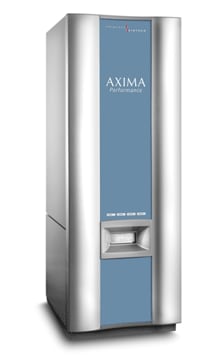
AXIMA Performance


- Analysis of animal tissue by MALDI-TOF MS - MS and MS/MS detection of drug directly from the tissue sample - Imaging software used to localize distribution of drug and endogeneous compounds
The analysis of biological material by MALDI-TOF MS instruments has become an integral part of analytical research over the last 20 years. Biological samples normally include blood, serum and tissue samples, all requiring complex separation procedures prior to analysis. More recently, researchers have begun to analyze tissue samples directly by MALDI with minimal sample preparation. A technique known as matrix assisted laser desorption ionization mass spectrometry imaging (MALDI-MSI) now enables the direct in-vitroanalysis of a tissue section. In this technique, a tissue sample is frozen in liquid nitrogen and cryosectioned onto an electrically conductive slide. MALDI matrix is deposited onto the sample to assist ionization of the compound of interest. The sample is then loaded into the MALDI-TOF MS instrument; the laser fires on a known set of coordinates and data is recorded within a set mass range, measured by time of flight (TOF). Each spectrum relating to where the laser has fired can then be compared to identify relative differences in intensity of a set mass/charge (m/z) value, or m/z range. Developments in MSI software have now enabled these results to be displayed visually so ion intensities can be represented as a colorimetric heat map image of the sample. In addition to developments in MSI, positive identification of proteins has been achieved following direct on tissue digestion and MS/MS analysis of resulting peptides. The strength of MALDI MSI as a technique can be seen when searching for a drug, metabolite or endogenous compound distribution in a tissue sample. Traditionally established techniques, such as the use of radiolabelled drug compounds or immunohistochemistry, do not necessarily provide information about what reaction might have happened after drug administration. Radiolabelled experiments provide information on the distribution of all labelled chemistries whilst immunohistochemistry follows a set number of protein epitopes and therefore modification of the protein may not be realized. An ability to spatially map an array of specific metabolic changes within a sample can provide vital additional information that may not otherwise be discovered. In this study, rats were dosed orally with the anti- schizophrenic drug clozapine. The aim of the experiment was to determine the distribution of clozapine and its metabolites within a tissue sample. This approach was investigated as a possible alternative to existing methods of identifying metabolites in non-radiolabelled pharmacodynamic studies. The advantage of this methodology is that it may help identify the distribution of a specific drug and related metabolites in non-labelled studies.
December 6, 2013 GMT
