
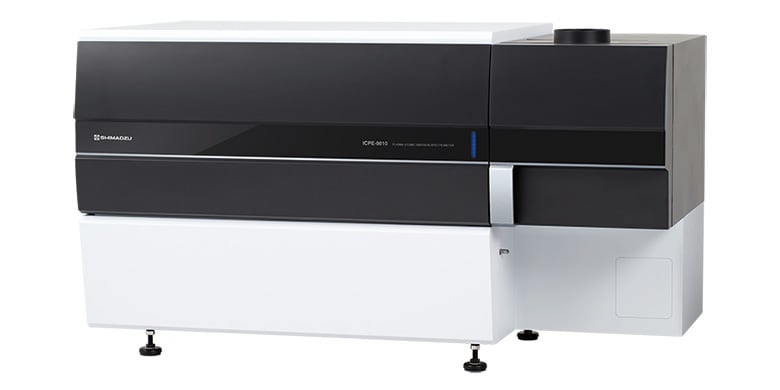
ICPE-9800 Series


Plating is a technique in which a thin film of metal is coated on the surface of a material to enhance the performance of a product. Management of the components in the plating solution is very important from the standpoint of maintaining the quality of the plating. Aside from the main components in the plating solution, management of the trace components and additives, typically present at different concentrations, is also important. Efficient analysis of these metallic components requires an analytical instrument capable of both high-sensitivity measurement and measurement over a wide concentration range. ICP atomic emission spectrometry is a method of analysis that is suitable for such analyses due to its wide dynamic range, permitting analysis over a wide range of concentrations, from μg/L to the percentage level. We performed simultaneous elemental analysis of the zinc plating solution, from the principle to trace level elements, using the Shimadzu ICPE-9820 multi-type ICP atomic emission spectrometer. Typically, when analyzing metals in plating solution, the principle elements are measured after diluting the sample between 1,000 and 10,000 times, whereas the trace level elements are measured in a low-dilution sample. As a result, many samples must be prepared at different dilutions, significantly lengthening the analysis time. With the ICPE-9820, however, the vertically-oriented torch – which prevents salt precipitation – coupled with automatic dual-view (axial and radial) observation, makes it possible to conduct simultaneous analysis of both high- and low-concentration elements.
September 25, 2014 GMT