
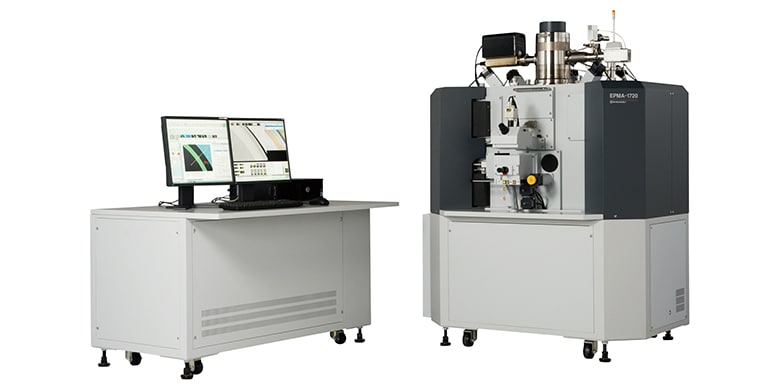
EPMA-1720


In recent years, in step with progress in nanotechnology, a variety of industrial products have been miniaturized, reduced in quantity, and made more precise. In addition, since all manufactured products consist of substances that exist on the Earth, where resources are limited, progress is being made to reduce their consumption, particularly with respect to limited resources such as rare metals, and also to develop materials that do not contain hazardous elements. Accordingly, nanoparticle-based materials are increasingly being used, with higher demand for high- sensitivity, high-resolution analysis in the microscopic region. The electron probe microanalyzer (EPMA) is conventionally known as high-sensitivity surface analysis equipment for microscopic areas, and is currently used in a wide range of fields for various purposes. Recently, the highly popular CeB6-EPMA has been used for measurement of microscopic regions in research and development and for defect analysis in on-site quality control, as it can provide more sensitive, higher resolution image observations and elemental analysis than the conventional W-EPMA. This paper presents data from high-sensitivity analysis in microscopic regions for catalytic materials and steel materials.
March 18, 2013 GMT