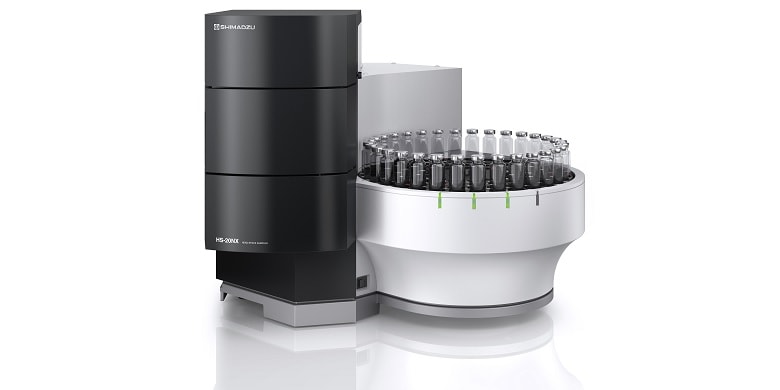
HS-20 NX series


The Shimadzu Application News (GC) “Analysis of Residual Solvents in Pharmaceuticals” series has previously introduced the following items. G185 (Part 1) Separation conditions and elution order of solvents specified as classes 1 and 2 in the guidelines G186 (Part 2) Introduction of methods IV and V in USP 23 (using HSS series) G193 (Part 3) Introduction of headspace GC for solvents specified as classes 1 and 2 in the guidelines G204 (Part 4) Introduction of method IV in USP 24 (using TurboMatrix HS series) Residual solvents in pharmaceuticals can be analyzed by dissolving pharmaceuticals in an appropriate solvent and injecting the solution directly into the GC. However, in the future, headspace GC, where the solution is sealed in a vial, kept warm to evaporate highly volatile components into the gas phase for analysis, will be the mainstream. In headspace GC, the sensitivity for the target components greatly differs depending on the degree of evaporation of the target components when the sample solvent is heated in the vial. This analysis example focuses on the difference of sensitivity for target components when using different solvents (diluent for standard solvent) to dissolve the pharmaceuticals. The target components are substances designated in the guidelines as classes 1 and 2 (and THF). Used solvents were water (specified in USP and EP), DMSO (specified in some of the USP pharmaceutical ordinances) and DMF (specified in EP 2001 for water- insoluble substances). For all components, standard solutions of 100ppm concentration were sealed in vials and kept warm for analysis. The heating conditions were 60min at 80 ̊C for DMSO and water (USP conditions and EP water conditions) and 45min at 105 ̊C for DMF (DMF conditions in EP).
March 24, 2003 GMT
Some products may be updated to newer models