
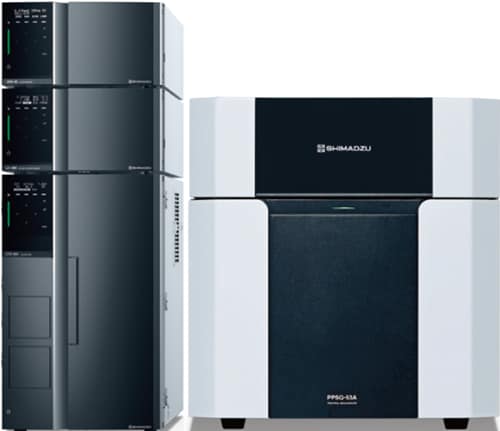
PPSQ-51A/53A


The main stream in current protein analysis is proteome analysis utilizing a mass spectrometer and a search engine based on genomic databases to identify proteins. Proteins form specific 3-dimensional structures and display the functions of the protein concerned by having that 3- dimensional structure. The 3-dimensional structures of proteins consist of four levels, one of which is the tertiary structure formed by pairs of the side chains of the amino acids that comprise the protein. One of these 3-dimensional structures is created by intramolecular crosslinking by disulfide (S-S) bonds of cysteines in a molecule. Disulfide bonds have the function of stabilizing the 3-dimensional structure of the protein and normally form S-S bonds in many cases. For this reason, it is sometimes necessary to identify cysteines when conducting an amino acid sequence analysis. When using a protein sequencer, even if the half-cystine residue on N-terminal side is converted to ATZ-half-cystine by Edman degradation, the half-cystine residue will form a disulfide bond with the half-cystine on C-terminal side, and elution and detection by HPLC will be impossible. Therefore, sequence analysis is generally carried out after reductive alkylation of the protein to sever the disulfide bonds, and the cysteine is then identified as a PTH-modified cysteine. This article introduces an example of identification of a PTHmodified cysteine (phenylthiohydantoin derivative of reductively-alkylated cysteine) by analyzing reductivelyalkylated peptides/proteins with PPSQ™ -50A series protein sequencer systems (isocratic system and gradient system).
December 10, 2020 GMT