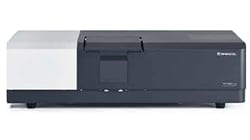
SolidSpec-3700i/3700iDUV


Spectrophotometric Analysis
LiDAR, an abbreviation for Light Detection and Ranging, is one type of optical sensor technology. The distance and angle to a remote measurement target and its nature can be analyzed by scanning laser light on the target and measuring the scattered light and reflected light. LiDAR systems have already been installed in aircraft and satellites and used as a ranging technology for research in geology and seismology. LiDAR has also attracted attention recently as a technology for use in selfdriving automobiles. In automated driving, LiDAR takes the place of a human driver and must operate the vehicle appropriately by detecting traffic signals, the road width, oncoming vehicles, pedestrians, and other conditions. LiDAR is extremely important as a technology for sensing objects that may become obstructions during driving, and thus is a key technology for realizing automated driving. Because the laser light scanned from the LiDAR device is transmitted through a sensor cover and irradiated on remote measurement objects, it is necessary to understand the optical properties of the materials to be used, such as the transmittance of the sensor cover for the laser in the LiDAR. The LiDAR viewing angle is also one important performance feature. For example, when a LiDAR device is mounted on the front of a vehicle, the widest possible viewing angle is necessary to cover a wide area in front of the car. At present, many LiDARs use semiconductor diode lasers that emit pulses with a near infrared wavelength of 905 nm, but in laser safety regulations in the United States and other countries, the laser pulse output is limited to prevent danger to human eyesight. Since the LiDAR detection range when using a 905 nm laser is limited to 30 to 40 m, technologies capable of detecting objects at greater distances are being developed by using a higher laser output with a long wavelength 1,550 nm laser which is safer for the human eye (1). The wavelength regions and quantity of laser light transmitted through the sensor cover vary depending on the incident angle of the laser and the position of the sensor cover. In other words, the optical properties of the cover material have a large influence on the performance of the LiDAR. Therefore, a wide range of measurements is necessary in a LiDAR evaluation system, for example, by changing the angle of the incident light or changing the wavelength regions. Application News No. A612A introduced examples of reflectance measurement and transmittance measurement of optical materials. In this article, the optical properties of 905 nm and 1,550 nm bandpass filters were evaluated using a SolidSpec™- 3700i UV-VIS-NIR spectrophotometer.
March 26, 2020 GMT
Some products may be updated to newer models