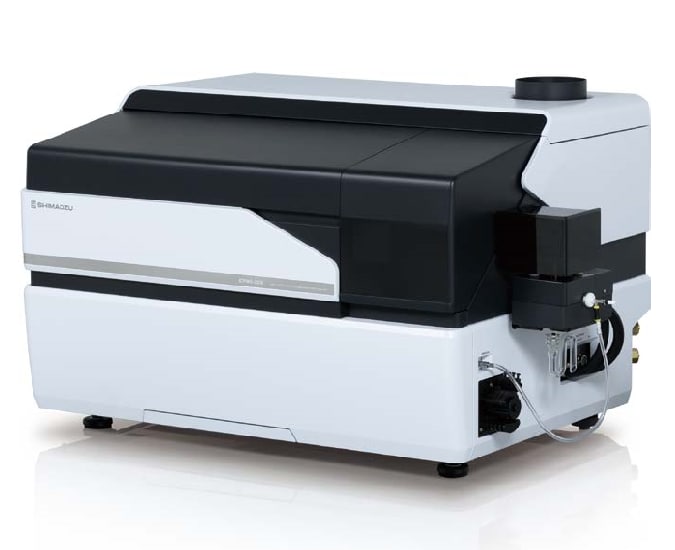
ICPMS-2030


Peptide mapping is an important and efficient technique for the primary structure characterization of monoclonal antibodies (mAbs). It involves enzymatic digestion (e.g., trypsin) and enables the direct detection of single amino acid changes. Also, it can provide additional information of post-translational modifications (PTMs). However, we have to note that peptide mapping is usually performed in a comparative manner, in which the peptide map of a mAb product is compared to that of a reference in a side-by-side experiment, which is highly dependent on the reproducible sample preparation and extremely time consuming. An in-depth peptide mapping workflow with a de novo sequencing method is thus required to verify primary structure of mAb and identify any alterations in structure. An emerging technique, and the focus of this report, is data-independent acquisition (DIA) mode on Q-TOF mass spectrometry. DIA enables a genetic, nonbiased approach for the MS/MS data acquisition, in which all the ions in each individual MS/MS event are fragmented without precursor ion isolation and all the fragment ions are measured in a mixed spectrum, ideal for peptide sequencing. In this report, we demonstrated an integrated MS full-scan and MS/MS DIA approach on Shimadzu LCMSTM-9030 (Q-TOF) mass spectrometer for de novo peptide sequencing of mAb.Milk is a complex matrix composed of several organic constituents like carbohydrates, proteins and fats as well as inorganic constituents like calcium and phosphorus. Several processed milk products are consumed daily in India as well as world wide. In addition to nutritional values, these products can also have toxic elements like As, Cd, Pb and Hg. They can get transferred from contaminated soil to plants and then into grass, causing accumulation of these toxic metals in cattle, but also in human consuming milk. Milk processing may also cause contamination of milk products with these toxic elements. India is the largest milk producer as well as consumer in the world. Several dairy products are exported from India to all over the word. These products include cheese, paneer, milk powder etc. The regulating agencies like Food Safety And Standard Authority Of India (FSSAI) and Export Inspection Council (EIC) have laid down stringent specifications for Maximum Residue Limits (MRL) in milk and milk products(1-2). These milk products has to meet the specifications laid by FSSAI/EIC in order to export them to Europe, USA or any other international market and to sell them in Indian market. In the present study, one milk powder sample was analyzed using Shimadzu ICPMS 2030. The milk powder was tested to meet the specifications of FSSAI.
January 10, 2020 GMT