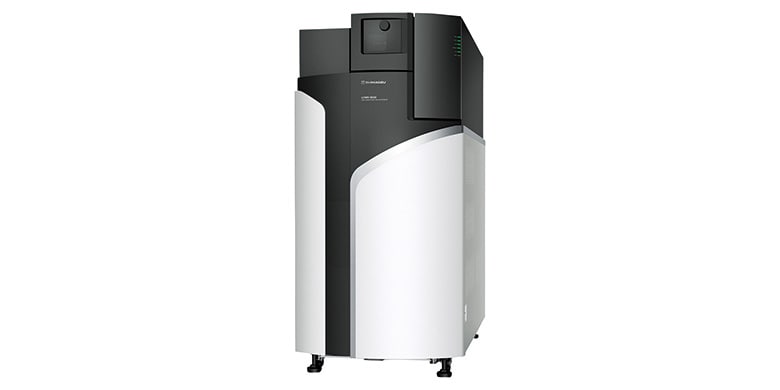
LCMS-9030


Peptide mapping is an important and efficient technique for the primary structure characterization of monoclonal antibodies (mAbs). It involves enzymatic digestion (e.g., trypsin) and enables the direct detection of single amino acid changes. Also, it can provide additional information of post-translational modifications (PTMs). However, we have to note that peptide mapping is usually performed in a comparative manner, in which the peptide map of a mAb product is compared to that of a reference in a side-by-side experiment, which is highly dependent on the reproducible sample preparation and extremely time consuming. An in-depth peptide mapping workflow with a de novo sequencing method is thus required to verify primary structure of mAb and identify any alterations in structure. An emerging technique, and the focus of this report, is data-independent acquisition (DIA) mode on Q-TOF mass spectrometry. DIA enables a genetic, nonbiased approach for the MS/MS data acquisition, in which all the ions in each individual MS/MS event are fragmented without precursor ion isolation and all the fragment ions are measured in a mixed spectrum, ideal for peptide sequencing. In this report, we demonstrated an integrated MS full-scan and MS/MS DIA approach on Shimadzu LCMSTM-9030 (Q-TOF) mass spectrometer for de novo peptide sequencing of mAb.
December 24, 2020 GMT