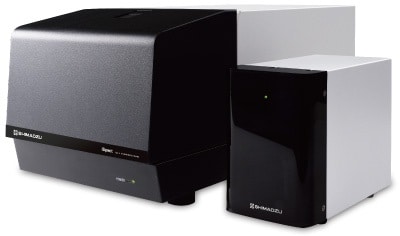
iSpect DIA-10


Eye drops can be classified as aqueous (nonaqueous) eye drops in which the ingredients are dissolved in water (oil), and aqueous (nonaqueous) suspension eye drops in which the ingredients are not dissolved but the particles are suspended. The Japanese Pharmacopoeia states that the maximum particle size of particles in suspension eye drops is generally 75 μm or less. The laser diffraction method is widely used as a technique for measurement of particle size distribution because measurement time is short and the measurement range is wide. However, this technique also has certain problems in cases where it is necessary to obtain the maximum length, as it is difficult to detect coarse particles that exist in very small quantities relative to the total amount of particles, and it is not possible to measure the maximum length of aspherical particles because the particle size is calculated as the sphere equivalent diameter. This article introduces an example of characterization of the maximum length of particles in a suspension eye drop product and a mixed sample containing both spherical and acicular particles by acquiring particle images and analyzing the particle shape, size distribution, and concentration with the iSpectTM DIA-10 dynamic particle image analysis system.
December 15, 2019 GMT