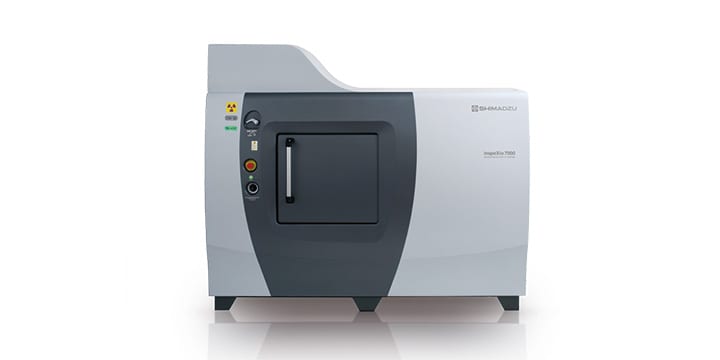
inspeXio™ 7000


- The complex three-dimensional shape of dried noodles can be easily observed non-destructively, which is useful for product research and development and quality control. - The density of noodles can be evaluated by calculating the volume fraction of noodles in a three-dimensional representation.
Instant noodles were born in Japan in 1971. They are now consumed widely around the world because of the convenience of being able to eat them anywhere after just adding hot water and waiting for a few minutes, their excellent storability due to advanced drying and packaging techniques, and their low price. Instant noodle manufacturers are constantly conducting research to develop products that are both easy to prepare and delicious. In order to develop products that will be popular with many consumers, it is important to consider the type and quantity of ingredients and the manufacturing method. However, even if the same ingredients are used, the shape and structure of the noodles change the way heat is conducted, which results in changes to the required cooking time and taste. Therefore, research and development on the shape of the noodles and quality control are essential to developing products that can be prepared deliciously in a short time. However, noodles have a complex three-dimensional shape, so it is not easy to visually observe their intricate internal structure. A useful tool for observing the complex shape of noodles is the micro-focus X-ray CT system. An X-ray CT system can easily visualize the three-dimensional structure of the object non- destructively. Here, an example of observing the inside of instant noodles using the inspeXio SMX-225 CT FPD HR Plus microfocus X-ray CT system is presented.
September 2, 2021 GMT