
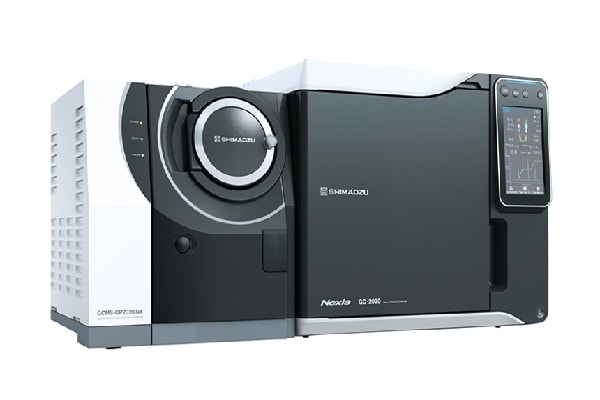
GCMS-QP2020 NX


- Perform chemical ionization safely with SMCI setup since it requires only common laboratory solvents as reagent gas - Chemical ionization provides complementary mass spectral information to electron ionization for identification of terpenes in complex mixtures - Mass spectra produced by SMCI can be used for quick screening of terpenes
The application of the positive chemical ionization (CI) technique in gas chromatography/mass spectrometry (GC-MS) has developed into a powerful tool for the identification of organic molecules. In contrast to the electron ionization (EI) technique which utilizes electrons to ionize analytes, the CI technique is affected by gas-phase ion-molecule interaction. CI produces complementary information to EI. EI is a hard ionization technique that results in maximum fragmentation using high-energy electrons such that the molecular ions of the analyte are fully consumed. Despite that, the reproducibility of the EI spectra have allowed the creation and use of mass spectral databases for unknown identification. As CI is a soft ionization technique, it retains the ionized species of the analyte molecule (i.e., M+•, [M+H]+, [M-H]+, [M+adduct]+) and enables the determination of its molecular weight. Conventional CI technique relies on the usage of methane, isobutane, or ammonia as reagent gas. This requires the use of flammable gas cylinders in the laboratory. The solvent- mediated chemical ionization (SMCI) technique , an alternative procedure, enables CI techniques to be carried out with general organic solvents such as methanol or acetonitrile without the use of flammable reagent gas. This results in greater safety and lowers the overall running costs for CI analysis. In addition, the resultant mass spectra are equivalent to those obtained with conventional reagent gas. Terpenes are natural products that comprise more than 30,000 compounds. They play a crucial role in the defense system of plants to protect against herbivores, diseases, and aid as mediators in many other ecological interactions with the surrounding environment. When extracted as essential oils, they are usually used for aromatherapy or added into many everyday products due to their characteristic flavors and scents. The identification of terpenes by GC-MS necessitates the use of a huge mass spectral database and retention index information. However, the lack of molecular ion EI spectra can sometimes hamper identification effort via library match. As the chemical structures of terpenes can be exceedingly similar (many are positional isomers of another), the fragment information alone may be insufficient for identification. For example, the fragment of a monoterpene could also be formed from an oxygenated monoterpene or sesquiterpene. Chemical ionization could thus be a valuable complementary tool to aid the identification effort. In this article, we will examine the usage of the SMCI technique on a mixture of 21 terpene compounds, containing monoterpenes, oxygenated monoterpenes, sesquiterpenes, and oxygenated sesquiterpenes. The resultant mass spectra from SMCI using methanol and acetonitrile as reagent gas will be examined. In addition, the possibility to utilize SMCI mass spectral information for quick screening of terpene or terpene distribution is explored.
April 27, 2022 GMT