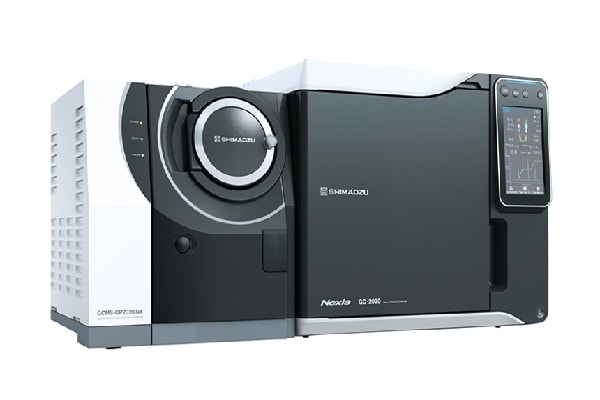
GCMS-QP2020 NX


- NCI-GC/MS analysis can detect nitroglycerin metabolites and nitric acid metabolites with high levels of sensitivity. - The same GC-MS system configuration can measure both nitroglycerin metabolites and nitric acid metabolites. - It may be possible to predict optimal nitroglycerin dosage from the quantitation results of metabolites.
Nitroglycerin (glyceryl trinitrate [GTN]) is an explosive compound and raw material of dynamite. GTN also has medical uses as an antianginal agent that induces vasodilation. Upon administration, nitroglycerin is metabolized into glyceryl dinitrate (GDN) and glyceryl mononitrate (GMN) in the liver and blood, and nitric oxide (NO) derived from nitrogen dioxide (NO2) is released into cells. Nitrogen oxide increases cyclic GMP production by activating guanylate cyclase, which subsequently decreases intracellular Ca2+2+ levels and relaxes the myocardium. Nitroglycerin is effective in treating patients with acute heart failure or chronic conditions such as angina, but requires proper dosing due to anemia-related side effects such as hypotension- induced lightheadedness and dizziness. Negative chemical ionization (NCI) is a type of chemical ionization that specifically detects compounds with electron affinity. Compounds that are detected with low sensitivity by electron ionization (EI) can be detected with high sensitivity by NCI by adding fluorine derivatives with electron affinity such as pentafluorobenzyl (PFB). This Application News describes an investigation into using an NCI-GC/MS analytical system to measure nitroglycerin metabolites and nitric acid metabolites in order to predict the optimal dosage of nitroglycerin, a nitrate medication.
July 28, 2022 GMT