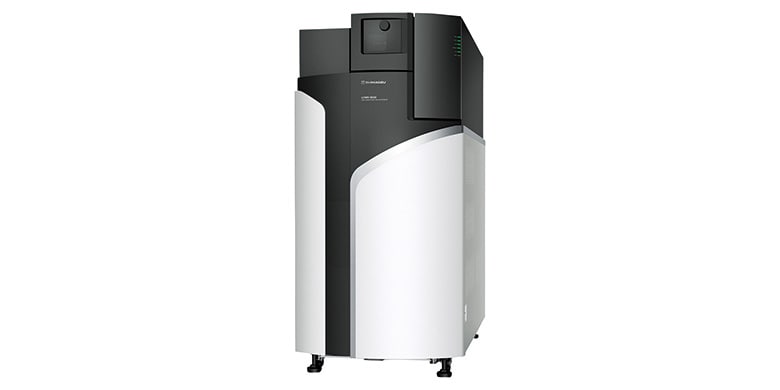
LCMS-9030


- It enables comprehensive measurement of veterinary drugs by full scan analysis using the LCMS-9030, which can obtain accurate mass. - Extracted ion chromatograms (XIC) with narrow m/z range can provide peaks with less noise and fewer contaminants. - It is possible to perform highly sensitive analysis that covers the lower limit of quantitation required for routine analysis.
Veterinary drugs are used for various purposes such as prevention and treatment of diseases and growth promotion of livestock and farmed fish. While veterinary drugs enable a stable supply of livestock and seafood products, there is a problem of health risks due to drug residues. For this reason, each region and country has established maximum residue limits (MRLs) for veterinary drugs in food and strictly regulates them. Currently, triple quadrupole mass spectrometers, which can perform quantitative analysis highly selectively and highly sensitively, are widely used for the analysis of veterinary drugs in food. However, this method can only detect the envisaged target compounds, and there is a limit to the number of compounds that can be measured at one time. Therefore, this method has limited comprehensiveness for use in screening applications. Against this background, comprehensive analysis for veterinary drugs in full scan mode using a high-resolution mass spectrometer is attracting attention. This article introduces an example of comprehensive analysis of veterinary drugs in chicken tenders using a quadrupole time-of- flight mass spectrometer LCMS-9030.
November 29, 2022 GMT
Some products may be updated to newer models