
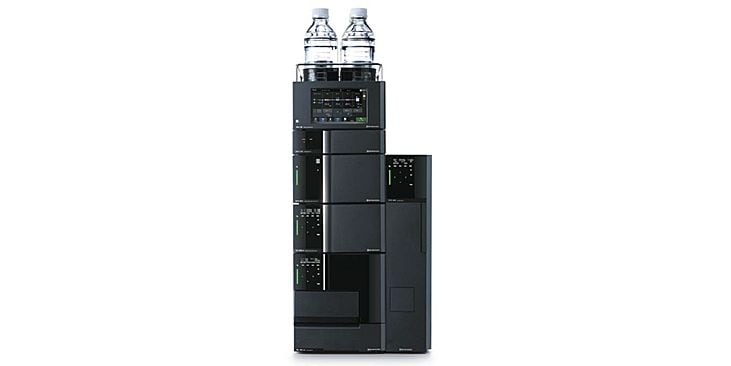
Nexera Series Ultra High Performance Liquid Chromatograph


- Simple, novel and most sensitive method with LLOQ - 0.5 ng/mL - Low plasma volumes in sample extraction extends the life of mass spectrometer - Quick sample extraction method increased sample productivity
Liraglutide is a glucagon-like peptide-1 receptor agonist (GLP-1 receptor agonist) also known as incretin mimetics. It works by increasing insulin release from the pancreas and decreases excessive glucagon release. Liraglutide is a medication used for treatment of type 2 diabetes or obesity. The prolonged action of liraglutide is achieved by attaching a fatty acid molecule at one position of the GLP- 1-(7-37) molecule, enabling it to both self-associate and bind to albumin with-in the subcutaneous tissue and blood stream. The active GLP-1 is then released from albumin at a slow, consistent rate. Albumin binding also results in slower degradation and reduced renal elimination compared to GLP-1-(7-37). Following subcutaneous administration, a mean C max of 35 ng/mL was achieved after 8-12 hours of dosing with an absolute bioavailability of 55 %. It indicates that the method required for pharmacokinetic evaluations need to achieve a sensitivity limit of 0.50 ng/mL. Such method should address many problems posed by peptides viz., poor ionization, non-specific adsorption, carry-over and low extraction recovery. We have therefore developed a method with high chromatographic resolution, good sensitivity with lowest limit of quantification (LLOQ) of 0.50 ng/mL for liraglutide in human plasma using LCMS-8060. Method was developed keeping some key criteria in focus namely simpler extraction procedure, highly optimized chromatography and enhanced sensitivity. These factors enable selective and high-throughput analysis of liraglutide for the pharmacokinetic investigation.
September 5, 2023 GMT
Some products may be updated to newer models
