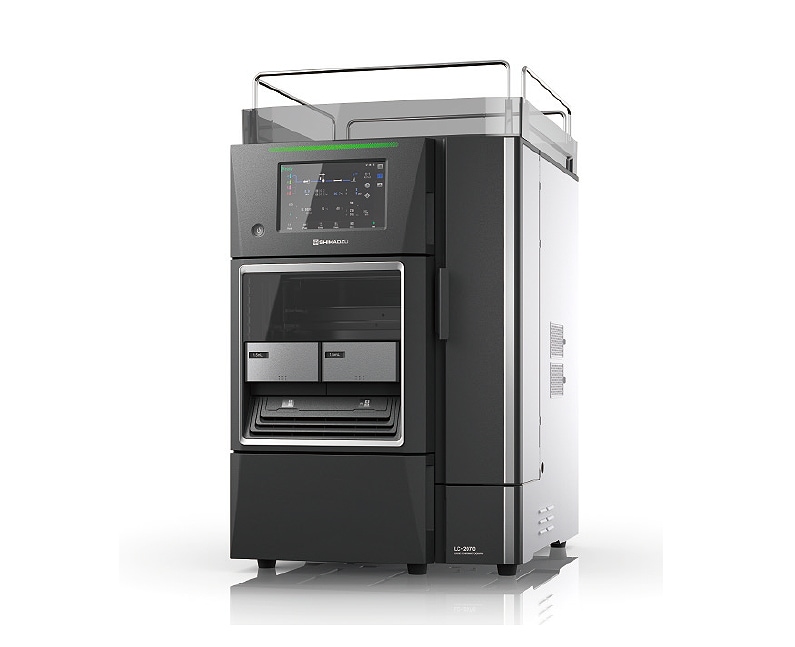
i-Series


- Ca-type size exclusion-ligand exchange column retain sugar alcohols more strongly than Na-type column and can separate sugar alcohols and monosaccharides more selectively. - Just water can be employed as mobile phase, requiring no mobile phase preparation. - The integrated HPLC system allows for the installation of a refractive index detector without changing the footprint.
Saccharides are the main component of sweetness in food and an important source of energy. However, excessive saccharide intake has been reported to increase the risk of lifestyle-related diseases such as obesity and dental caries. Monitoring the amount of saccharide in food plays an important role in quality control and nutritional management. Since saccharides are hydrophilic compounds, reversed phase chromatography, which provides mutual separation of analytes based on hydrophobic interaction, is not suitable for saccharide analysis. In this study, ligand exchange chromatography is applied to saccharides separation. The fundamental principle of this separation mode is size exclusion chromatography, in which analytes are separated based on differences in molecular size in solution. Furthermore, saccharides are retained through complex formation between metal counterions and the hydroxyl groups of saccharides and eluted through ligand exchange with water molecules in the mobile phase. Saccharides can be reliably separated by utilizing the difference in complex formation between metal cations on the stationary phase surface and respective saccharides. Here, Saccharide analysis using size exclusion-ligand exchange (Ca-type) column with integrated HPLC is introduced.
September 30, 2025 GMT